Level 10 · Sharp turns and back to sport · from week 39
Reactive cuts
Run towards a fork in a line of cones and cut left or right when a partner points or a phone shows an arrow, to practice turning without knowing the side in advance.
- 3 × 6
- Cones in a Y; a partner to point, or a phone on a stand with an arrow app
- Operated leg
General information, not medical advice. Follow your surgeon's and physio's plan. Read the disclaimer
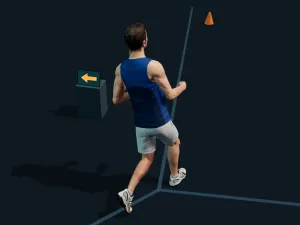
Loading the 3D figure…
Drawn with a phone, at about half pace and gentle 45° angles. With a phone, three-quarter pace and gentle angles are the most the steps allow. The floor turns under the figure to keep it facing the camera.
- Run
- The next rep
Key positions
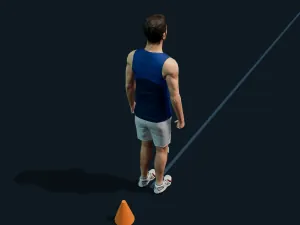
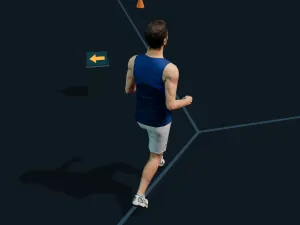
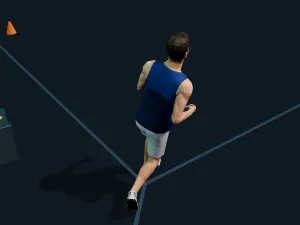
Follow along
The highlighted step is the one playing. Tap a step to see it.
- Step 5: If the signal has not come by the time you reach the fork, run straight on and slow down. Never cut after you have passed the fork
- Step 6: Start at half pace with gentle angles. Go faster or turn more sharply only while every cut feels controlled, with your kneecap over your second and third toes. With a phone, stay at three-quarter pace and gentle angles at most. Full speed and sharp angles need a partner, and only once you have sprinted at full speed in your sprint plan with no trouble
- Step 7: Stop if your knee gives way, feels unstable or you find yourself holding back from pushing off it, and tell your physio
- Step 8: If your knee is more swollen or sore the next morning, skip the drills for a day and do fewer next time
How much
3 × 6
That is the dose at Level 10, where the exercise starts. It changes as you move up:
- Level 10 · Sport drills (full speed stage): 3 sets of 6 reps. Half pace first, with the side cones at a gentle angle (about 45°), then a sharp one (about 90°). With a phone arrow in place of a partner, keep to three-quarter pace and gentle angles: full-speed cuts need a partner. Training alone, you can finish this stage at three-quarter pace. Full speed only once you have sprinted at full speed in your sprint plan with no trouble.
- Level 10 · Sport drills (your sport stage): 3 sets of 6 reps. Now with a partner giving the signal where you can: full speed and sharp angles (about 90°), once you have sprinted at full speed in your sprint plan with no trouble and every cut at three-quarter pace feels controlled. With a phone arrow, keep to three-quarter pace and gentle angles (about 45°).
Your physio may set a different dose. Theirs wins.
Before you start
Level 10 usually starts around week 39 after surgery. Move on to it when you can tick off the checks of Level 9:
- Planned 45-60° cuts at three-quarter speed with no pain, swelling or giving way
- No hesitation in the drills at three-quarter speed
- No swelling or pain with running, jumping and drills
- Return-to-sport confidence (ACL-RSI) at least 70%. A good score is not a clearance
- Thigh strength 90% or more of the other leg (measured by a physio)
- Hop tests 90% or more of the other leg (measured by a physio)
After some surgeries done with the ACL, the app starts it later: Revision surgery, not before week 43.
This animation shows the exercise as the app describes it. It is general information, not medical advice. Follow your surgeon's and physiotherapist's instructions, and stop if the knee hurts.
If you had a meniscus repair or other surgery along with your ACL, your surgeon may limit how far you bend the knee or how much weight you put on the leg. Follow their limits.
On Level 10 the app adds a note after some surgeries:
- Patellar tendon graft: Front-of-knee pain is common with your patellar tendon graft. Protocols usually keep exercise pain below 5/10, easing range or load if it reaches 5.
- Quadriceps tendon graft: Front-of-knee pain is common with your quadriceps tendon graft. Protocols usually keep exercise pain below 5/10, easing range or load if it reaches 5.
- Donor graft (allograft): With a donor graft, protocols usually wait at least 12 months, with every criterion met, before you return to cutting and pivoting sport.
- Revision surgery: After a revision, protocols usually delay return to sport longer than after a first reconstruction. However long it's been, your surgeon and physio decide when.
Use a flat, dry surface you can turn on without slipping or sticking, such as grass, a track or a sports hall, in trainers: not wet grass, and not in socks.
From the steps:
- If the signal has not come by the time you reach the fork, run straight on and slow down. Never cut after you have passed the fork
- Stop if your knee gives way, feels unstable or you find yourself holding back from pushing off it, and tell your physio
- If your knee is more swollen or sore the next morning, skip the drills for a day and do fewer next time
Next in the programme
All exercises by level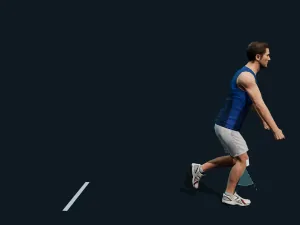
The 3D figure
The figures are Sports_Male_04 from the Microsoft Rocketbox Avatar Library, MIT licence. The poses are computed in the browser from the steps. Microsoft Rocketbox
MIT License
MIT License

Copyright (c) 2020 Microsoft

Permission is hereby granted, free of charge, to any person obtaining a copy
of this software and associated documentation files (the "Software"), to deal
in the Software without restriction, including without limitation the rights
to use, copy, modify, merge, publish, distribute, sublicense, and/or sell
copies of the Software, and to permit persons to whom the Software is
furnished to do so, subject to the following conditions:

The above copyright notice and this permission notice shall be included in all
copies or substantial portions of the Software.

THE SOFTWARE IS PROVIDED "AS IS", WITHOUT WARRANTY OF ANY KIND, EXPRESS OR
IMPLIED, INCLUDING BUT NOT LIMITED TO THE WARRANTIES OF MERCHANTABILITY,
FITNESS FOR A PARTICULAR PURPOSE AND NONINFRINGEMENT. IN NO EVENT SHALL THE
AUTHORS OR COPYRIGHT HOLDERS BE LIABLE FOR ANY CLAIM, DAMAGES OR OTHER
LIABILITY, WHETHER IN AN ACTION OF CONTRACT, TORT OR OTHERWISE, ARISING FROM,
OUT OF OR IN CONNECTION WITH THE SOFTWARE OR THE USE OR OTHER DEALINGS IN THE
SOFTWARE.