Questions · Progression, Timeline, Return to sport
ACL rehab weeks 39 to 48: cutting and sport
The last stage of ACL rehab adds cutting drills in steps, then tests you before sport. Why it rarely starts before 9 months, and what finishing it means.
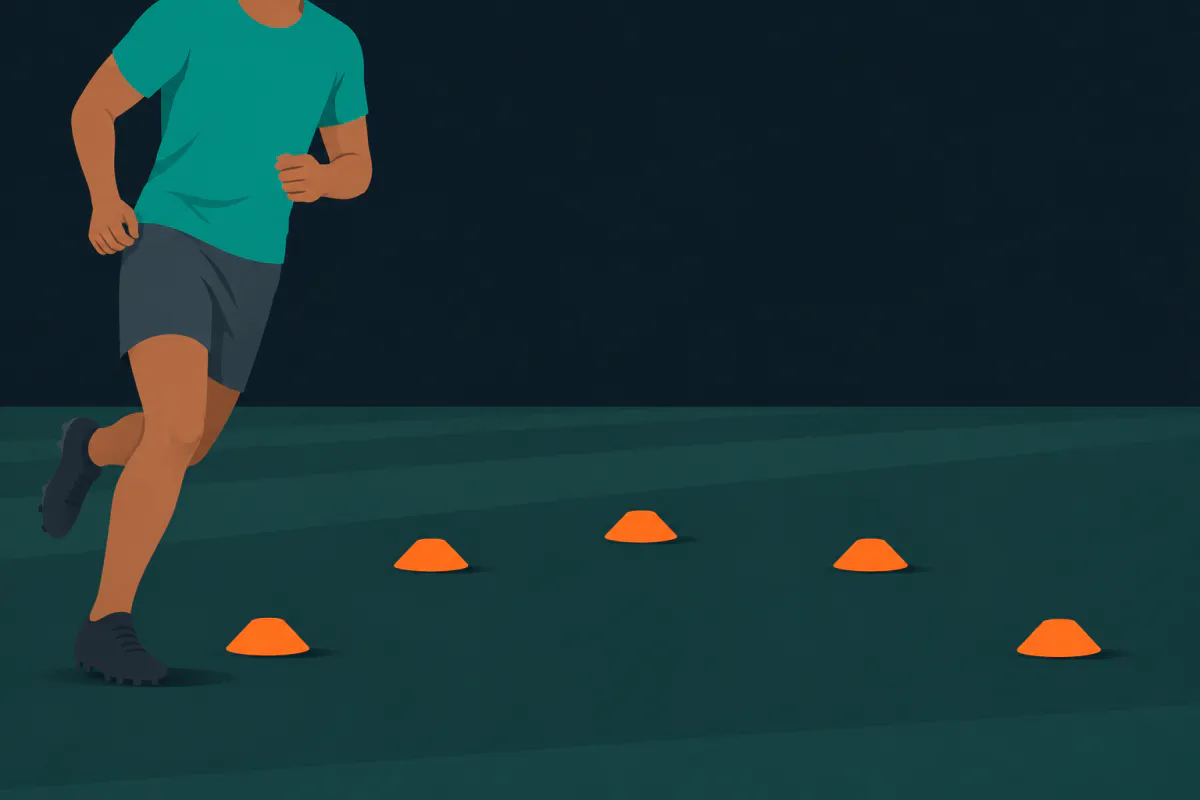
The short answer: the last stage of ACL rehab adds cutting, the sharp sidesteps and turns of sports such as football. The drills go from slow and planned to fast and unplanned. It ends with tests of strength, hops and movement, usually not before 9 months after surgery. Passing them starts your return in steps, not straight into matches.
Your surgeon’s and physiotherapist’s instructions come first. They decide when you start this stage and when you play again.
Why this stage rarely starts before 9 months
Cutting waits until late because the timing of your return seems to matter. A study followed 106 people in pivoting sports for two years after reconstruction. Up to 9 months after surgery, each month they waited before going back cut the rate of new knee injury by about half.
That study was about returning to sport, not about when drills begin. But cutting drills are close to sport, so many programmes start them near that point. In a standard knee textbook, ACL rehabilitation moves through phases, and running, jumping and cutting come last, just before sport.
What lets you start is what your knee can already do. You will usually need steady running, single-leg landings you can control, and strength and hop tests close to the other leg’s.
How the cutting drills build up
Programmes usually build cutting from control towards chaos. Rehabilitation staff in professional football call this the “control-chaos continuum”. You start with movements you know in advance. Step by step the drills move towards the random, reactive moments of a real game.
Along the way, these usually change:
- the angle of the turn, from wide curves to sharp cuts and full turns;
- the speed, from jogging to running hard;
- braking, from easing to a stop to stopping sharply on one leg;
- who decides the direction, from you to a coach, a partner or a signal.
The same staff progress the drills by criteria, not by the weeks that have passed. A review of this late stage adds two more things that matter. One is training while tired. The other is enough training in your sport’s own movements, built up before you return.
The detail of each drill, and why unplanned cuts load the knee more, is in cutting and change of direction after ACL surgery.
What is tested at the end
This stage usually ends with a set of tests before you train with your team. A study of 158 male professional athletes used one such set:
- thigh muscle strength on a machine, at three speeds;
- a timed running test with forward, sideways and backward running (the T test);
- three hop tests on one leg, compared with the other leg.
About 1 in 6 of the athletes tore their graft again, on average about three and a half months after going back. The study had six criteria for passing, based on tests like these. Those who had not met all six before returning to team training were about four times as likely to tear it.
This study and the one on timing above both observed people. They do not prove that passing a test protects you. No set of tests is agreed, and a recent guideline found no evidence for which criteria to use. That is why most programmes ask for the tests and the months together.
Finishing rehab is not the same as playing
Passing the tests usually starts a return in steps, not a first match. An international consensus statement describes three stages:
- Return to participation: you train, but below your target level or not yet in your own sport.
- Return to sport: you are back in your sport at your target level, but not yet at your best.
- Return to performance: you play at or above your level before the injury.
The statement treats the decision as shared. You, your clinicians and, if you have one, your coach weigh the risks together.
How long each step takes varies with your sport and how your knee responds. How the clearance decision is made is in return to sport after ACL reconstruction.
When to tell your care team
A knee that is more swollen or sore the morning after a drill session usually means the load was too much. Most plans then hold or step back. A knee that gives way, or feels unstable when you push off, is a reason to stop and contact your physiotherapist.
Some signs need prompt contact, whatever the week:
- a calf that is hot, red, swollen or painful;
- a fever, or spreading redness or discharge at the incision;
- new weakness or numbness in your foot;
- a locked knee.
Where the app fits
In our free ACL recovery app, ACL Recovery Tracker for iOS and Android, this stage is Level 10, “Sharp turns and back to sport”. It typically starts at week 39, and after a revision no earlier than week 43. Its “Sport drills” workout is planned twice a week, and holds only the drills of your current stage:
- Fast and planned: stage 2 of the sprint plan, then the Y, Z and H drills;
- Full speed: stage 3 of the sprint plan, the same drills, then 5-0-5 turns and reactive cuts;
- Your sport: the same, then 20 minutes of your own sport’s skills, without contact until your physio or surgeon clears you.
A “Strength and power” workout, also twice a week, goes on alongside. Two weeks into a stage, the app offers to move you on. You can go back a stage at any time if your knee reacts.
The checklist asks, among other things, for:
- at least 9 months since surgery, 12 with a donor (allograft) graft;
- no pain or swelling after sport drills, and a full range;
- hop tests 90 per cent or more of the other leg, measured by a physio;
- a block of your sport’s training done without contact;
- clearance to play from your physio or surgeon.
You tick it yourself: the app does not test your knee or decide that you are ready. You can use it to log each drill session and your pain the next morning. Then your physiotherapist can see how your knee copes as the drills get sharper.
This is the stage where your knee relearns the moves it was injured in. Building them slowly, then returning in steps, gives it the best chance to cope.
The illustrations in this article were generated with AI.
Sources
- Grindem H, Snyder-Mackler L, Moksnes H, Engebretsen L, Risberg MA. Simple decision rules can reduce reinjury risk by 84% after ACL reconstruction: the Delaware-Oslo ACL cohort study. Br J Sports Med. 2016;50(13):804-808.
- Kyritsis P, Bahr R, Landreau P, Miladi R, Witvrouw E. Likelihood of ACL graft rupture: not meeting six clinical discharge criteria before return to sport is associated with a four times greater risk of rupture. Br J Sports Med. 2016;50(15):946-951.
- Ardern CL, Glasgow P, Schneiders A, et al. 2016 Consensus statement on return to sport from the First World Congress in Sports Physical Therapy, Bern. Br J Sports Med. 2016;50(14):853-864.
- Taberner M, Allen T, Cohen DD. Progressing rehabilitation after injury: consider the 'control-chaos continuum'. Br J Sports Med. 2019;53(18):1132-1136.
- Buckthorpe M. Optimising the late-stage rehabilitation and return-to-sport training and testing process after ACL reconstruction. Sports Med. 2019;49(7):1043-1058.
- Kotsifaki R, Korakakis V, King E, et al. Aspetar clinical practice guideline on rehabilitation after anterior cruciate ligament reconstruction. Br J Sports Med. 2023;57(9):500-514.
- Noyes FR, Barber-Westin SD, eds. Noyes' Knee Disorders: Surgery, Rehabilitation, Clinical Outcomes. 2nd ed. Elsevier; 2017.