The guide · Return to sport, Progression
Return to sport after ACL reconstruction
Most people return to some sport after ACL reconstruction, about half to competition. Clearance rests on tests, not the date, and the return is staged.
The short answer: in a pooled review of 69 studies, 81 per cent of people returned to some sport after ACL reconstruction, 65 per cent to the level they played before the injury and 55 per cent to competitive sport. The Dutch clinical guideline keeps rehabilitation going for 9 to 12 months, and clearance rests on a battery of strength, hop and movement tests rather than on the date. The return itself is usually staged, from training back to full matches. When you go back, and to what, is decided with your surgeon and physiotherapist; this article describes what the research and the guidelines say, not what your knee is ready for.
What “return to sport” means
The phrase sounds like a single day. The 2016 consensus statement from the First World Congress in Sports Physical Therapy in Bern, written by 17 clinicians and led by Ardern, describes it instead as a continuum with three stages:
- Return to participation: training or playing, but below the level you aim for, or not yet in your own sport.
- Return to sport: back in your sport, at your target level, though not yet performing as you did.
- Return to performance: playing at or above your level before the injury.
The statement treats the decision as risk management, made collaboratively by the athlete, the clinicians and, where there is one, the coach. That framing matters because the studies below count “returned” in different ways. Someone who jogs and plays a friendly game of five-a-side has returned to sport in one study and not in another.
How many people go back, and how soon
Ardern and colleagues’ 2014 meta-analysis brought together 69 studies with 7,556 participants. On average 81 per cent returned to any sport, 65 per cent to their preinjury level and 55 per cent to competitive sport. Several factors went with getting back to the preinjury level: symmetrical hop test results, a younger age, being male, playing at an elite level and a positive psychological response.
The timing is often slower than people expect. In an earlier study the same group followed 503 Australian football, basketball, netball and soccer players, all cleared by their surgeon to return. By 12 months, 67 per cent had attempted some sport and 33 per cent had attempted competitive sport. Of those who had not tried any sport by then, nearly half said they were still planning to. Players with hop test results of at least 85 per cent of the other leg were more likely to have returned. The authors concluded that many people may need a longer rehabilitation period than the six to twelve months typically advised.
Those who do not go back often give reasons other than the knee itself. Fear of a second injury is the one that comes up most, and fear of reinjury after ACL surgery covers what is known about it and what helps.
What clearance is usually based on
The Dutch guideline by van Melick and colleagues, a systematic review with multidisciplinary consensus, describes three criterion-based phases after surgery, the last of which is return to play. It recommends that rehabilitation continue for 9 to 12 months and that readiness be judged with a test battery: strength tests, hop tests and an assessment of movement quality, with psychological tests used to guide progression as well.
In practice a battery usually includes:
- quadriceps and hamstring strength of the operated leg compared with the other leg, often aiming for at least 90 per cent;
- hop tests for distance and control, compared the same way;
- a running or agility test in the sport’s own movements;
- questionnaires on how the knee feels and on psychological readiness;
- a check that the knee is not swollen and moves fully.
The number most often quoted, 90 per cent of the other leg, is a limb symmetry index, explained in the limb symmetry index article.
The 2023 Aspetar clinical practice guideline, led by Kotsifaki, adds an honest caveat. It names return to running and return to training as key milestones, but states that there is no evidence on which progression or discharge criteria should be used. The batteries are expert agreement built on cohort studies, not tests proven in trials.
Why the tests and the months both matter
Two cohort studies are the main reason criteria and time are both used. In Grindem and colleagues’ Delaware-Oslo cohort of 106 people in pivoting sports, each month that return was delayed, up to nine months after surgery, was associated with a 51 per cent lower reinjury rate, and more symmetrical quadriceps strength before return was also associated with a lower rate. Kyritsis and colleagues tested 158 male professional athletes on strength, a running test and three hop tests before they rejoined team training. Those who had not met all six of the study’s discharge criteria had about four times the risk of a graft rupture. Why those two studies made nine months the usual minimum is explained in the article on the nine-month figure.
Neither study proves that a test protects anyone; both are observational. They are why most programmes ask for the criteria and the months together, not one instead of the other. How often a second injury happens and who is most at risk is covered in the article on second ACL injuries.
A staged return, not a single day
Clearance is rarely the moment you play a full match. In Noyes’ Knee Disorders, the established structure is a progression through phases that ends with running, jumping and cutting drills before sport. The return to the sport itself is usually built up in steps too. The order below is a common one, not a fixed protocol, and programmes differ:
- sport-specific drills on your own, with the movements of your sport added one at a time;
- non-contact team training;
- full training, contact included;
- part of a match, then a full one.
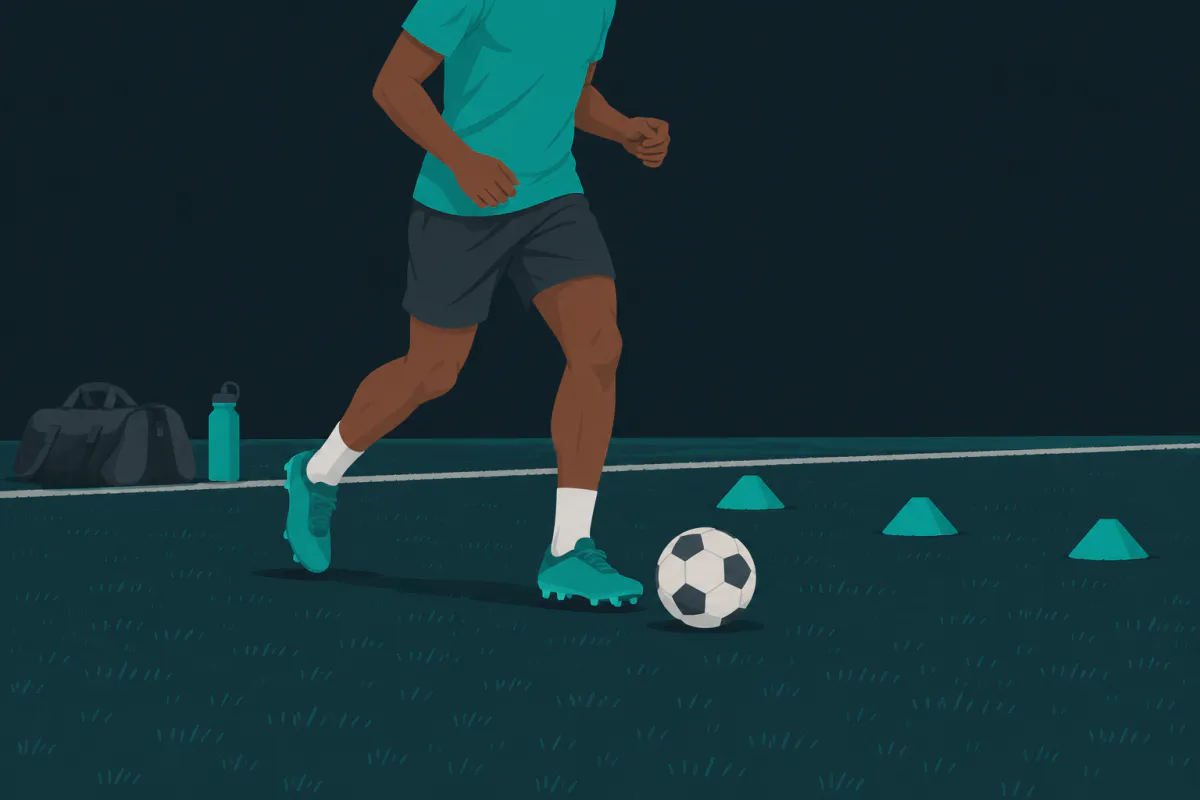
How long each step takes varies with the sport, the level and how the knee responds. Pivoting and contact sports such as soccer, basketball and netball usually take the longest, because cutting and landing are what the knee has to cope with. A sport with straight-line movement, such as cycling or running, may come back much earlier, and the return to running is its own milestone months before.
During that time some soreness after a harder session is common. A knee that swells, gives way or keeps getting more painful from one session to the next is a reason to stop and contact your physiotherapist, and a locked knee that will not straighten needs prompt medical review.
Where the app fits
The last stretch of rehabilitation is Levels 9 and 10 in ACL Recovery Tracker, a free ACL rehab app for iOS and Android: advanced jumping and deceleration, then cutting drills and sport-specific movements. Level 10’s checklist sets out return-to-sport criteria, including hop tests at 90 per cent of the other leg, full knee motion, no swelling, a minimum of nine months since surgery and clearance from your ACL rehabilitation clinician. You tick it yourself; the app does not test the knee or decide that you are ready. You can use it to keep the record your physiotherapist will want to see at the testing session: the sessions you completed, the pain diary after the harder drills, and the healthy-leg baseline your measurements are compared with.
Going back to sport is the goal for many people, and most of them reach some version of it. The research suggests that the return goes better when it is earned in stages and judged on how the knee performs, with the calendar as a floor rather than a deadline.
The illustrations in this article were generated with AI.
Sources
- Ardern CL, Taylor NF, Feller JA, Webster KE. Fifty-five per cent return to competitive sport following anterior cruciate ligament reconstruction surgery: an updated systematic review and meta-analysis including aspects of physical functioning and contextual factors. Br J Sports Med. 2014;48(21):1543-1552.
- Ardern CL, Webster KE, Taylor NF, Feller JA. Return to the preinjury level of competitive sport after anterior cruciate ligament reconstruction surgery: two-thirds of patients have not returned by 12 months after surgery. Am J Sports Med. 2011;39(3):538-543.
- Ardern CL, Glasgow P, Schneiders A, et al. 2016 Consensus statement on return to sport from the First World Congress in Sports Physical Therapy, Bern. Br J Sports Med. 2016;50(14):853-864.
- van Melick N, van Cingel RE, Brooijmans F, et al. Evidence-based clinical practice update: practice guidelines for anterior cruciate ligament rehabilitation based on a systematic review and multidisciplinary consensus. Br J Sports Med. 2016;50(24):1506-1515.
- Kotsifaki R, Korakakis V, King E, et al. Aspetar clinical practice guideline on rehabilitation after anterior cruciate ligament reconstruction. Br J Sports Med. 2023;57(9):500-514.
- Grindem H, Snyder-Mackler L, Moksnes H, Engebretsen L, Risberg MA. Simple decision rules can reduce reinjury risk by 84% after ACL reconstruction: the Delaware-Oslo ACL cohort study. Br J Sports Med. 2016;50(13):804-808.
- Kyritsis P, Bahr R, Landreau P, Miladi R, Witvrouw E. Likelihood of ACL graft rupture: not meeting six clinical discharge criteria before return to sport is associated with a four times greater risk of rupture. Br J Sports Med. 2016;50(15):946-951.
- Noyes FR, Barber-Westin SD, eds. Noyes' Knee Disorders: Surgery, Rehabilitation, Clinical Outcomes. 2nd ed. Elsevier; 2017.