The guide · Return to running, Progression
When can you run again after ACL reconstruction?
Most people are told "about three months", but the calendar is the weakest test. The strength, range and control criteria physios use before the first jog.

“When can I run?” is the question every physiotherapist hears from week two onwards, and the honest answer is unsatisfying: when your knee has earned it, which is not a date. This article explains what “earned it” means in practice, what the research says about the risks of rushing, and how ACL Recovery Tracker’s programme sequences the build-up.
Your surgeon and physiotherapist make this call. The criteria below are what they are likely to be looking at, so you can prepare for the conversation rather than guess.
Why the calendar is a bad test
A scoping review by Rambaud and colleagues looked at how studies and protocols decided when a patient could start running after ACL reconstruction. The most common criterion by far was time since surgery, typically around twelve weeks. Only a minority used measurable clinical criteria, and even fewer used strength or performance tests. In other words, most people are being cleared to run on the calendar alone.
Time matters, because the graft needs it to heal and become strong. But two people at twelve weeks can have completely different knees: one with a full range of motion and a quadriceps close to the other side, the other still swollen, still missing the last few degrees of extension and with a thigh that is visibly smaller. The date says nothing about which one is ready to absorb the load of running, which puts several times body weight through the knee with every stride.
The criteria physios actually use
Pulling together the scoping review and the consensus rehabilitation guideline, a reasonable set of return-to-running criteria looks like this:
- Time. Most guidelines suggest not before roughly twelve weeks, and many protocols go later. This is a floor, not a target.
- Full extension and near-full flexion. A knee that cannot straighten fully will not run well and will overload the front of the joint.
- No or minimal swelling. Effusion means the joint is still irritated, and running on an irritated joint makes it worse.
- Pain-free daily activity, including stairs, squats and single-leg stance.
- Quadriceps strength in the operated leg at a good proportion of the healthy side. Figures used in the literature vary; a common working threshold for starting to run is around seventy percent of the other leg, rising to ninety percent or more before return to sport. Your physio may measure this with a dynamometer or with repetition-based tests. How that side-to-side comparison is calculated, and where it misleads, is in the limb symmetry index.
- Movement quality. Single-leg squats, step-downs and small hops without the knee collapsing inwards, with a controlled landing. The single-leg hop tests are the standard way to score it.
- Clearance from your care team, which weighs all of the above plus anything specific to your operation, such as a meniscus repair with its own timeline.
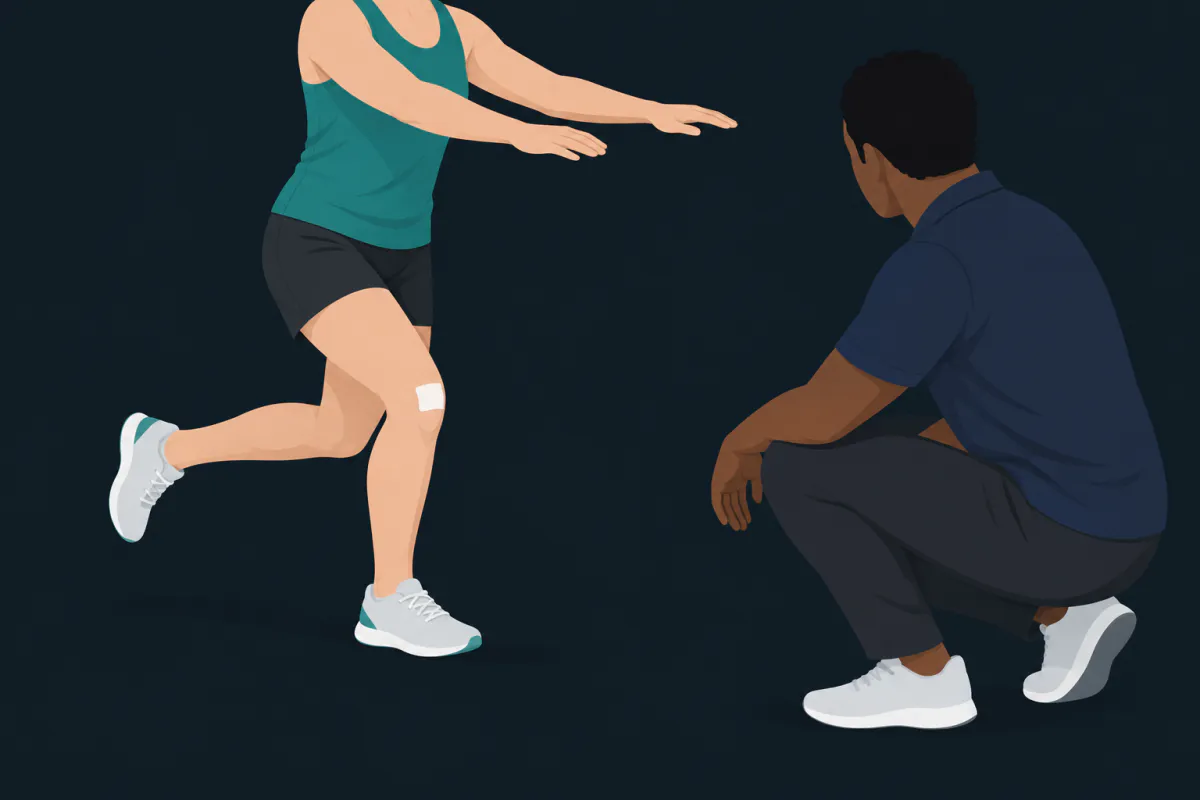
None of these is exotic. What they have in common is that they can be measured and written down, which is exactly what the app’s progression checklist is for.
Why rushing costs more than it saves
Two studies are worth knowing about because they changed how physios think about timing.
Grindem and colleagues followed patients after reconstruction and found that every month return to sport was delayed, up to nine months after surgery, was associated with a substantially lower rate of reinjury, and that returning with a quadriceps strength deficit raised the risk further. Kyritsis and colleagues found that athletes who returned to sport without meeting a set of six discharge criteria were about four times more likely to rupture the graft.
Both papers are about return to sport rather than the first jog, but the message carries: the body of evidence points towards criteria and patience, not the calendar. Starting to run is the first big load the graft takes, so it is a sensible place to begin holding yourself to that standard.
How the app sequences it
ACL Recovery Tracker is deliberately on the conservative side. The programme spends its middle levels building strength in the gym before any running: Level 4 through Level 6 cover roughly weeks eight to twenty of gym-based strength work. Level 7, “linear running prep”, sits around weeks twenty to twenty-four and introduces the hopping, landing and single-leg control work that running requires. Level 8, “running”, follows around weeks twenty-four to twenty-eight.
That is later than the twelve-week figure many people are quoted, and that is intentional: the weeks are typical, not fixed, and each level is gated by its own criteria rather than by the date. If your physio clears you to run earlier because your strength and control are there, the app lets you move levels. If they want you to wait, the ladder waits with you. The ACL rehab app is free on iOS and Android, and you can use it to work through the strength levels so that the running level arrives with the groundwork already logged.
What you can do now
- Log knee flexion and extension regularly so the range-of-motion trend is visible rather than remembered.
- Keep the pain diary honest, including pain after sessions, because “pain-free daily activity” is a criterion and the trend is the evidence.
- Ask your physio which strength test they will use and what number they want to see, then track it.
- Treat the progression checklist for Level 7 as the pre-running exam and tick it with your physio, not on your own.
Running again is a milestone worth wanting. Earning it with numbers rather than a date is how you keep it.
The illustrations in this article were generated with AI.
Sources
- Rambaud AJM, et al. Criteria for return to running after anterior cruciate ligament reconstruction: a scoping review. Br J Sports Med. 2018;52:1437-1444.
- Grindem H, et al. Simple decision rules can reduce reinjury risk by 84% after ACL reconstruction: the Delaware-Oslo ACL cohort study. Br J Sports Med. 2016;50:804-808.
- Kyritsis P, et al. Likelihood of ACL graft rupture: not meeting six clinical discharge criteria before return to sport is associated with a four times greater risk of rupture. Br J Sports Med. 2016;50:946-951.
- van Melick N, et al. Evidence-based clinical practice update: practice guidelines for anterior cruciate ligament rehabilitation based on a systematic review and multidisciplinary consensus. Br J Sports Med. 2016;50:1506-1515.