The guide · Measuring progress, Return to sport
Hop tests after ACL surgery
The four single-leg hop tests used after ACL reconstruction, how the limb symmetry index is worked out, and what a symmetrical hop distance can hide.
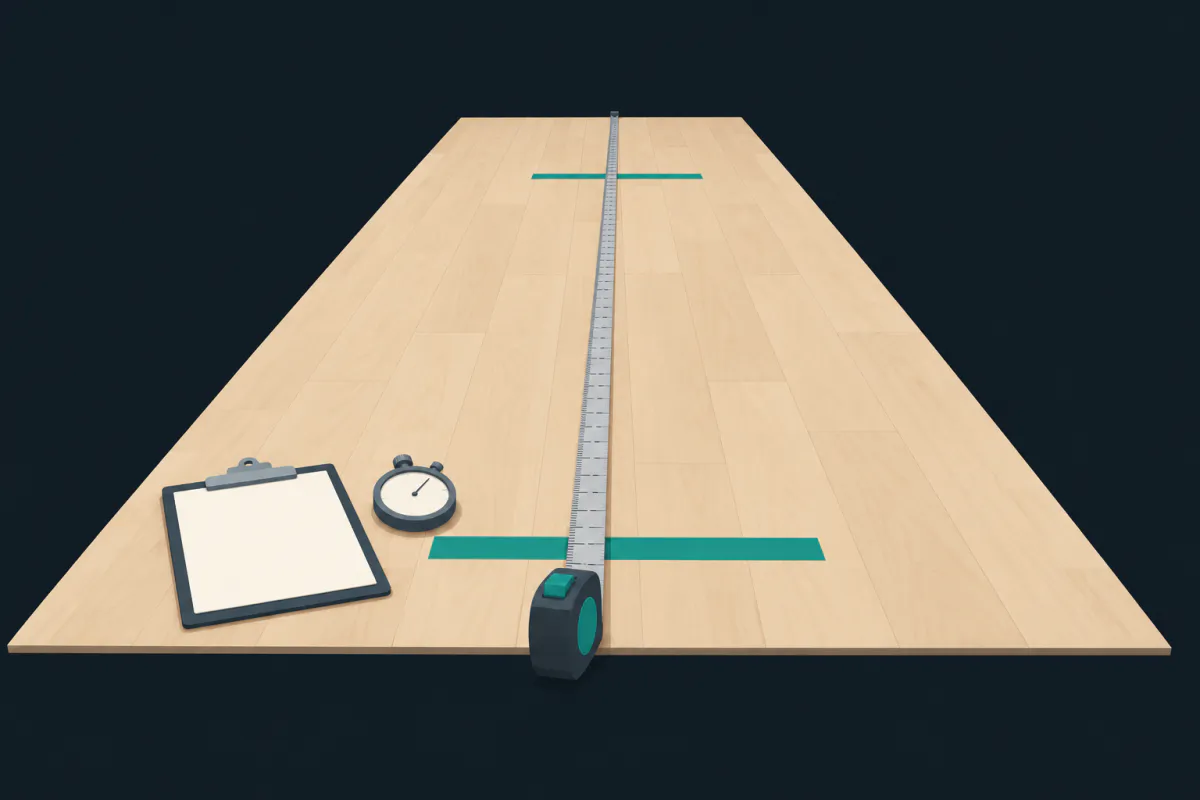
Somewhere in the second half of a recovery, a physiotherapist is likely to clear a strip of floor, lay down two lines of tape and ask you to hop on one leg. Hop tests are among the oldest measurements in ACL rehabilitation and still among the most used, and the number they produce — a percentage comparing the operated leg with the other one — tends to carry real weight in the conversation about going back to sport.
Whether your knee is ready to be tested, and what your own results mean, is a judgement for your surgeon and physiotherapist: they can watch how the leg behaves under load and they know what was done to it. What follows is what the tests are, what research says they measure well, and what they are known to miss.
The four tests, and the number they produce
The battery that most clinics use comes in four parts, all performed on one leg at a time with the arms free.
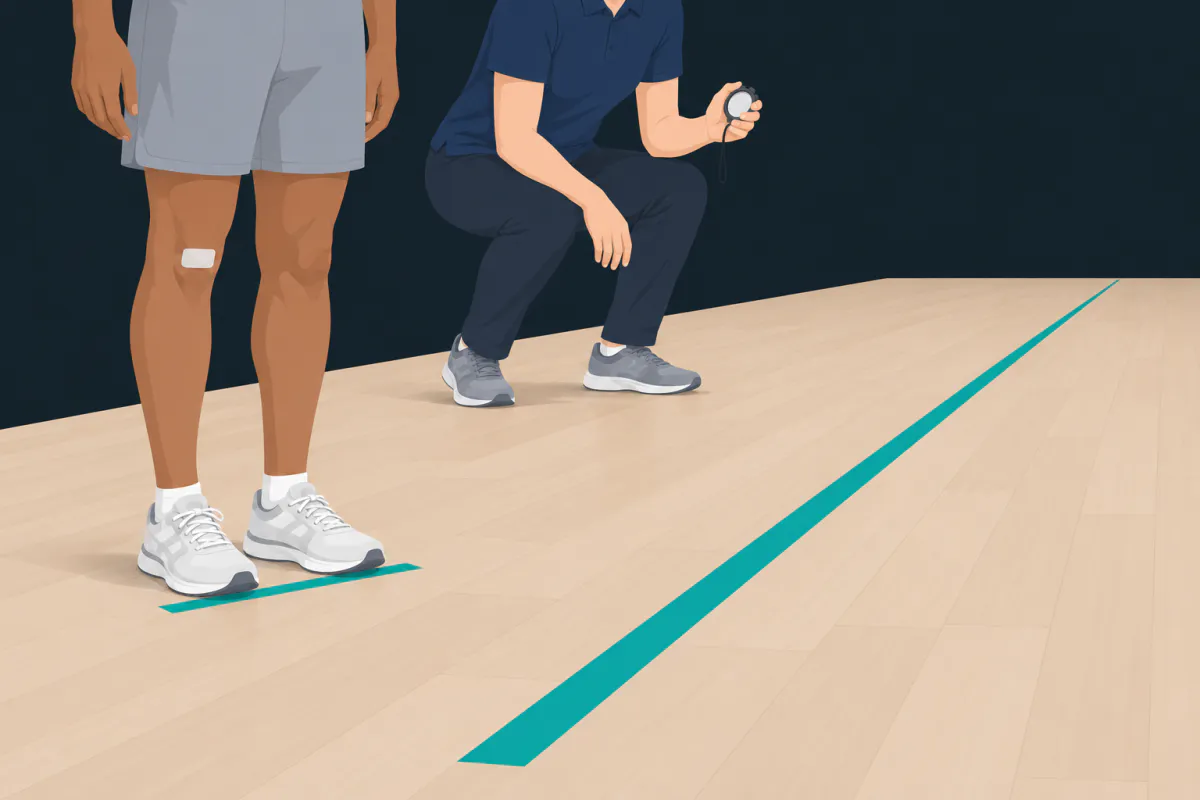
- Single hop for distance. You stand with your toes behind a line, hop forward once as far as you can and hold the landing.
- Triple hop for distance. Three hops in a row on the same leg, as far as you can, holding the final landing for a couple of seconds.
- Crossover hop for distance. Three hops again, but each one crosses over a strip marked on the floor, so the leg has to deal with sideways as well as forward load.
- Six-metre timed hop. You hop the length of a six-metre line as quickly as you can and the time is recorded.
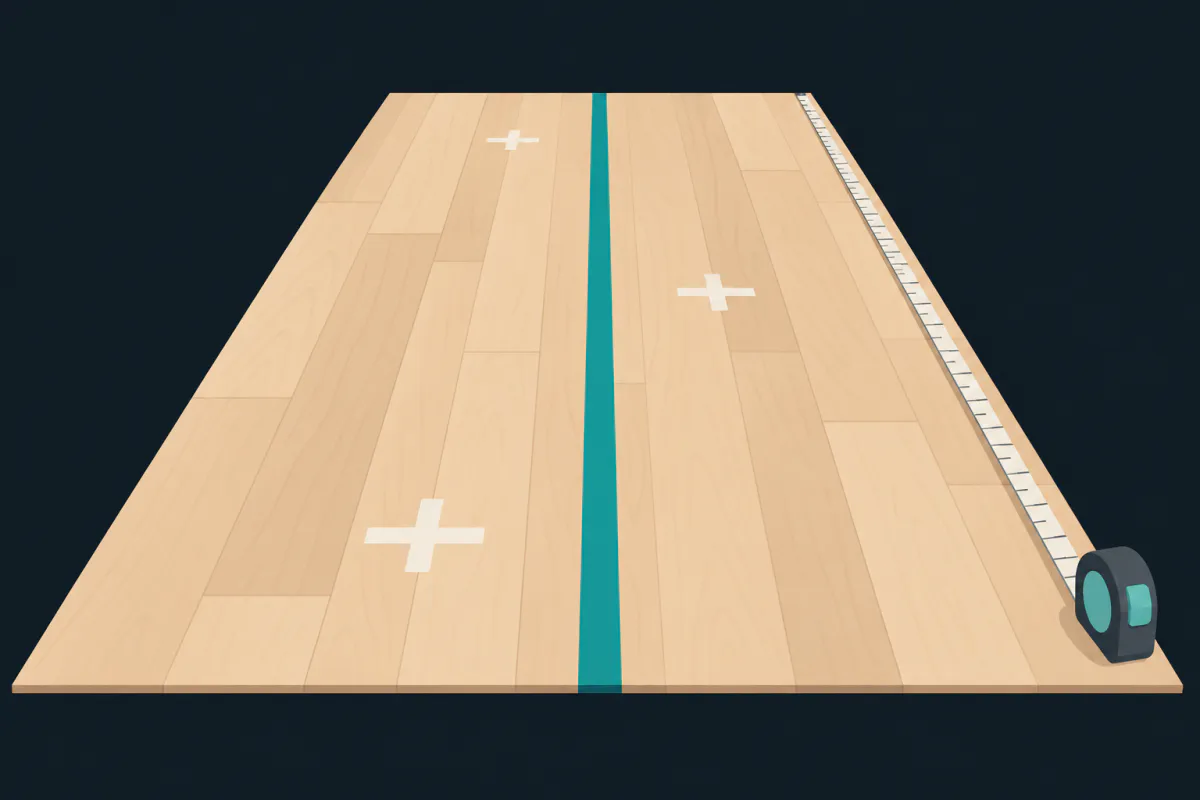
Each test is done on both legs, and the result is expressed as a limb symmetry index: the operated leg’s score divided by the other leg’s score, multiplied by a hundred. Hop 150 cm on the operated leg and 170 cm on the other, and the index is 88 per cent. Clinics commonly look for 90 per cent or more on each test. The whole apparatus is two lines of tape, a tape measure and a stopwatch, which is a large part of why these tests have lasted.
Why physiotherapists use them
The tests were built to find something that was otherwise invisible. Noyes, Barber and Mangine introduced them in 1991 in patients with ACL-deficient knees, asking how sensitive one-legged hopping was to a problem that strength testing and clinical examination were missing. Half of their patients had an abnormal symmetry score on a single hop test; combining two tests raised that to 62 per cent. The tests had high specificity and few false positives, which is why the authors described them as a way to confirm a suspected deficit rather than to rule one out.
They are also consistent enough to use as a measure of progress. Reid and colleagues tested 42 patients after reconstruction on four separate occasions and reported intraclass correlation coefficients for the symmetry indexes between 0.82 and 0.93, with the smallest change that can be distinguished from measurement error ranging from about 7 to 13 percentage points depending on the test. In other words, a rise from 78 to 84 per cent between visits may be noise; 78 to 95 per cent is unlikely to be.
The strongest argument for testing, though, is what happens to people who return to sport without passing. In the Delaware-Oslo cohort, Grindem and colleagues followed 106 patients in pivoting sports and defined passing as scoring above 90 on quadriceps strength, hop test symmetry and two questionnaires. Among those who failed, 38.2 per cent suffered a reinjury, against 5.6 per cent of those who passed. Kyritsis and colleagues found something similar in 158 male professional athletes, who were discharged against six criteria including isokinetic strength and the single, triple and crossover hop tests: those who did not meet all six before returning to team training had roughly four times the risk of rupturing the graft. Neither study shows that the hop tests themselves did the work — timing, strength and sport all moved together — but a battery of criteria clearly separates two very different groups, the point made at more length in when you can run again after ACL reconstruction. How often a second tear happens, and in whom, is covered in second ACL injury: how common and what lowers the risk.
What a 90 per cent score does not tell you
Here the literature becomes much less comfortable, in two separate ways.
The first is the comparison leg. A symmetry index assumes the other leg is a fair standard, and after months of limping and reduced training it often is not. Wellsandt and colleagues tested 70 athletes before reconstruction and again six months after it, then scored them twice: once against the uninjured leg at six months, the usual method, and once against the uninjured leg’s own pre-surgery performance. Forty of the 70 reached 90 per cent by the usual method; only 20 reached it against the earlier baseline. The second measure was the better predictor of a second ACL injury. The same patients, the same hops, and nearly half of the passes disappeared when the yardstick stopped moving.
The second problem is what the distance measures. A leg is a chain of three joints, and a hop can be produced by different combinations of them. Kotsifaki and colleagues pooled 19 studies in a 2020 meta-analysis and found strong evidence that the operated leg lands with less knee flexion and smaller knee flexion moments than the other leg and than uninjured controls, despite performance that looked adequate. Their own later work put numbers on it: athletes cleared for return to sport hopped with a symmetry index of about 97 per cent, while the symmetry of work done by the knee during push-off was around 69 per cent, with the hip and the trunk making up the difference. The distance, they concluded, largely reflects hip and ankle function and is a poor measure of the knee’s.
Davies, Myer and Read reached a related verdict in their 2020 critical review: the hop tests are reliable, but the relationship between passing them and doing well afterwards is equivocal, and running all four horizontal tests appears unnecessary when the time could buy a wider look at the athlete. None of this makes the tests useless. It does mean that a physiotherapist watching how you land is reading something the tape measure cannot.
Where hop testing sits in a programme
Rehabilitation after this operation is organised in phases with criteria for moving between them, the structure set out in Noyes’ Knee Disorders, and hop testing belongs to the late ones. Before anyone measures a hop, the knee is generally expected to have its range of motion, little or no swelling, and enough strength and landing control to absorb single-leg impact; the consensus guideline from van Melick and colleagues and the 2023 Aspetar clinical practice guideline both place return-to-sport decisions on a battery of criteria rather than on elapsed time, and both treat testing as something a clinician sets up and supervises. What follows the tests, from clearance to a full match, is in the article on return to sport.
That is also why they make a poor home progress check: maximal hopping on one leg is demanding, the tests were validated under supervision, and a number nobody can interpret is not worth the loading. Swelling that comes back after a session, a knee that gives way, or one that locks, are all things to report rather than train through.
Where the app fits
Levels 7 to 9 of our free ACL rehab app for iOS and Android are the jumping and landing levels — pogos, snap downs, plate jumps and single-leg box jumps — and their progression criteria are the kind a clinic can check, such as holding single-leg landing control and a single-leg leg press at a given multiple of body weight. The app does not score hop tests, but it is a reasonable place to keep the training that leads up to them, with the pain log recorded beside the sessions themselves.
Hop tests are best understood as a screen rather than a verdict: cheap, repeatable and good at catching a leg that is plainly behind, while symmetrical numbers can sit on top of a knee still doing less than its share. That is why no guideline rests a return to sport on them alone. If your own numbers are close to the threshold, the useful question for your physiotherapist is not only what the percentage is, but what they saw while you were producing it.
The illustrations in this article were generated with AI.
Sources
- Noyes FR, Barber SD, Mangine RE. Abnormal lower limb symmetry determined by function hop tests after anterior cruciate ligament rupture. Am J Sports Med. 1991;19(5):513-518.
- Reid A, Birmingham TB, Stratford PW, Alcock GK, Giffin JR. Hop testing provides a reliable and valid outcome measure during rehabilitation after anterior cruciate ligament reconstruction. Phys Ther. 2007;87(3):337-349.
- Grindem H, Snyder-Mackler L, Moksnes H, Engebretsen L, Risberg MA. Simple decision rules can reduce reinjury risk by 84% after ACL reconstruction: the Delaware-Oslo ACL cohort study. Br J Sports Med. 2016;50:804-808.
- Kyritsis P, Bahr R, Landreau P, Miladi R, Witvrouw E. Likelihood of ACL graft rupture: not meeting six clinical discharge criteria before return to sport is associated with a four times greater risk of rupture. Br J Sports Med. 2016;50:946-951.
- Wellsandt E, Failla MJ, Snyder-Mackler L. Limb symmetry indexes can overestimate knee function after anterior cruciate ligament injury. J Orthop Sports Phys Ther. 2017;47(5):334-338.
- Kotsifaki A, Korakakis V, Whiteley R, Van Rossom S, Jonkers I. Measuring only hop distance during single leg hop testing is insufficient to detect deficits in knee function after ACL reconstruction: a systematic review and meta-analysis. Br J Sports Med. 2020;54(3):139-153.
- Kotsifaki A, et al. Single leg hop for distance symmetry masks lower limb biomechanics: time to discuss hop distance as decision criterion for return to sport after ACL reconstruction? Br J Sports Med. Published online 2021.
- Davies WT, Myer GD, Read PJ. Is it time we better understood the tests we are using for return to sport decision making following ACL reconstruction? A critical review of the hop tests. Sports Med. 2020;50(3):485-495.
- Kotsifaki R, Korakakis V, King E, et al. Aspetar clinical practice guideline on rehabilitation after anterior cruciate ligament reconstruction. Br J Sports Med. 2023;57:500-514.
- van Melick N, et al. Evidence-based clinical practice update: practice guidelines for anterior cruciate ligament rehabilitation based on a systematic review and multidisciplinary consensus. Br J Sports Med. 2016;50:1506-1515.
- Noyes FR, Barber-Westin SD, eds. Noyes' Knee Disorders: Surgery, Rehabilitation, Clinical Outcomes. 2nd ed. Elsevier; 2017.