The guide · Timeline, Progression
How long does ACL surgery recovery take?
Six months, nine months, a year: where those numbers come from, what happens in each phase, and why the end of ACL rehab is not really a date.
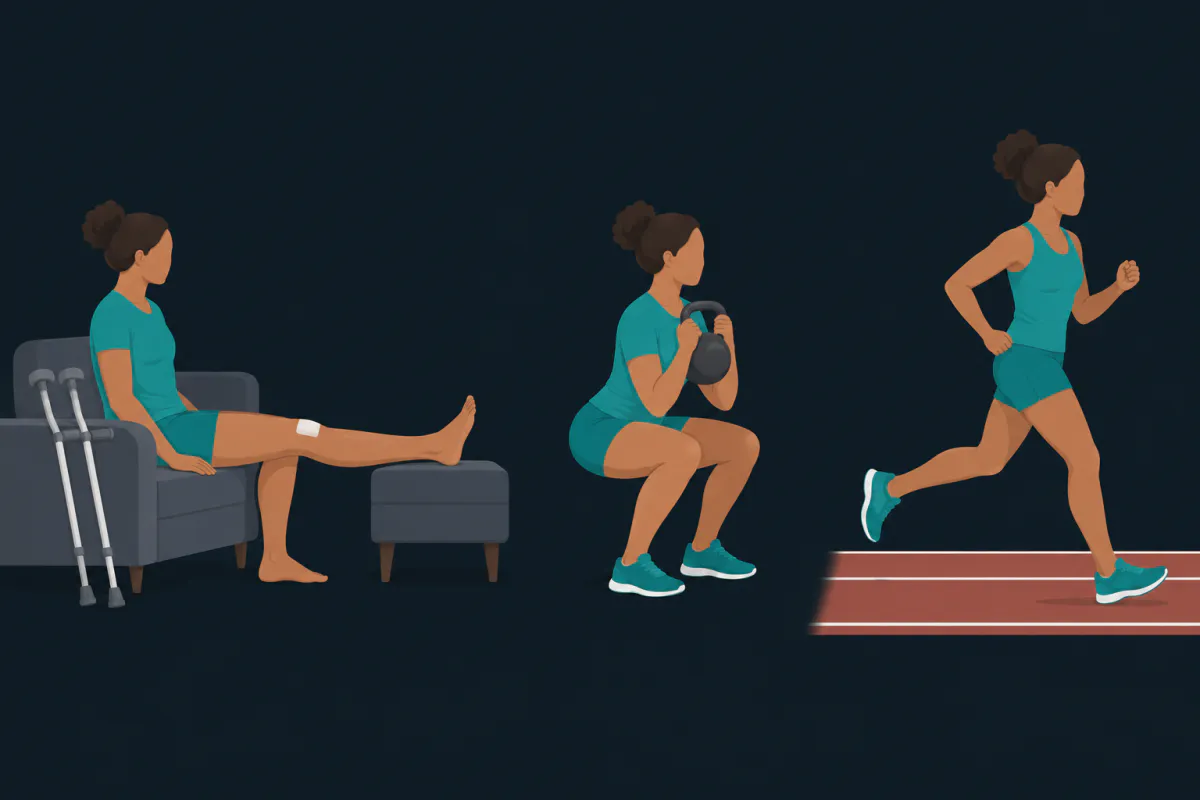
Everyone wants a number, and the numbers on offer disagree: six months, nine months, a year, sometimes two. They disagree because they are answers to different questions — when you can walk without thinking about it, when a surgeon might clear you for sport, when the leg is genuinely as strong as the other one. This article separates those questions, says where each number comes from, and explains why the honest answer is a range with conditions attached.
Your surgeon and physiotherapist set your timeline. What follows is background so that conversation makes more sense, not a schedule to hold yourself to.
Why there is no single number
Recovery after an ACL reconstruction is not one process that finishes at one moment. Several run in parallel and on different clocks. Swelling and wound healing settle over weeks. Range of motion usually returns over the first weeks and months. Muscle strength takes considerably longer than either. And the graft goes through a biological remodelling process of its own, which is part of why surgeons stay cautious long after a knee has stopped feeling like a problem.
The NHS puts the headline figure at up to a year for a full recovery, while noting that most everyday activities come back within a few months and that crutches are typically needed for around the first two weeks. That gap between “back to normal life” and “fully recovered” is where most of the confusion lives. People hear the first figure and expect the second.
On top of that, individual circumstances move the whole picture. Graft choice, whether a meniscus was repaired at the same time (which usually brings its own restrictions on weight-bearing and bending), age, the sport you want to go back to, how much supervised physiotherapy you can get, and how strong the leg was before surgery all change the pace. Two people operated on the same day can be months apart by the summer.
The phases, and what each one is for
The published consensus guideline from van Melick and colleagues describes rehabilitation as a prehabilitation phase before surgery followed by three criterion-based phases afterwards: an impairment-based phase, a sport-specific training phase, and a return-to-play phase. The word doing the work there is criterion-based. You move to the next phase when the knee meets the criteria for it, not when a certain number of weeks has passed.
In practice the shape of it is fairly consistent across protocols. The earliest phase is about the unglamorous basics: settling swelling, getting the knee fully straight, waking the quadriceps back up, and walking normally. The middle stretch is strength, first with both legs and then increasingly with one, building the capacity that everything later depends on. The final stretch reintroduces speed and impact — running, hopping, landing, changing direction — and ends with testing rather than with a date on a calendar.
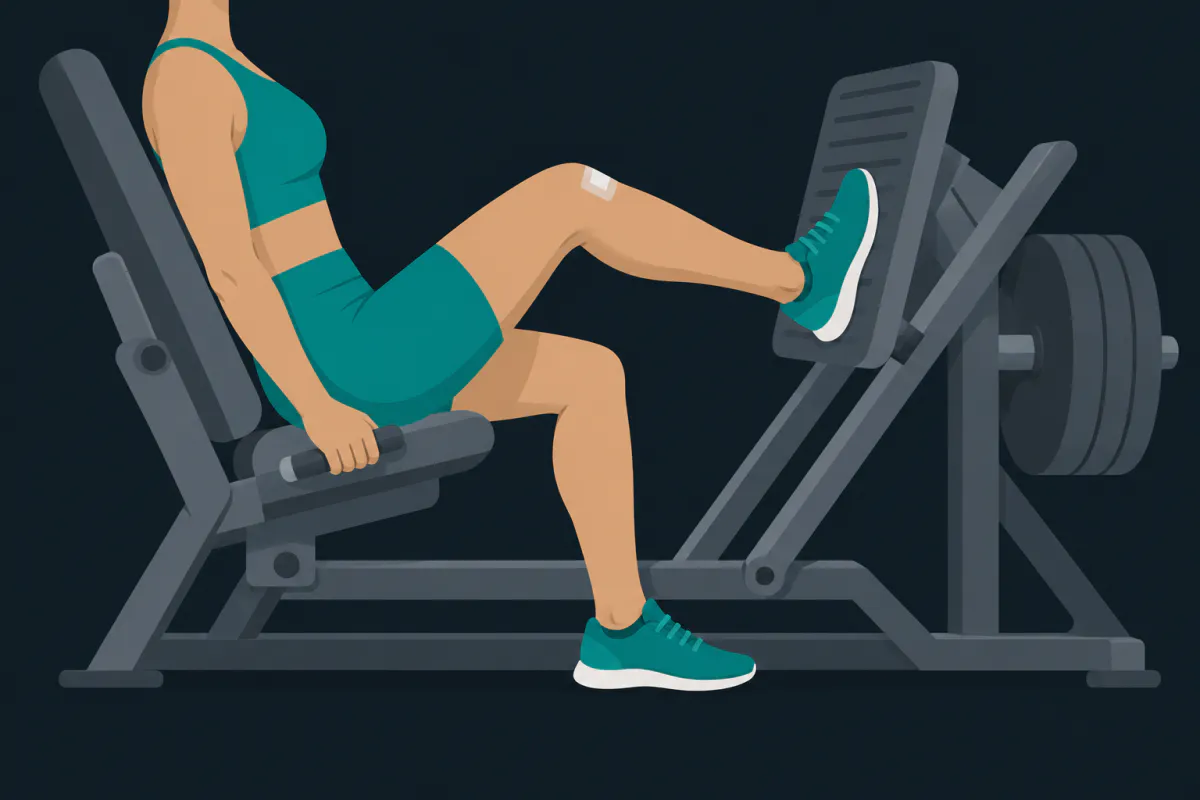
Timeframes get attached to those phases for planning, and they are useful for that. They are not promises. A knee that is still swollen and cannot fully straighten at week eight is not ready for what week eight nominally contains, and most protocols would hold it there rather than push on. Keeping the work going through that long middle stretch is a problem of its own, covered in staying motivated through ACL rehab.
Where the nine-month figure comes from
Nine months keeps appearing because two well-known cohort studies pointed at it from different directions.
Grindem and colleagues, in the Delaware-Oslo cohort, followed patients returning to pivoting sports and found that the reinjury rate fell by roughly half for each month that return to sport was delayed, up to nine months after surgery — after which no further reduction was seen. They also found that patients who passed a set of return-to-sport criteria had far fewer reinjuries than those who did not, and that more symmetrical quadriceps strength before returning lowered the rate further.
Beischer and colleagues looked at athletes aged fifteen to thirty and reported that those who returned to knee-strenuous sport before nine months had a rate of new knee injury around seven times that of those who waited longer.
Both are observational studies of people playing demanding sports, not trials, and neither means that something changes in the knee at the nine-month mark. What they show is an association between returning early and getting hurt again, and both point just as firmly at strength and criteria as at the date. Nine months is best read as the point where waiting longer stopped buying extra protection in Grindem’s data — a floor for high-risk sport, not a finish line for everyone. Where the number came from, and what it does not tell you, is set out in why ACL guidelines say nine months.
What “recovered” means after that
If “recovered” means back playing, the figures are more sobering than most people expect. In Ardern and colleagues’ meta-analysis, 81 percent of patients returned to some form of sport, 65 percent returned to their pre-injury level, and 55 percent returned to competitive sport. The reasons for the drop-off were not only physical; the review looked at psychological and contextual factors too. The commonest of those reasons, fear of doing it again, has an article of its own: fear of reinjury after ACL surgery.
If “recovered” means the leg is as strong as the other one, the timeline is longer still. Brown and colleagues compared reconstructed limbs with those of matched uninjured people and found lower quadriceps strength in the reconstructed limb regardless of how long it had been since surgery, in studies extending to around four years. Comparing your operated leg with your own other leg — the limb symmetry index most clinics use — can flatter the result, because the uninjured leg often loses ground during rehabilitation too. How that index is calculated, and where it misleads, is in the limb symmetry index after ACL surgery, and the hop tests are where most clinics apply it.
None of that is a reason for gloom. It is a reason to treat month nine as a checkpoint rather than a discharge, and to keep strength work going after the formal programme ends.
How the app’s ladder maps onto the year
ACL Recovery Tracker, a free ACL rehab app for iOS and Android, splits that period into ten levels. Level 1 covers roughly the first four weeks and opens each workout with gait drills while you are on crutches, Level 4 begins gym-based strength work around week eight, Level 8 is running at roughly weeks twenty-four to twenty-eight, and Level 10 runs from about week thirty-nine to week forty-eight. End to end, the ladder spans a little under a year, which is deliberately closer to the cautious end of published protocols.
Those week ranges are labels, not gates. Each level has its own progression criteria, and the app asks you to work through that checklist — ideally with your physiotherapist — before moving up. If you are ahead of the typical weeks, you can move; if you are behind, the level waits, and the pain diary and mobility log give you something concrete to show at your next appointment instead of a guess about how the month went. You can use the app as the running record of the whole year: sessions done, angles measured, pain logged.
So the usual pattern is walking well within weeks, most ordinary activities back within a few months, and sport becoming a serious question in the second half of the first year, with the care team deciding when. The spread between those figures is not vagueness. It is the honest shape of a recovery that is measured in what the knee can do, not in how many weeks have gone by. Work is usually the first of those milestones, and going back to work after ACL surgery sets out what the studies found about its timing.
The illustrations in this article were generated with AI.
Sources
- van Melick N, et al. Evidence-based clinical practice update: practice guidelines for anterior cruciate ligament rehabilitation based on a systematic review and multidisciplinary consensus. Br J Sports Med. 2016;50:1506-1515.
- NHS. ACL (anterior cruciate ligament) surgery: recovering.
- Grindem H, et al. Simple decision rules can reduce reinjury risk by 84% after ACL reconstruction: the Delaware-Oslo ACL cohort study. Br J Sports Med. 2016;50:804-808.
- Beischer S, et al. Young athletes who return to sport before 9 months after anterior cruciate ligament reconstruction have a rate of new injury 7 times that of those who delay return. J Orthop Sports Phys Ther. 2020;50(2):83-90.
- Ardern CL, et al. Fifty-five per cent return to competitive sport following anterior cruciate ligament reconstruction surgery: an updated systematic review and meta-analysis including aspects of physical functioning and contextual factors. Br J Sports Med. 2014;48:1543-1552.
- Brown C, Marinko L, LaValley MP, Kumar D. Quadriceps strength after anterior cruciate ligament reconstruction compared with uninjured matched controls: a systematic review and meta-analysis. Orthop J Sports Med. 2021;9(4):2325967121991534.