The guide · Daily life, Timeline
When can you drive after ACL reconstruction?
Why the answer ranges from two weeks to six, what the braking studies measured, and how the side, the graft and the painkillers change it.
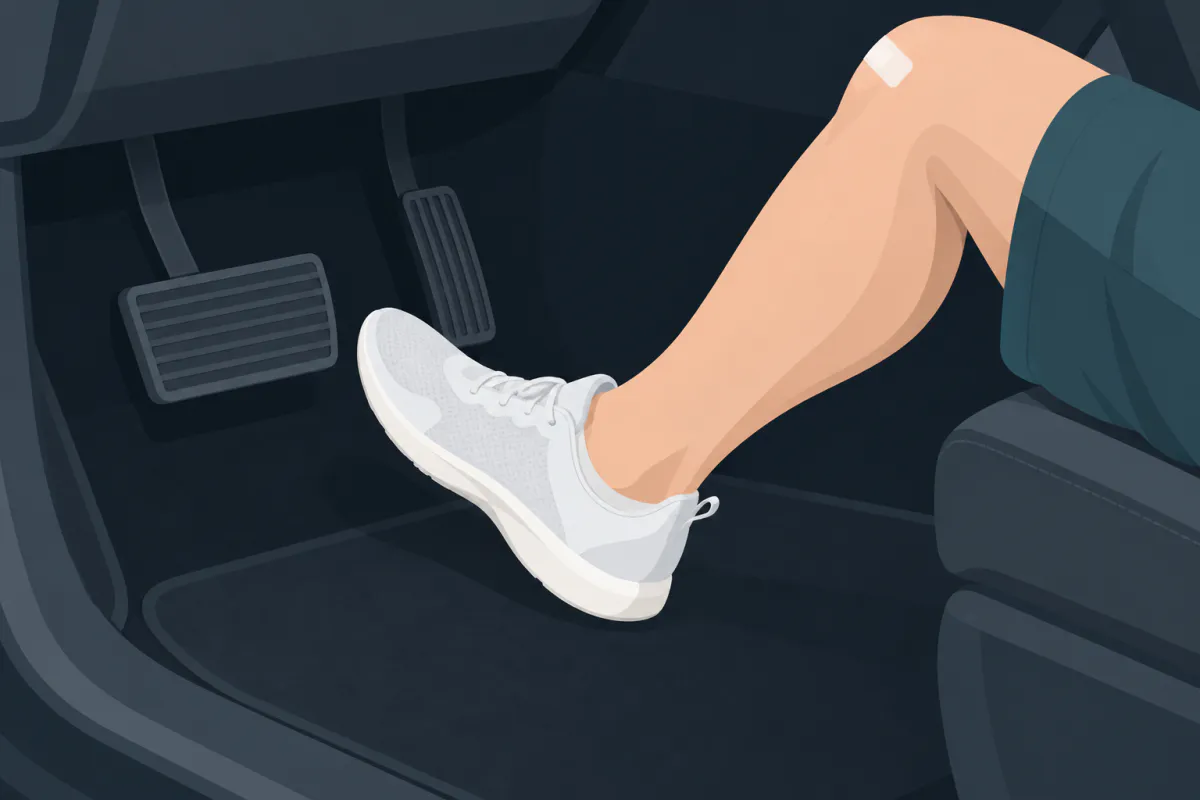
Driving is usually the first piece of ordinary life people want back, and the answers they are given range from two weeks to six. Both can be right, because the real question is not how the knee feels in the driver’s seat but how quickly the leg can get to the brake pedal, and who carries the responsibility if it cannot. This article covers what the braking research measured, why the operated side and the graft change the timing, and what else decides it.
Your surgeon and physiotherapist make this call, and their instructions come first. Nothing here is clearance to drive.
What “ready to drive” is actually measured by
Almost all of the research on this question uses one test: how fast you can move your foot from the accelerator to the brake and push it, measured on a rig or a driving simulator. The usual measures are brake reaction time, the gap between a signal appearing and the foot reaching the brake, and total braking time, which adds the travel of the pedal itself. In the control group of thirty healthy volunteers tested by Wasserman and colleagues, mean brake reaction time was 725 milliseconds and the whole sequence took about 3.6 seconds.
That is a narrow proxy for driving, and worth naming as one. Nobody has run a trial in which people recovering from an ACL reconstruction drive on real roads and their crashes are counted. What these studies show is how long a reconstructed leg takes to move like an uninjured one in a laboratory, which is the best available stand-in for an emergency stop.
Underneath the pedal test is the same leg the rest of your rehabilitation is about. Pressing a brake hard and fast needs the quadriceps to fire on demand, and the earliest phase of rehabilitation is largely spent restoring exactly that. The consensus guideline from van Melick and colleagues puts quadriceps control, full extension, swelling control and normal walking among the goals of the first postoperative phase, and Noyes’ Knee Disorders sets out the same criterion-based reasoning that most protocols follow: what the leg can do decides what comes next, not the date. A knee that still cannot hold a straight-leg raise is not a knee that can stamp on a brake.
What the studies found, and how much they disagree
The largest of them is also one of the oldest. Nguyen, Hau and Bartlett tested seventy-three patients on a computer-linked car simulator before surgery and again at two, four, six and eight weeks afterwards, against twenty-five controls. Reaction time in the left-knee group matched controls by two weeks. The right-knee group, the braking leg in most countries, took six.
Graft choice appears to matter too. Wasserman and colleagues followed twenty-seven people after right-knee reconstruction, nine with a bone-patellar tendon-bone autograft, nine with a hamstring autograft and nine with a tibialis anterior allograft, testing at one, three and six weeks. At one week every group was slower than controls on nearly every measure. The allograft group was back to normal braking values by three weeks; the two autograft groups still were not at that point. The authors suggested waiting six weeks after the autograft procedures and three after the allograft.
Salem and colleagues pulled the five available studies together in a systematic review and found broadly that pattern: normal braking by around two weeks for left-sided surgery, three weeks after allograft reconstruction, and four to six weeks after autograft reconstruction, with one study using a manual transmission simulator landing at four to six weeks for hamstring autografts.
The disagreements are as informative as the numbers. These are small studies — Gotlin and colleagues, measuring brake response time every two weeks for ten weeks, had twelve patients and ten controls; response times changed significantly over the ten weeks within the operated group, but at no point did the group differ significantly from the controls. Different rigs, different countries, different graft mixes and small groups produce a range rather than a threshold. Six weeks is the outer end of what this research supports for a right-sided autograft and two weeks the early end for a left-sided one, and neither is a date that transfers to an individual knee.
The parts that have nothing to do with your knee
Several things can stop you driving while the leg itself is fine.
- The anaesthetic. NHS guidance after an operation is not to drive for at least twenty-four hours after a general anaesthetic or sedation, and you cannot drive yourself home from surgery.
- The medication. Strong painkillers cause drowsiness and slow reactions, and the ones prescribed after this operation often fall under drug-driving law. Whoever prescribed them is the person to ask.
- Pain and distraction. The NHS puts the practical test plainly: do not drive until you can perform an emergency stop without pain or discomfort. A knee that hurts when you press hard is a knee that will hesitate.
- A brace. If yours is locked straight, your leg cannot work the pedals. Whether it comes off to drive is a question for your surgeon, not a decision to make in the car park.
- Insurance. The NHS advises checking your policy, since insurers can have their own conditions about driving after surgery.
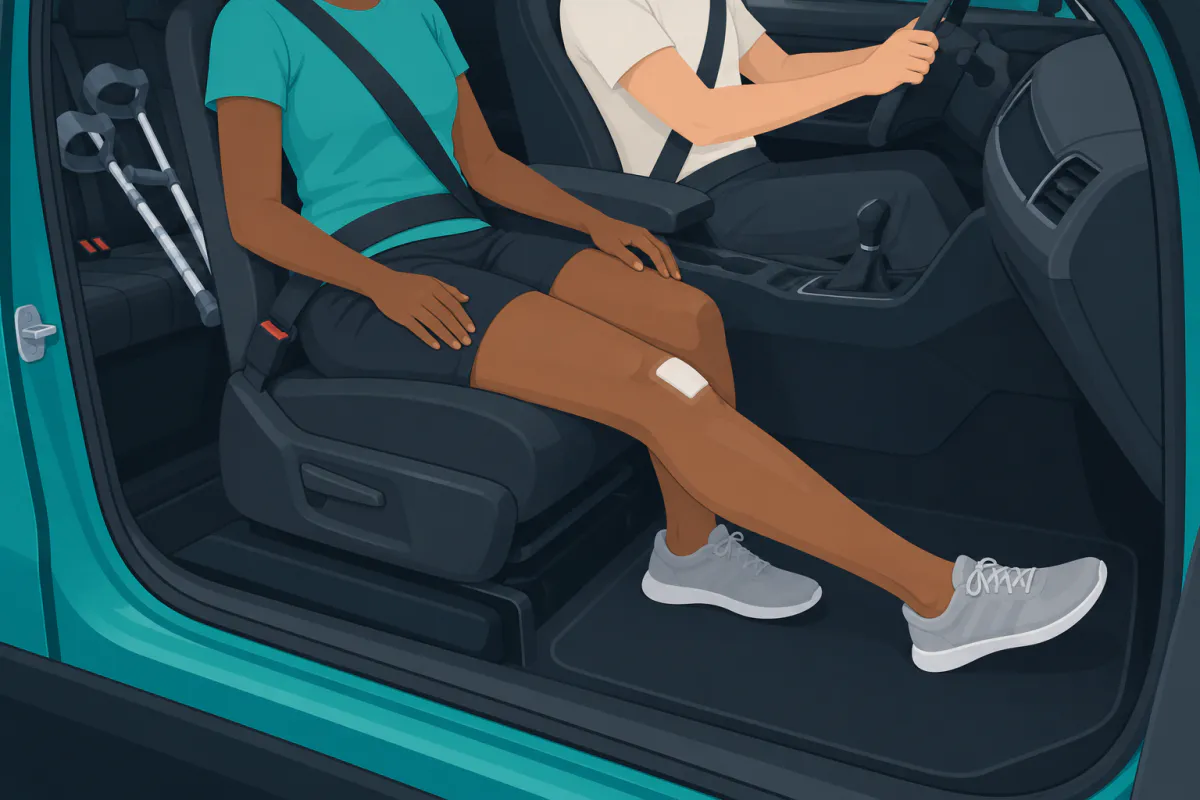
For drivers in the UK, DVLA’s guide for medical professionals sets the frame for the rest: after an operation the decision is made between the patient and their own doctor, taking account of recovery, pain, the effects of medication and any physical restriction, and the licence holder must be in control of the vehicle at all times. DVLA itself generally only needs to be told when a condition is likely to affect safe driving for more than three months, which most uncomplicated ACL reconstructions are not. Rules elsewhere differ, so check the ones where you hold your licence.
One safety note that sitting still in a car intersects with: the standard warning signs after this surgery, which the NHS recovery guidance lists, are a calf that is hot, red, swollen or painful, or new shortness of breath or chest pain, which can indicate a blood clot; spreading redness at the incision, discharge from the wound or a fever; new weakness or numbness in the foot; and a knee that locks and cannot be moved. Any of those means contacting your surgical team, your GP or an urgent care service the same day.
Where driving sits in the programme
In practical terms this question comes up somewhere in the first weeks, around the early strengthening levels, while the daily work is still extension, quadriceps control and walking normally. It is worth asking about it at an appointment rather than deciding alone in week three, and the appointment goes better with something concrete in hand. Nguyen and colleagues found that simple clinical tests of stepping and standing tracked driving reaction time closely enough to be used for monitoring — which is roughly what a physiotherapist is doing when they watch you get in and out of a chair.
If you use ACL Recovery Tracker, a free ACL rehab app for iPhone and Android, the things a physiotherapist will want for that conversation are the ones it already records: pain diary entries from 0 to 10 with the location and the moment they happened, mobility logs of extension and flexion against your healthy-leg baseline, and the sessions you have completed at your current level. None of that clears you to drive; it just means the answer is based on your last fortnight rather than your memory of it. You can use it the same way for every other “when can I” question in this recovery.
Driving comes back sooner than most of the milestones people care about, and it is the one where the cost of being a week early is carried by other people as well as by you. The research points at a window rather than a date, and the person who has watched your leg work is better placed to read it than the calendar is.
The illustrations in this article were generated with AI.
Sources
- Nguyen T, Hau R, Bartlett J. Driving reaction time before and after anterior cruciate ligament reconstruction. Knee Surg Sports Traumatol Arthrosc. 2000;8(4):226-230.
- Wasserman BR, et al. Braking reaction time after right-knee anterior cruciate ligament reconstruction: a comparison of 3 grafts. Arthroscopy. 2017.
- Salem HS, et al. Return to driving after anterior cruciate ligament reconstruction: a systematic review. Orthop J Sports Med. 2021.
- Gotlin RS, et al. Measurement of brake response time after right anterior cruciate ligament reconstruction. Arch Phys Med Rehabil. 2000.
- van Melick N, et al. Evidence-based clinical practice update: practice guidelines for anterior cruciate ligament rehabilitation based on a systematic review and multidisciplinary consensus. Br J Sports Med. 2016;50:1506-1515.
- Noyes FR, Barber-Westin SD, eds. Noyes' Knee Disorders: Surgery, Rehabilitation, Clinical Outcomes. 2nd ed. Elsevier; 2017.
- DVLA. Assessing fitness to drive: a guide for medical professionals.
- NHS. Having an operation (surgery): after surgery.
- NHS. ACL (anterior cruciate ligament) surgery: recovering.