The guide · Timeline, Early recovery
Quadriceps tendon graft recovery after ACL surgery
Where a quadriceps tendon graft is taken from, why extension gets watched so closely afterwards, and what the strength and registry data actually show.
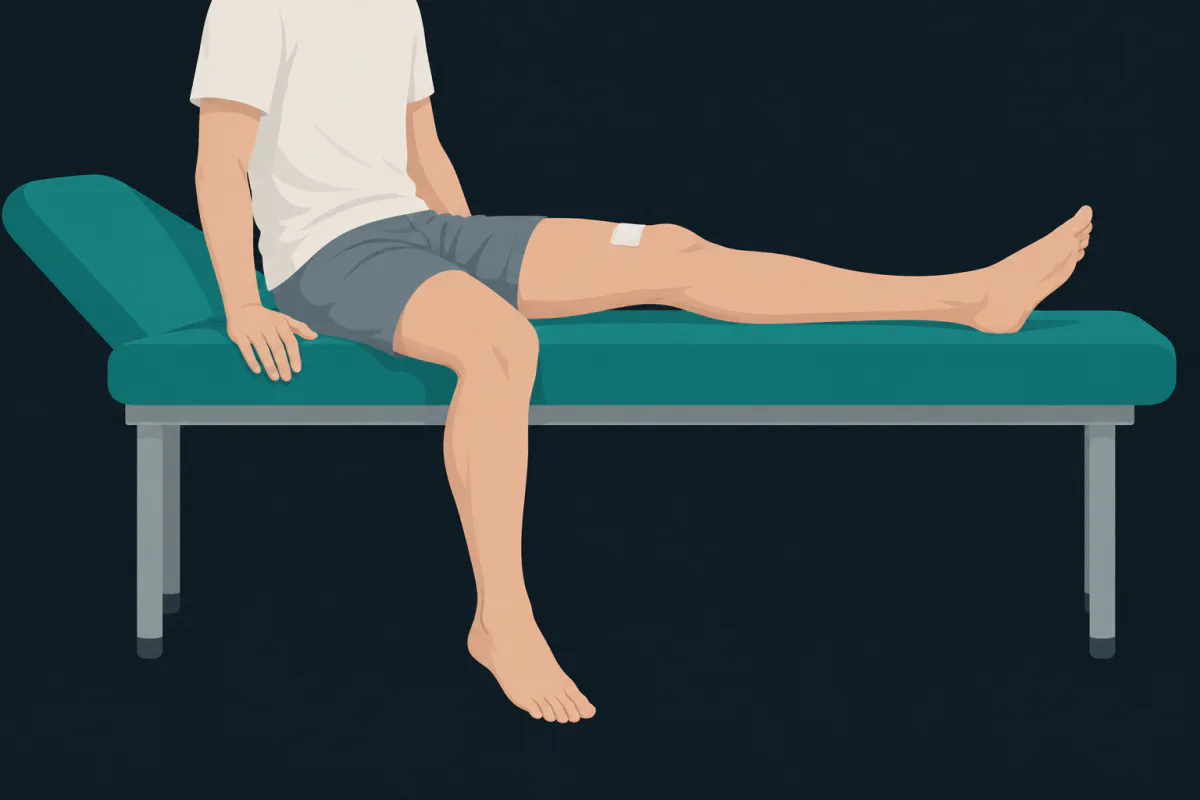
The graft for an ACL reconstruction has to come from somewhere, and for a growing share of operations it now comes from above the kneecap rather than below it or from the back of the thigh. A quadriceps tendon graft leaves the same reconstructed ligament inside the joint as any other; what differs is that the piece came out of the muscle group that is already the weak link after this surgery.
What your knee is allowed to do, and when, belongs to your surgeon and physiotherapist, and their instructions come first. This is general information about a pattern, not a plan for a particular knee.
Where the graft comes from
The quadriceps tendon is the broad tendon joining the thigh muscles to the top of the kneecap. A quadriceps tendon graft — usually shortened to QT — takes a strip of it through a short incision above the kneecap, either as soft tissue alone or with a small block of bone from the top of the patella at one end. A hamstring graft is taken through an incision on the inside of the shin, and a bone-patellar tendon-bone graft from the tendon below the kneecap; how those two differ from each other is a separate question.
Inside the joint the operation looks much the same whichever graft is used, and rehabilitation follows the phases and progression criteria that ACL programmes have used for years — the structure set out in Noyes’ Knee Disorders. What changes is which structure had a piece taken out of it, and here that structure is the extensor mechanism: the muscles and tendon that straighten your knee.
What the comparisons found
This graft has been compared with the other two often enough to give a fair picture. Mouarbes and colleagues pooled 27 studies covering 2,856 patients. Comparing 581 quadriceps tendon with 514 patellar tendon reconstructions, they found no significant difference in instrumented laxity, the Lachman test, the pivot-shift grade, Lysholm or IKDC scores, or graft failure. What did differ was donor-site pain, which was markedly less common after a quadriceps tendon graft: a risk ratio of 0.25, with a 95 per cent confidence interval of 0.18 to 0.36.
Dai and colleagues reached the same place in a later meta-analysis in the same journal — comparable graft survival, function and stability against both patellar tendon and hamstring grafts, with significantly lower donor-site morbidity than either. In practice that mostly means the front-of-knee soreness and the trouble with kneeling that can follow a patellar tendon harvest are less likely, which is the clearest advantage the graft has.
The quadriceps is where it shows
The cost sits in the muscle the tendon belongs to. Johnston and colleagues pooled knee strength results from 952 quadriceps tendon reconstructions and found that knee extensor strength, expressed as a limb symmetry index against the other leg, had still not reached 90 per cent at 24 months after surgery. Knee flexor strength passed 90 per cent much earlier, somewhere in the 9 to 15 month window. At 5 to 8 months, extensor strength after a quadriceps tendon graft looked similar to a patellar tendon graft but weaker than a hamstring one.
Holmgren and colleagues found the same ordering in patients measured around seven months after surgery: the quadriceps tendon group was weaker in the quadriceps than both the patellar tendon and the hamstring groups.
Two things are worth holding apart. Quadriceps weakness is not a quadriceps tendon graft problem — it follows this operation whatever the graft, and waking the muscle up again is the central job of the early weeks for everyone. What these measurements suggest is that this graft adds to a deficit that was going to be there anyway.
Extension, and why it is watched
Because the harvest is in the extensor mechanism, one of the first things a physiotherapist tends to check is extension. Two different problems get described in the same words. One is a true loss of extension: the knee will not straighten fully even when someone else moves it. The other is an extension lag, where the knee straightens when someone else moves it but the quadriceps cannot hold it there, so it sags out of straight when you lift the leg yourself — a strength and activation problem rather than a stiffness one.
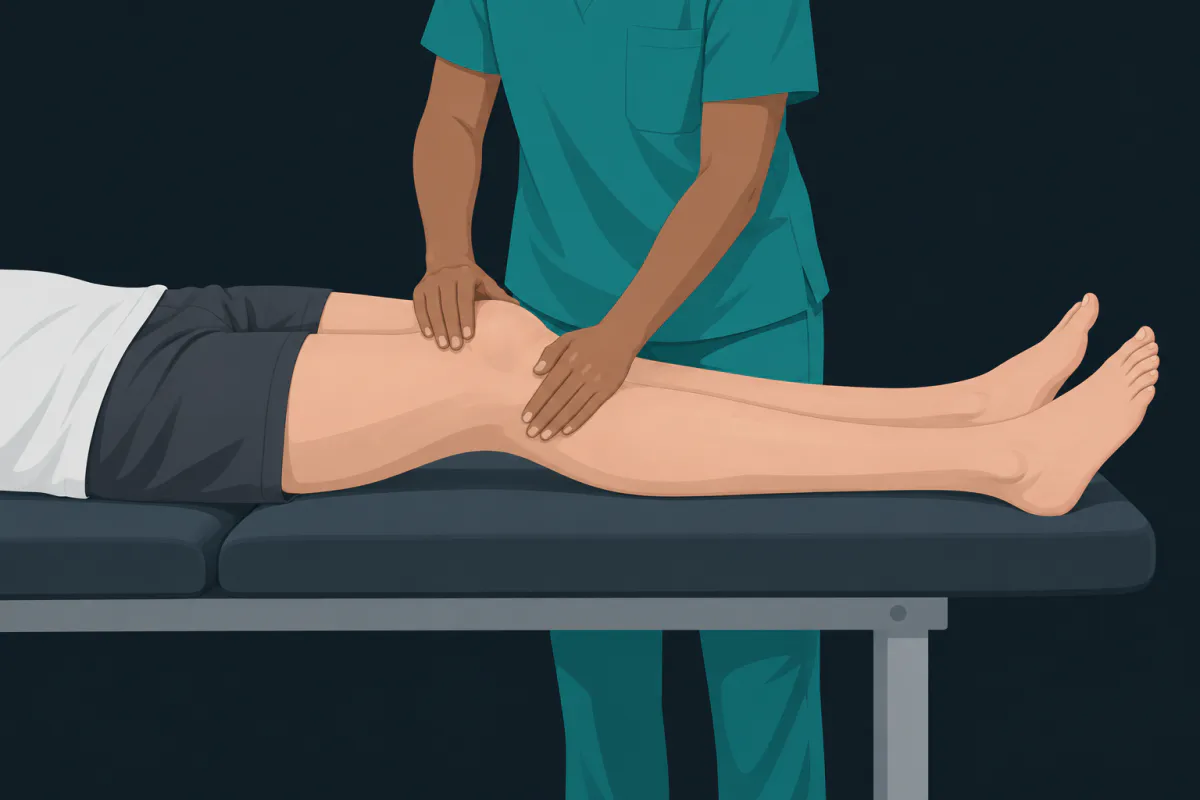
It shows up in the outcome data as well. Kekki and colleagues analysed 5,653 primary reconstructions and found that quadriceps tendon grafts carried significantly higher rates of non-revision reoperation — most often for an extension deficit or pain — and less improvement in patient-reported outcomes at two years than hamstring grafts.
None of that changes the target. Getting the knee fully straight early is the part of ACL rehabilitation every protocol agrees on, and the consensus guideline from van Melick and colleagues sets the gate for adding load in the same terms for everyone: a correct movement pattern, no pain, no effusion (fluid inside the joint), and no increase in symptoms afterwards. Protocols treat a persistent loss of extension as something to address promptly rather than wait out, which is why it belongs in the conversation with your physiotherapist early. The longer version is in why won’t my knee straighten.
What the registries say about failure
Here the evidence is genuinely mixed, and the disagreement is instructive. The Danish Knee Ligament Registry, reported by Lind and colleagues, covered 531 quadriceps tendon, 14,213 hamstring and 1,835 patellar tendon reconstructions carried out between 2005 and 2017, and found a two-year revision rate of 4.7 per cent for the quadriceps tendon graft against 2.3 per cent for hamstring and 1.5 per cent for patellar tendon.
The same group then looked at where those revisions came from. In clinics that performed the operation rarely, the quadriceps tendon revision rate was 6.4 per cent; in clinics that performed it often it was 2.9 per cent, an adjusted hazard ratio of 2.3 for the low-volume clinics. Pooled randomised trials, where the technique is generally in practised hands, have not found the same gap. A registry that catches a technique while it is still spreading is measuring surgeons learning it as well as the graft itself — an explanation rather than a dismissal, and the fair summary is that the reported failure rates for this graft vary with how often it is done.
How much of rehabilitation changes
Less than the strength figures might suggest, mostly because the guidance is thin. Briem and colleagues screened the rehabilitation guidelines published between 2014 and 2024 and kept 17; most of the graft-specific advice in them concerned the graft itself or the patellar tendon harvest site, few addressed the quadriceps tendon harvest site, and only one covered all three autografts. Solie, Monson and Larson set out graft-specific considerations for this graft in a clinical commentary for physiotherapists, which is the fullest account available — but a commentary is not a guideline.
Some things are not graft questions at all. The NHS recovery guidance lists the warning signs after this surgery: a calf that is hot, red, swollen or painful; a fever with spreading redness or discharge at the incision; new weakness or numbness in the foot; a knee that locks and will not move. Any of those means contacting your surgical team, your GP or an urgent care service the same day.
Where the app fits
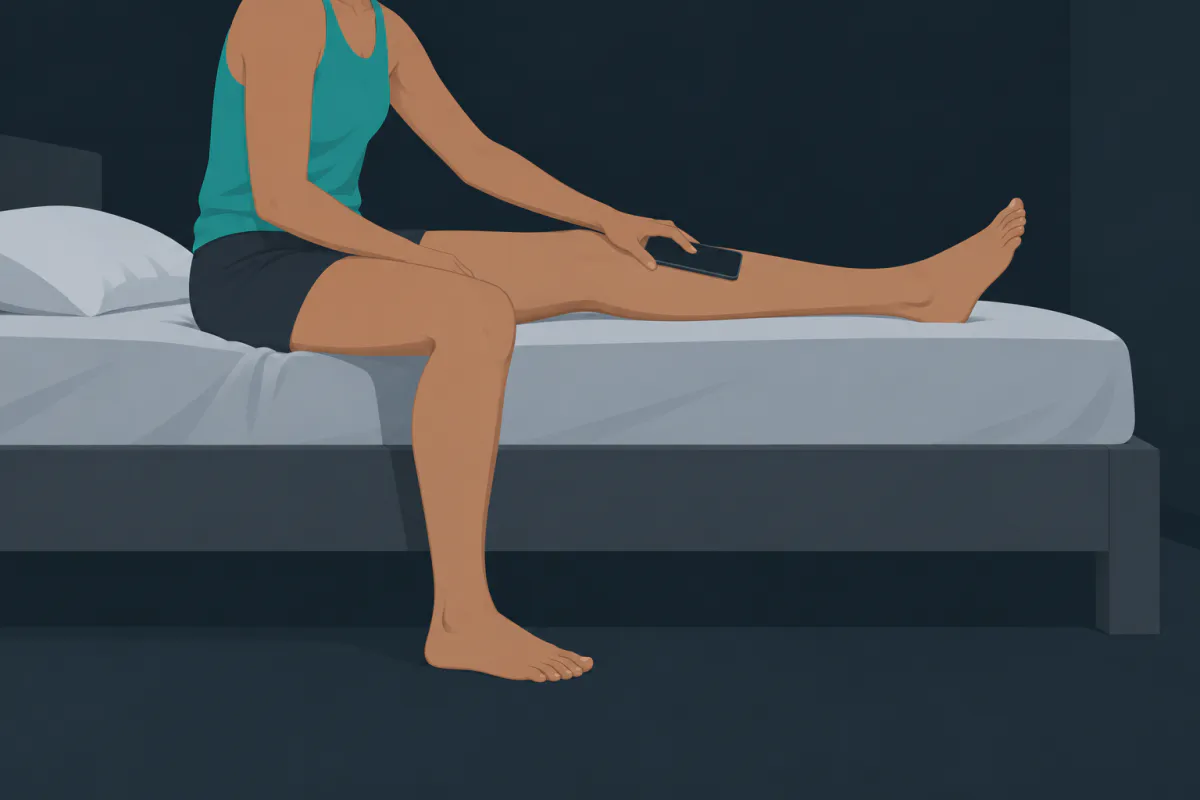
Levels 0 to 2 in ACL Recovery Tracker cover roughly the first six weeks, and extension is written into them: Level 1 lists regaining full knee extension among its goals, and Level 2 asks for full extension, 125 degrees of flexion and no swelling before it is complete. Since extension is the measurement worth following closely after this particular graft, the part of our free ACL recovery app for iPhone and Android that earns its place here is the mobility log — it stores extension and flexion in degrees, typed in or measured with the phone’s gyroscope, and the healthy-leg baseline gives you your other knee’s numbers to compare against instead of a figure from a protocol.
The graft was chosen before you were awake, for reasons to do with your sport, your other knee and your surgeon’s practice. What it leaves behind is a smaller sore spot than a patellar tendon graft and a quadriceps that takes longer to come back. The second of those is slow rather than complicated, and it is measurable, which helps more than it sounds like it should.
The illustrations in this article were generated with AI.
Sources
- Mouarbes D, Menetrey J, Marot V, Courtot L, Berard E, Cavaignac E. Anterior cruciate ligament reconstruction: a systematic review and meta-analysis of outcomes for quadriceps tendon autograft versus bone-patellar tendon-bone and hamstring-tendon autografts. Am J Sports Med. 2019.
- Dai W, Leng X, Wang J, Cheng J, Hu X, Ao Y. Quadriceps tendon autograft versus bone-patellar tendon-bone and hamstring tendon autografts for anterior cruciate ligament reconstruction: a systematic review and meta-analysis. Am J Sports Med. 2022.
- Johnston PT, McClelland JA, Feller JA, Webster KE. Knee muscle strength after quadriceps tendon autograft anterior cruciate ligament reconstruction: systematic review and meta-analysis. Knee Surg Sports Traumatol Arthrosc. 2021;29:2918-2933.
- Holmgren D, Noory S, Moström E, Grindem H, Stålman A, Wörner T. Weaker quadriceps muscle strength with a quadriceps tendon graft compared with a patellar or hamstring tendon graft at 7 months after anterior cruciate ligament reconstruction. Am J Sports Med. 2024;52(1):69-76.
- Kekki C, Cristiani R, Stålman A, von Essen C. Quadriceps tendon autografts are associated with increased short-term reoperation rates for extension deficit or pain and inferior patient-reported outcomes compared with hamstring tendon autografts: an analysis of 5653 cases of primary anterior cruciate ligament reconstruction. Am J Sports Med. 2026.
- Lind M, Strauss MJ, Nielsen T, Engebretsen L. Quadriceps tendon autograft for anterior cruciate ligament reconstruction is associated with high revision rates: results from the Danish Knee Ligament Registry. Knee Surg Sports Traumatol Arthrosc. 2020;28(7):2163-2169.
- Lind M, et al. Low surgical routine increases revision rates after quadriceps tendon autograft for anterior cruciate ligament reconstruction: results from the Danish Knee Ligament Reconstruction Registry. Knee Surg Sports Traumatol Arthrosc. 2021.
- Solie B, Monson J, Larson C. Graft-specific surgical and rehabilitation considerations for anterior cruciate ligament reconstruction with the quadriceps tendon autograft. Int J Sports Phys Ther. 2023;18(2):493-512.
- Briem K, Zebis MK, Haraldsson BTh, Bencke J, Fernandes L. Rehabilitation guidelines after autograft anterior cruciate ligament reconstruction need more graft-specific exercise recommendations - a scoping review. Knee Surg Sports Traumatol Arthrosc. 2026;34(1):83-101.
- van Melick N, et al. Evidence-based clinical practice update: practice guidelines for anterior cruciate ligament rehabilitation based on a systematic review and multidisciplinary consensus. Br J Sports Med. 2016;50:1506-1515.
- Noyes FR, Barber-Westin SD, eds. Noyes' Knee Disorders: Surgery, Rehabilitation, Clinical Outcomes. 2nd ed. Elsevier; 2017.
- NHS. ACL (anterior cruciate ligament) surgery: recovering.