The guide · Timeline, Early recovery
Hamstring vs patellar tendon graft: the early weeks
What differs in the first weeks after a hamstring or a patellar tendon graft, what each donor site adds, and how much of rehabilitation is the same.
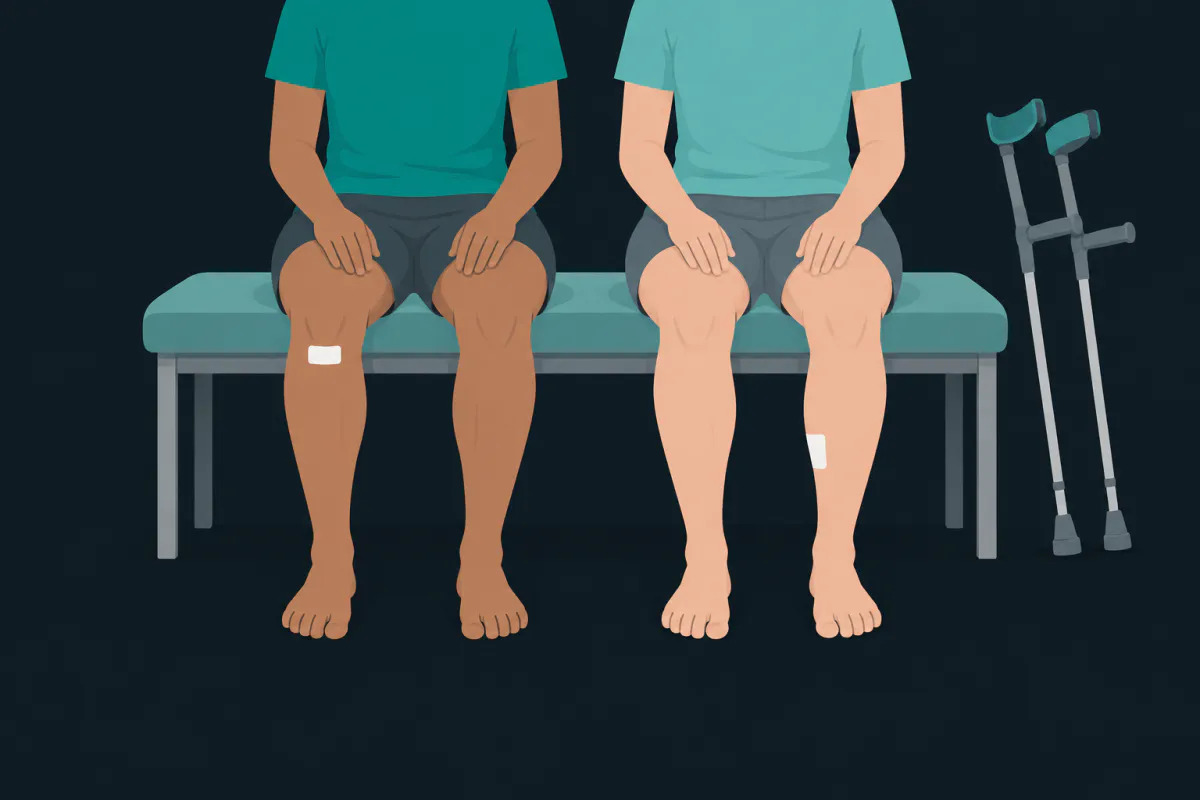
Two people can have the same operation on the same morning and go home with different sore spots. An ACL reconstruction does not repair the torn ligament; it replaces it with tendon taken from somewhere else in the same leg, and the two most common places to take it from leave different marks behind. That is most of what separates the early weeks after a hamstring graft from the early weeks after a patellar tendon graft.
Which graft you were given, and what your knee is allowed to do while it heals, are your surgeon’s and physiotherapist’s decisions, and their instructions come first. This is general information about the pattern, not a schedule for your knee.
The graft and the place it came from
A hamstring graft usually takes the semitendinosus tendon, sometimes with the gracilis beside it, through a small incision on the inside of the shin just below the knee. A bone-patellar tendon-bone graft — often shortened to BPTB — takes the middle third of the patellar tendon below the kneecap, with a small block of bone from the kneecap at one end and a block from the shin at the other.
Inside the joint, the rest of the operation looks much the same. Tunnels are drilled through the shin and thigh bone, the graft is passed through them and fixed at both ends. What differs afterwards is mainly where it hurts to press, and which muscle group had a piece taken out of it.
What the choice changes, and what it does not
The comparison has been made many times. The Cochrane review by Mohtadi and colleagues pooled 19 trials covering 1,597 adults and found that tests of static knee stability favoured patellar tendon grafts, while anterior knee pain and discomfort with kneeling were more common after them. Patient-reported function came out broadly similar between the two.
Graft rupture is the outcome people ask about most, and the numbers are closer than the discussion around them suggests. Samuelsen and colleagues pooled 47,613 patients and found the graft had ruptured in 212 of 7,560 patellar tendon reconstructions (2.80 per cent) and in 1,123 of 39,510 hamstring reconstructions (2.84 per cent). The raw percentages are almost the same; the pooled odds ratio of 0.83, with a 95 per cent confidence interval of 0.72 to 0.96, favoured the patellar tendon graft slightly. Both of those things are true at once, and it is worth holding them together rather than picking the more dramatic one.
None of this is a decision you make after surgery. By the time you are reading about it, the graft is already in place, and the useful question is what the donor site is going to do over the next couple of months.
Where the donor site shows up
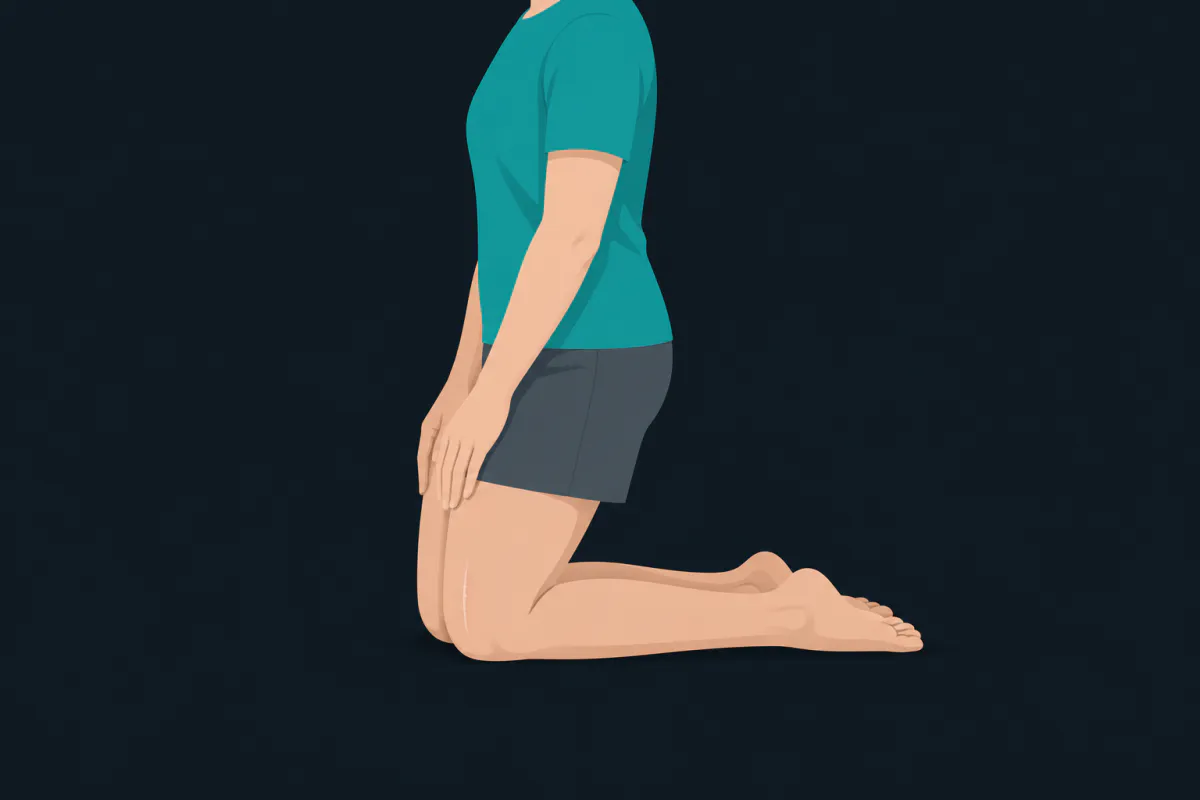
For a patellar tendon graft, it shows up at the front of the knee. Peebles and colleagues reviewed the level I randomised trials and found the reported incidence of anterior knee pain after BPTB reconstruction ranged from 5.4 to 48.4 per cent, and of kneeling pain from 4.0 to 75.6 per cent. Those ranges are enormous, and the reason matters: the trials defined the symptom differently, asked at different points and measured it in different ways. What they agree on is the direction — the front of the knee, and kneeling in particular, is where this graft is felt.
For a hamstring graft, the donor site shows up behind the knee and at the back of the thigh, and mostly when the knee is bent a long way. Ardern and Webster, reviewing flexor strength after hamstring harvest, found no difference in isokinetic hamstring strength between graft compositions, but deficits at knee flexion angles of 70 degrees or more when the gracilis had been taken alongside the semitendinosus rather than the semitendinosus alone. That review compares two hamstring graft types with each other rather than hamstring with patellar tendon, so read it as evidence about how much tendon was taken, not as a verdict on graft choice.
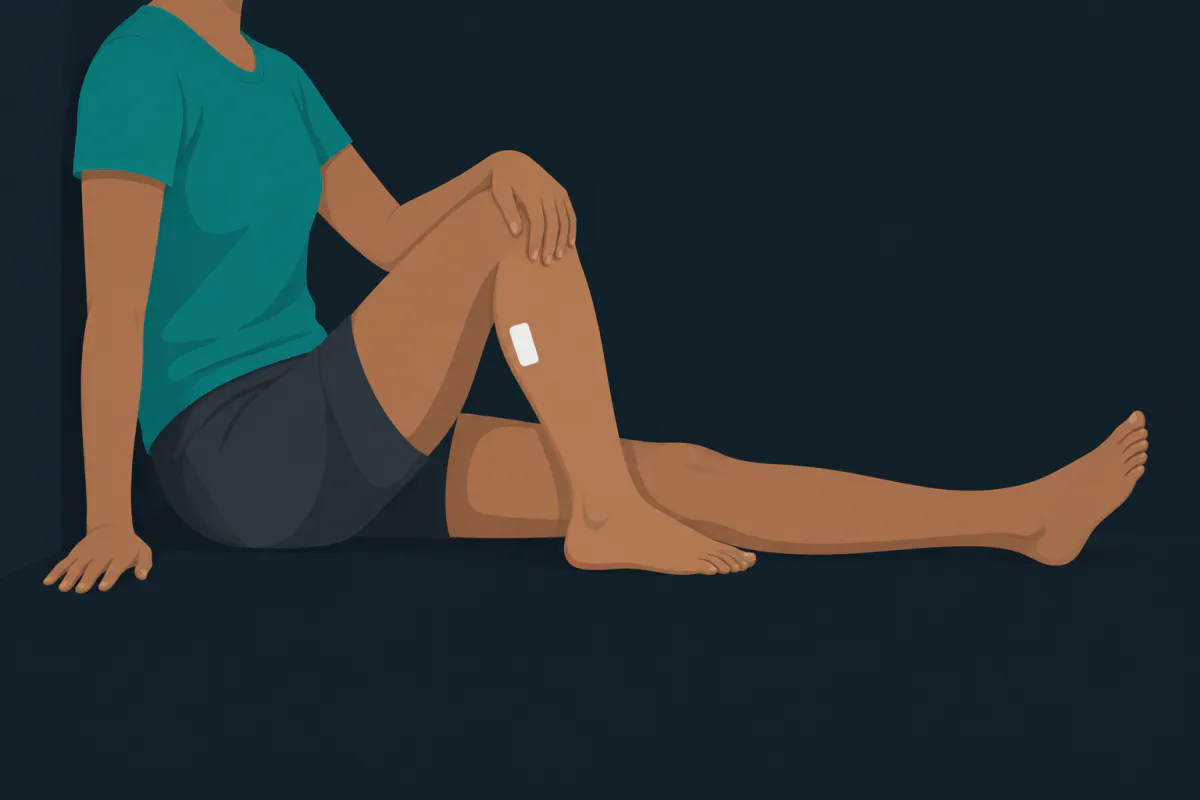
Both harvests also cut through skin where small sensory nerve branches run, which is why a numb patch near the scar is common after either one. The longer version of that is in numbness beside the scar.
The quadriceps problem belongs to both
It is tempting to assume that taking tendon from the front of the knee is what makes the thigh waste away, and that a hamstring graft spares it. The measurements do not support that reading.
Milutinovic and colleagues tested international male soccer players who had received either graft. At three months, both groups showed moderate to large asymmetry in knee extensor peak torque between the operated and healthy leg; by six months the asymmetry was trivial in both, and the difference in limb symmetry index between the two graft groups was not significant. These were full-time athletes in supervised rehabilitation, so the timescale is not everyone’s. The pattern still says something plain: quadriceps weakness after this operation is an ACL problem, not a patellar tendon problem, and waking the quadriceps up is the same job either way.
How much of rehabilitation actually differs
Less than most people expect, and less than it probably should. Briem and colleagues screened the rehabilitation guidelines published between 2014 and 2024 and kept 17. Sixteen contained at least one graft-specific consideration, but most of those concerned protecting the graft itself or the patellar tendon harvest site; few addressed the hamstring or quadriceps tendon harvest sites, and only one set of guidelines covered all three autografts. Their conclusion was that guidance covering all three is needed — which is a fair description of a gap, and an honest answer to the question of whether your programme should look different.
What the programmes do share is the part that decides the outcome. Getting the knee fully straight early, restoring flexion, keeping swelling down and progressing on what the leg can do rather than on the calendar are common to every protocol, and are the structure set out in Noyes’ Knee Disorders. The consensus guideline from van Melick and colleagues states the gate for adding load in the same terms for everyone: a correct movement pattern, no pain, no effusion (fluid inside the joint), and no increase in symptoms afterwards.
Some things are not graft questions at all. The NHS recovery guidance lists the warning signs after this surgery: a calf that is hot, red, swollen or painful; a fever with spreading redness or discharge at the incision; new weakness or numbness in the foot; a knee that locks and will not move. Any of those means contacting your surgical team, your GP or an urgent care service the same day.
Where the app fits
ACL Recovery Tracker does not ask which graft you had, and nothing in the programme changes by graft type — Levels 0 to 2 cover roughly the first six weeks for everyone, with Level 1 asking for 90 degrees of flexion and no limp and Level 2 for 125 degrees and no swelling before each is complete. What our free ACL tracker for iPhone and Android is useful for here is the thing that does differ: the pain diary records a 0 to 10 score with the location and the moment, so a front-of-knee ache on kneeling and a pull at the back of the thigh in deep flexion stay separate entries rather than one blurred memory of a bad week, and the progression checklist keeps the criteria in front of you.
The graft you have is worth understanding and not worth relitigating. It was chosen before you were awake, and the reasons for it belong to the conversation you had with your surgeon beforehand. The part still in front of you — extension, the quadriceps, the swelling, the criteria — looks almost identical from either side of that decision.
The illustrations in this article were generated with AI.
Sources
- Mohtadi NG, Chan DS, Dainty KN, Whelan DB. Patellar tendon versus hamstring tendon autograft for anterior cruciate ligament rupture in adults. Cochrane Database Syst Rev. 2011;(9):CD005960.
- Samuelsen BT, Webster KE, Johnson NR, Hewett TE, Krych AJ. Hamstring autograft versus patellar tendon autograft for ACL reconstruction: is there a difference in graft failure rate? A meta-analysis of 47,613 patients. Clin Orthop Relat Res. 2017;475(10):2459-2468.
- Peebles LA, Akamefula RA, Aman ZS, Verma A, Scillia AJ, Mulcahey MK, Kraeutler MJ. Following anterior cruciate ligament reconstruction with bone-patellar tendon-bone autograft, the incidence of anterior knee pain ranges from 5.4% to 48.4% and the incidence of kneeling pain ranges from 4.0% to 75.6%: a systematic review of level I studies. Arthrosc Sports Med Rehabil. 2024;6(2):100902.
- Ardern CL, Webster KE. Knee flexor strength recovery following hamstring tendon harvest for anterior cruciate ligament reconstruction: a systematic review. Orthop Rev (Pavia). 2009;1(2):e12.
- Milutinovic A, Jakovljevic V, Dabovic M, Scanlan AT, Radovanovic D, Orlova A, Stojanovic E. A comparison in knee flexor and extensor strength following ACL reconstruction in international, male soccer players receiving patellar tendon or hamstrings grafts. Biol Sport. 2024;41(1):107-117.
- Briem K, Zebis MK, Haraldsson BTh, Bencke J, Fernandes L. Rehabilitation guidelines after autograft anterior cruciate ligament reconstruction need more graft-specific exercise recommendations - a scoping review. Knee Surg Sports Traumatol Arthrosc. 2026;34(1):83-101.
- van Melick N, et al. Evidence-based clinical practice update: practice guidelines for anterior cruciate ligament rehabilitation based on a systematic review and multidisciplinary consensus. Br J Sports Med. 2016;50:1506-1515.
- Noyes FR, Barber-Westin SD, eds. Noyes' Knee Disorders: Surgery, Rehabilitation, Clinical Outcomes. 2nd ed. Elsevier; 2017.
- NHS. ACL (anterior cruciate ligament) surgery: recovering.