The guide · Early recovery, Strength
Quad activation after ACL surgery
Why the thigh muscle refuses to fire in the first weeks, what arthrogenic muscle inhibition is, and what quad sets and electrical stimulation do about it.
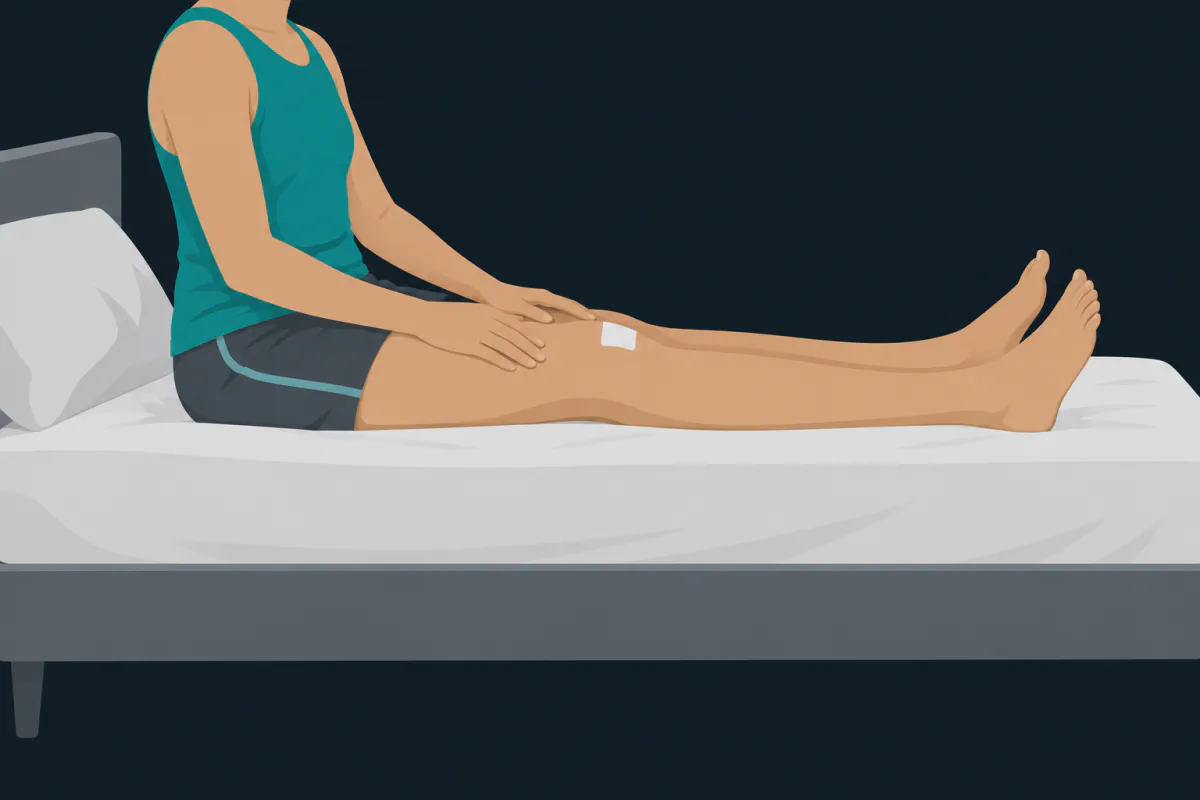
You are lying on the bed a few days after surgery, told to tighten the thigh and press the back of the knee down, and nothing happens. The muscle looks flat, the kneecap does not move, and lifting the straight leg either fails or the knee sags on the way up. This article covers why the quadriceps behaves like that, what the early exercises are trying to do about it, and what the research says about the equipment sometimes used alongside them.
Your physiotherapist’s programme and your surgeon’s restrictions come first; what follows is background, not a set of exercises to start on your own.
The muscle is not broken, it is turned down
What you are running into has a name: arthrogenic muscle inhibition, usually shortened to AMI. It means the nervous system is limiting how much of the quadriceps you can voluntarily switch on, because of what has happened to the joint underneath it. The muscle fibres themselves are intact. The signal telling them to contract is being held back.
Rice and McNair, in a review of the neural mechanisms, describe AMI as the result of altered discharge from the sensory receptors in and around the joint. Swelling, inflammation, pain, laxity and damage to the joint’s own nerve endings all change what the knee is reporting upwards, and several spinal reflex pathways then reduce the drive reaching the muscle. It is an ordinary protective response that happens to be unhelpful after a planned operation.
The most direct demonstration of one part of this is old and simple. Spencer and colleagues infused saline into the knees of healthy volunteers and measured the quadriceps reflex response as the volume rose. As the joint filled, the reflex response fell. Fluid inside a joint reduces the nervous system’s willingness to drive the muscle across it, without anything being wrong with the muscle.
That said, fluid is not the whole story, which matters because people often expect the quadriceps to come back the moment the knee looks normal again. Pain, inflammation and the surgery itself all contribute, and inhibition is commonly described as persisting after the obvious swelling has settled.
Why so much of early rehabilitation is aimed at it
Early protocols spend what can feel like a disproportionate amount of time on a muscle contraction you cannot see. Noyes’ Knee Disorders sets out the reasoning that most programmes follow: restoring quadriceps activation belongs in the earliest phase, alongside controlling swelling and protecting full extension, rather than being something strength work catches up on later.
The practical reason is that the quadriceps is what holds the knee straight when you stand on it. A thigh that will not fire produces an extension lag, where the knee can be straightened passively by someone else but not held straight by you, and a wobbly, guarded walking pattern that then has to be unlearned.
The longer-term reason is what the strength deficits look like months afterwards. Lepley’s review of quadriceps strength at the point people are cleared to return to activity found side-to-side deficits persisting at that stage, and linked them to altered lower limb mechanics and lower self-reported function; return criteria commonly ask for a difference of no more than about 10% between legs. Those figures describe the end of rehabilitation rather than the first fortnight, but they are the reason the first fortnight is treated as it is.
What the early exercises are trying to do
The consensus guideline from van Melick and colleagues, drawn up by a Dutch multidisciplinary group, sets out the first postoperative phase around reducing swelling and pain, regaining full extension, restoring quadriceps activation and normalising gait. For the quadriceps specifically it suggests beginning isometric quadriceps exercises in the first week where they cause no pain, and it rates electrical stimulation as useful for re-educating voluntary contraction of the quadriceps in those first weeks.
An isometric quadriceps exercise, often called a quad set, is the plainest thing in the programme: the leg is straight, the thigh is tightened so the kneecap pulls upwards, the contraction is held for a few seconds, and nothing moves. Straight leg raises usually come next, and the point at which the knee stops sagging during one is a landmark physiotherapists watch for. How many, how often and how soon are decisions for the person supervising you, and they differ depending on the graft, any meniscal repair and your weight-bearing instructions.
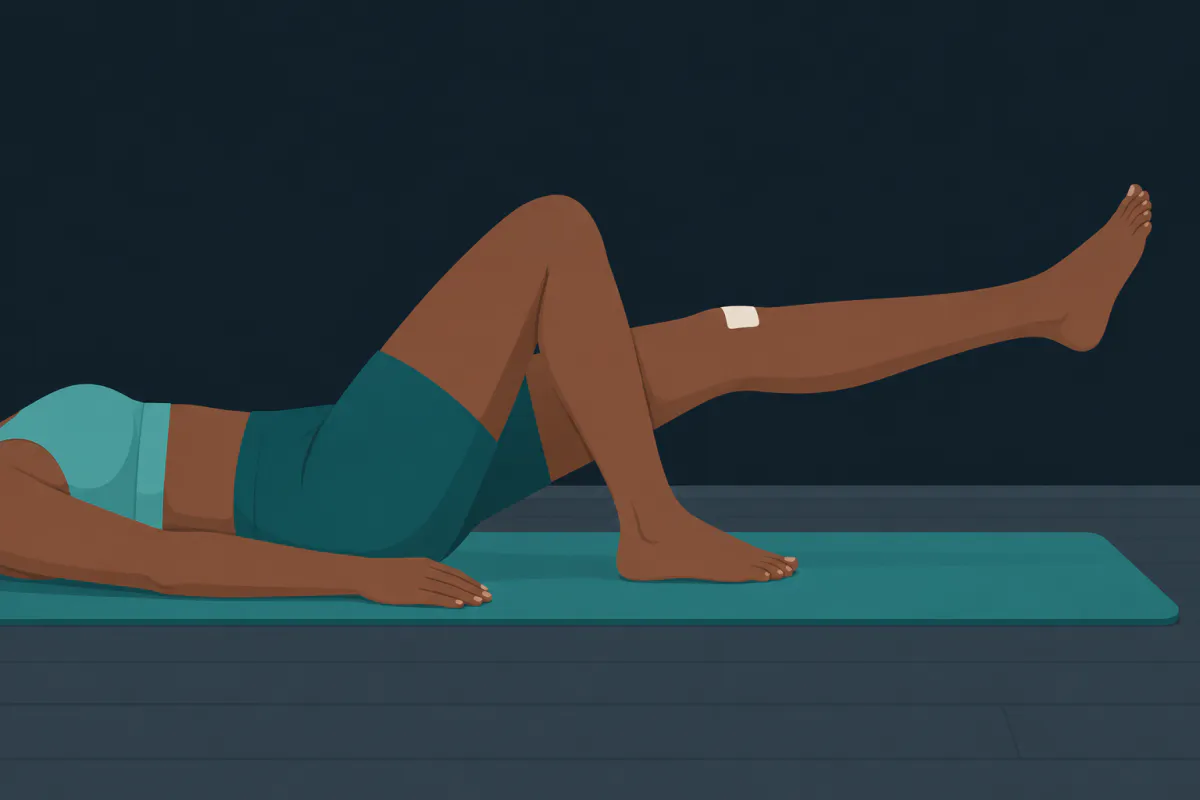
Two things tend to make a quad set easier, and both are ordinary parts of early protocols. One is doing it with the knee properly straight rather than resting on a pillow, which is also how extension is protected. The other is having the swelling and pain under some control first, which is the practical overlap between the icing instructions and the muscle work.
That overlap has been tested directly, though in an artificial setting. Rice, McNair and Dalbeth infused fluid into the knees of sixteen healthy volunteers until the pressure inside reached a set level, and applied ice to the knee of half of them for twenty minutes. Quadriceps torque dropped in everyone after the infusion, and recovered significantly more in the group that had been iced. That is an experimental model in uninjured knees, not a trial in post-surgical patients, so it supports the idea that cooling reduces inhibition rather than telling you how much difference it makes after a reconstruction.
What electrical stimulation does and does not do
Neuromuscular electrical stimulation, or NMES, uses electrodes on the thigh to make the quadriceps contract whether or not you can produce the contraction yourself. It is usually applied in the clinic rather than at home, and the settings used differ a great deal between studies and between clinics.
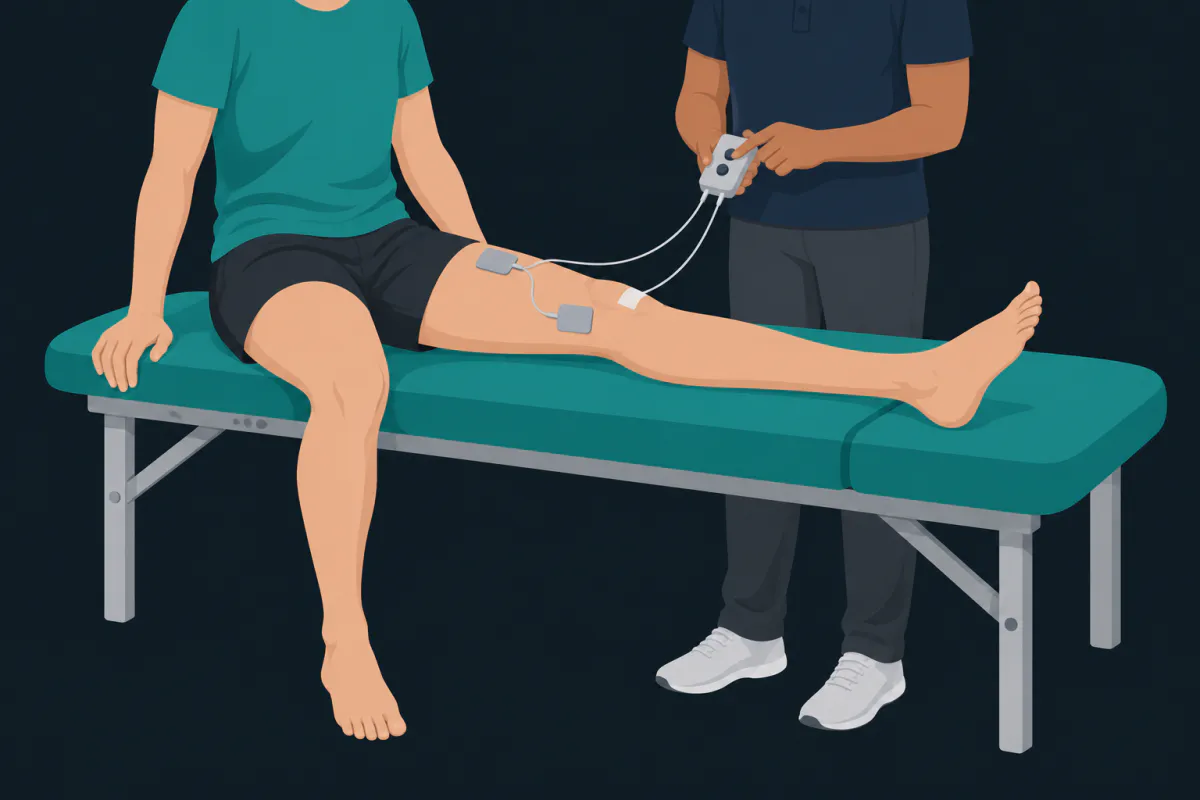
The evidence is reasonably consistent for strength and thinner for everything else. Kim and colleagues reviewed eight randomised trials in people after ACL reconstruction and concluded that NMES combined with exercise may be more effective for quadriceps strength than exercise alone, while its effect on functional performance and patient-reported outcomes was inconclusive; they also noted that the stimulation settings varied considerably between trials. A more recent meta-analysis by Li and colleagues pooled eleven trials, about four hundred patients in total, and found greater quadriceps strength with NMES added to standard physiotherapy at both under and over six weeks of follow-up, with no difference on one common knee function score.
Read together, that is a useful addition to rehabilitation rather than a replacement for it. Every one of those trials added stimulation to exercise; none of them replaced the exercise with it. Whether it is offered to you depends on your clinic’s equipment and your physiotherapist’s judgement, which makes it a reasonable thing to ask about if your quadriceps is slow to respond.
Weakness that is worth reporting
Inhibition after this operation is expected. Some other things are not, and the NHS recovery guidance lists the standard warning signs: a calf that is hot, red, swollen or painful, or new shortness of breath or chest pain, which can indicate a blood clot; spreading redness at the incision, discharge from the wound or a fever; new weakness or numbness in the foot; and a knee that locks and cannot be moved. Those need same-day contact with your surgical team, your GP or an urgent care service. A knee that had been improving and then loses movement or strength over a few days is also worth a call rather than a wait.
Logging the early quad work
If you use ACL Recovery Tracker, an isometric quadriceps contraction is one of the exercises in the level 1 session, with a timer for the hold and set logging for what you actually completed, so an early week of sessions where the contraction was weak is recorded rather than remembered. The pain diary sits alongside it, which is useful here because pain and inhibition travel together and your physiotherapist will want to see both. It is a free ACL rehab app for iOS and Android, and you can use it alongside whatever your physiotherapist adds, stimulation included.
The unsatisfying part of this stage is that the work looks like nothing and feels like less. Quadriceps activation tends to return gradually over the early weeks as the swelling and pain settle, and the first sign is usually mundane: the kneecap moves when you tighten the thigh, and the leg comes up without the knee dropping.
The illustrations in this article were generated with AI.
Sources
- Rice DA, McNair PJ. Quadriceps arthrogenic muscle inhibition: neural mechanisms and treatment perspectives. Semin Arthritis Rheum. 2010;40(3):250-266.
- Spencer JD, Hayes KC, Alexander IJ. Knee joint effusion and quadriceps reflex inhibition in man. Arch Phys Med Rehabil. 1984 Apr.
- van Melick N, et al. Evidence-based clinical practice update: practice guidelines for anterior cruciate ligament rehabilitation based on a systematic review and multidisciplinary consensus. Br J Sports Med. 2016;50:1506-1515.
- Kim KM, Croy T, Hertel J, Saliba S. Effects of neuromuscular electrical stimulation after anterior cruciate ligament reconstruction on quadriceps strength, function, and patient-oriented outcomes: a systematic review. J Orthop Sports Phys Ther. 2010;40(7):383-391.
- Li Z, et al. Effects of neuromuscular electrical stimulation on quadriceps femoris muscle strength and knee joint function in patients after ACL surgery: a systematic review and meta-analysis of randomized controlled trials. Orthop J Sports Med. 2025.
- Rice D, McNair PJ, Dalbeth N. Effects of cryotherapy on arthrogenic muscle inhibition using an experimental model of knee swelling. Arthritis Rheum. 2009;61(1):78-83.
- Lepley LK. Deficits in quadriceps strength and patient-oriented outcomes at return to activity after ACL reconstruction: a review. Sports Health. 2015;7(3):231-238.
- Noyes FR, Barber-Westin SD, eds. Noyes' Knee Disorders: Surgery, Rehabilitation, Clinical Outcomes. 2nd ed. Elsevier; 2017.
- NHS. ACL (anterior cruciate ligament) surgery: recovering.