The guide · Early recovery, Pain and swelling
Numbness beside the scar after ACL surgery
Why a patch of skin below the kneecap stops feeling after ACL reconstruction, how common it is by graft and incision, and how long it usually lasts.
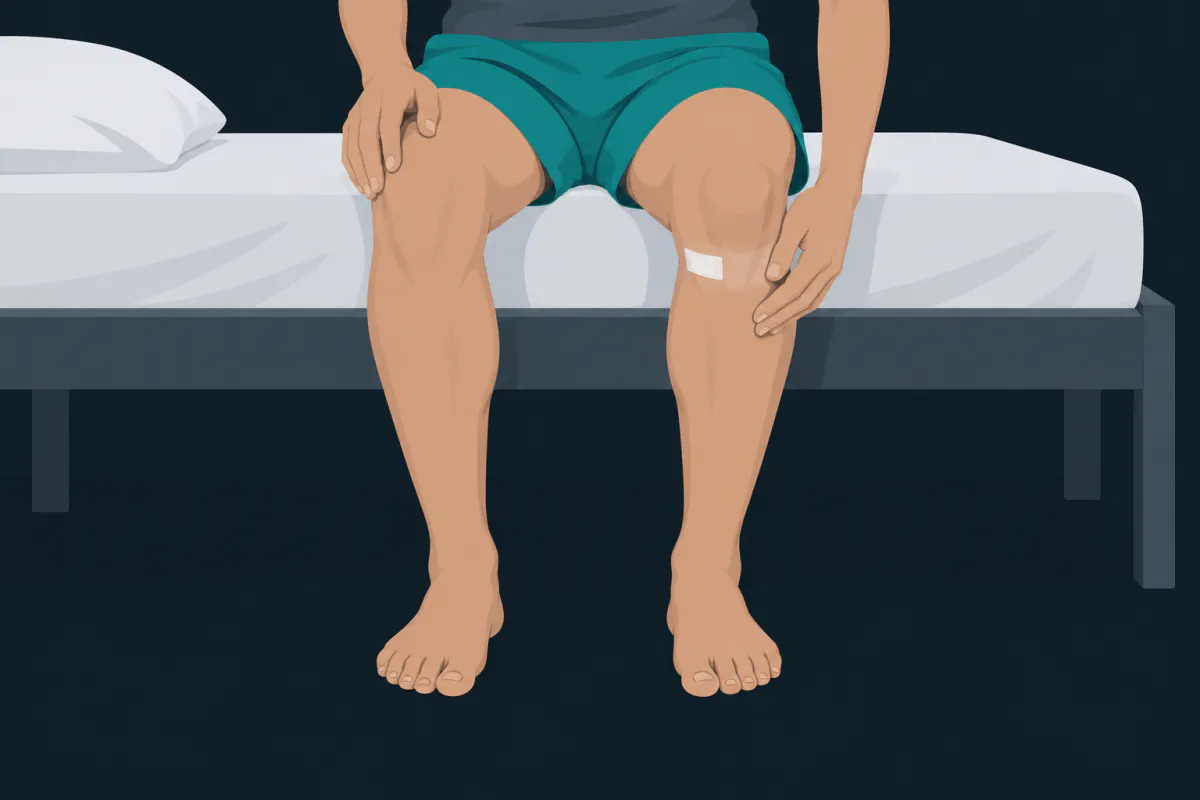
Somewhere in the first days or weeks after ACL reconstruction, most people find a patch of skin near the scar that no longer feels like skin. Touch it and the sensation is dull, distant, or oddly like being touched through a layer of cloth. This article covers which nerve is responsible, how common the numbness is, how long it usually lasts, and how it differs from the numbness that does need reporting.
Anything new about your own knee is a question for your surgeon and physiotherapist, and their answer comes first. If a nerve block was used for the operation, numbness in the first day or two may still be the block wearing off, and how long that takes is something to ask the team who gave it.
The nerve that lies across the operation
Getting to the knee means working through its anteromedial side — the front and inner aspect — and that is exactly where a small sensory nerve runs. The infrapatellar branch of the saphenous nerve crosses below the kneecap on its way to the skin over the front and outer part of the upper shin. It is purely sensory: it reports touch and temperature and does nothing for any muscle. Damaging it costs feeling, not strength.
It is also difficult to avoid. Kerver and colleagues dissected the branch in twenty embalmed knees and mapped it with a computer-assisted surgical anatomy tool, looking for somewhere safe to cut. Their finding was that the nerve’s course varies enough between people that no definite safe zone could be identified. What they could describe were three relatively low-risk zones, and the point that the nerve’s direction depends on where you cross it, so an incision should run parallel to it where that is technically possible. Longitudinal incisions, which cut across its path, were the most likely to catch it.
That is the entire explanation for a numb patch. It is not a sign that the graft is loose, that the operation went badly, or that something is pressing on a nerve. It is skin whose wiring ran through the site the surgeon had to open.
How common it is depends on the graft and the incision
Common enough that its absence is the surprise. The reported rates vary with how hard the researchers looked, which graft was taken, and how the skin was opened.
Grassi and colleagues pooled the studies comparing incision techniques for hamstring tendon harvest and found the shape of the cut mattered. Compared with a horizontal incision, a vertical one carried an odds ratio of 2.4 (95% confidence interval 1.5 to 3.6) for injury to the branch; a horizontal incision in turn carried an odds ratio of 1.8 (1.2 to 2.8) compared with an oblique one. Vertical was worst, oblique best, which is consistent with the anatomy above. That is a decision taken in theatre rather than something rehabilitation can change.
Graft choice matters too. Haviv and colleagues followed 94 people who had a primary reconstruction with either a bone-patellar-tendon-bone or a hamstring autograft, at a mean of 23 months afterwards. Reduced sensation was reported by 77% of the patellar tendon group and 58% of the hamstring group. In a companion paper on the patellar tendon patients from the same series, the infrapatellar branch was the region most often involved, 35 of the 60 patients still had some loss of sensation at final follow-up, and the authors noted that the sensory loss did not impair normal daily activities in those patients.
How long it lasts
The honest answer is months for many people, permanently for a substantial minority, and usually smaller either way than it was at the start.
Egerci and colleagues reviewed 159 people after hamstring-graft reconstruction at a single centre. Signs of saphenous nerve injury were present after surgery in 87 of them (54.7%). Pins and needles had resolved in 36 patients — 22.6% of the whole group — after an average of 11.1 months. In 51 (32.1%) the deficit was still there at least two years later. That study also found that the people whose injury persisted scored lower on the Lysholm knee score and reported more effect on daily activities than those who recovered or were never affected, so it is not a purely cosmetic matter. It was retrospective, from one centre, and counted the neighbouring sartorial branch as well as the infrapatellar one.
Full recovery does happen, but it is the minority: in the Haviv series a quarter of the affected patients regained normal sensation, on average seven to eight months after surgery. Worth knowing is that none of the studies here tested a treatment for the numbness. They describe what happens to it, which is a different thing from telling you what to do about it.
What numb skin changes day to day
Mostly nothing, which is why it reads as a footnote in the research. Two practical consequences are worth thinking about, and neither is a medical instruction.
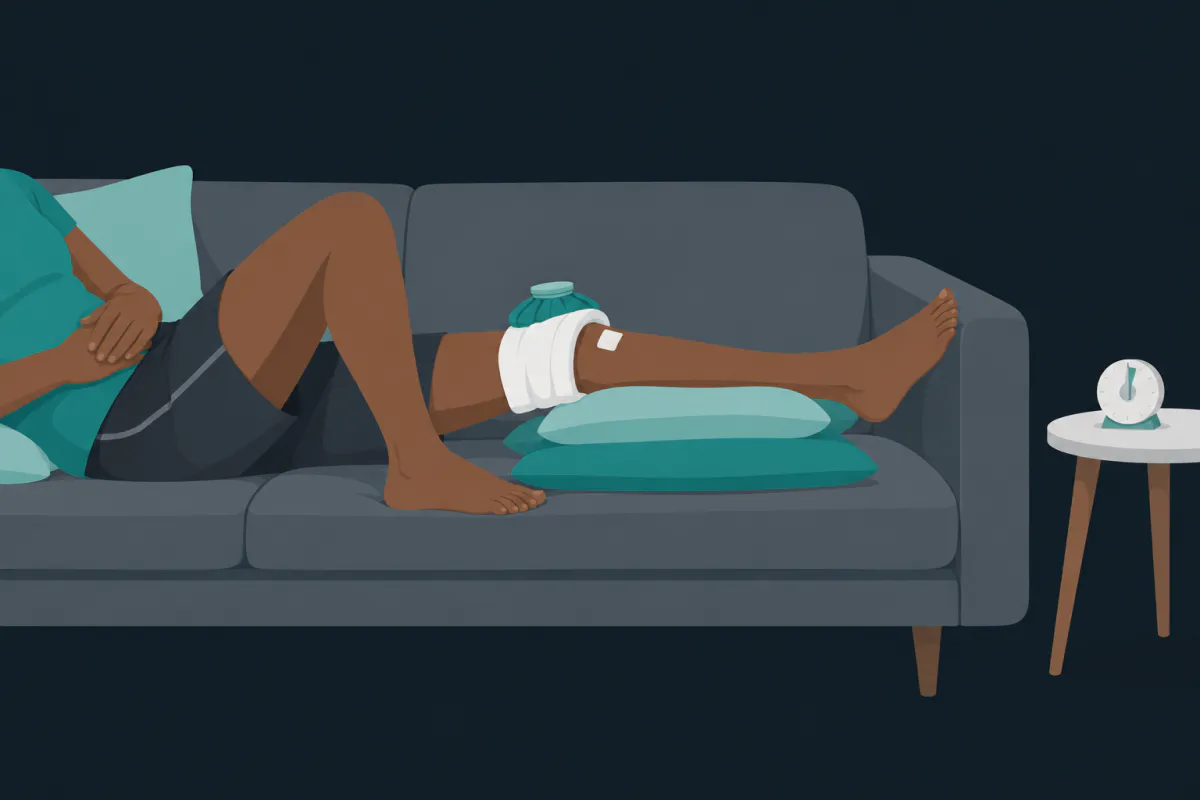
The first is that skin which cannot feel cold cannot warn you that an ice pack has been on too long. Icing is heavily used in the first fortnight — the swelling article covers what it is for — and the usual advice about a barrier between ice and skin and a time limit matters more over a patch that has stopped reporting. The same logic applies to very hot water and to a razor.
The second is that numbness and pain are not alternatives. Egerci and colleagues describe neuropathic pain and painful neuroma among the ways this nerve injury shows up, so a patch that is both numb to light touch and sharply tender when pressed is a normal pattern rather than a contradiction, and a reasonable thing to raise at an appointment rather than tolerate silently.
When numbness is not this
The expected numbness is local and sensory: a patch beside or below the scar, over the front and outer side of the knee and upper shin, with normal strength everywhere. Numbness with weakness, or numbness in the whole foot, is a different thing.
The NHS recovery guidance lists the standard warning signs after this surgery: a calf that is hot, red, swollen or painful; a fever with spreading redness or discharge at the incision; new weakness or numbness in the foot; a knee that locks and will not move. Any of those means contacting your surgical team, your GP or an urgent care service the same day. Numbness that appears suddenly having not been there, or that is spreading rather than shrinking, belongs in the same conversation.
Where this sits in your rehab
Numbness belongs to the weeks ACL Recovery Tracker covers with Levels 0 to 2 — crutches and gait drills, early recovery, progressive strengthening — and the useful thing about those levels is what their criteria do not mention. Level 1 asks for at least 90 degrees of flexion, walking without a limp, minimal swelling and pain no higher than 5 out of 10; Level 2 asks for 125 degrees and full extension with no swelling. Sensation is not among them, because rehabilitation progresses on range, effusion (fluid inside the joint), strength and control — the criterion-based structure set out in Noyes’ Knee Disorders and in the consensus guideline from van Melick and colleagues. The app has no field for a numb patch, for the same reason. What it does have is a pain diary with a body map, a 0 to 10 score and a notes field, which is where a tender spot beside the scar can be recorded so that the pattern over a fortnight is described at your follow-up rather than remembered. It is a free ACL recovery app for iOS and Android.
A numb patch is the part of this operation nobody mentions beforehand and almost everybody notices afterwards. In the research it is recorded, counted and then left alone, which is close to how it tends to feel in the end: it does not slow the knee down, and the work that decides how this year goes is happening in the quadriceps and the last few degrees of extension.
The illustrations in this article were generated with AI.
Sources
- Kerver AL, Leliveld MS, den Hartog D, Verhofstad MH, Kleinrensink GJ. The surgical anatomy of the infrapatellar branch of the saphenous nerve in relation to incisions for anteromedial knee surgery. J Bone Joint Surg Am. 2013;95(23):2119-2125.
- Grassi A, Perdisa F, Samuelsson K, et al. Association between incision technique for hamstring tendon harvest in anterior cruciate ligament reconstruction and the risk of injury to the infra-patellar branch of the saphenous nerve: a meta-analysis. Knee Surg Sports Traumatol Arthrosc. 2018;26:2410-2423.
- Haviv B, Bronak S, Rath E, Yassin M. Nerve injury during anterior cruciate ligament reconstruction: a comparison between patellar and hamstring tendon grafts harvest. Knee. 2017;24(3):564-569.
- Haviv B, Yassin M, Rath E, Bronak S. Prevalence and clinical implications of nerve injury during bone patellar tendon bone harvesting for anterior cruciate ligament reconstruction. J Orthop Surg (Hong Kong). 2017;25:2309499016684988.
- Egerci OF, Dogruoz F, Asoglu MM, Ertan MB, Yapar A, Kose O. The prognosis of iatrogenic saphenous nerve injuries during hamstring tendon harvesting in anterior cruciate ligament reconstruction. J Orthop Surg Res. 2024;19(1):428.
- van Melick N, et al. Evidence-based clinical practice update: practice guidelines for anterior cruciate ligament rehabilitation based on a systematic review and multidisciplinary consensus. Br J Sports Med. 2016;50:1506-1515.
- Noyes FR, Barber-Westin SD, eds. Noyes' Knee Disorders: Surgery, Rehabilitation, Clinical Outcomes. 2nd ed. Elsevier; 2017.
- NHS. ACL (anterior cruciate ligament) surgery: recovering.