The guide · Pain and swelling, Mindset
Normal soreness or a setback in ACL rehab?
How to tell ordinary soreness after a rehab session from a knee reacting badly, what swelling adds, and which signs get reported the same day.
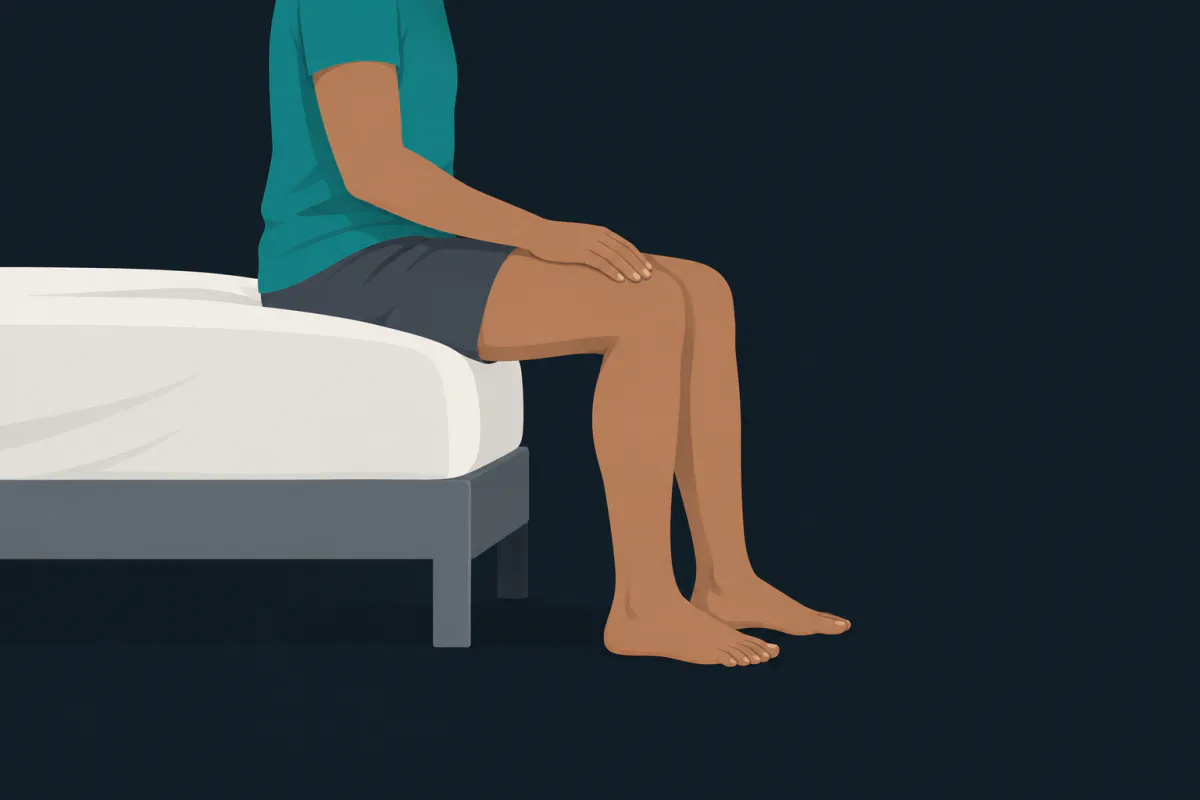
Rehabilitation after an ACL reconstruction is meant to be uncomfortable some of the time, which is exactly what makes the ordinary sort of discomfort hard to tell apart from the sort that means something has gone wrong. This article is about that distinction: what soreness after a session usually looks like, what swelling adds to the picture, and which signs are not for interpreting at home at all.
Where the line sits for your own knee is a question for your physiotherapist and surgeon, and their answer beats anything here. They have had their hands on it. What follows is general information about patterns, not a verdict on a particular bad week.
What ordinary soreness looks like
The familiar version is delayed onset muscle soreness, usually shortened to DOMS: the ache that follows unfamiliar or heavier work, particularly the part of a movement where the muscle lengthens under load. Cheung and colleagues’ review in Sports Medicine describes its course. Discomfort builds over the first day after exercise, peaks somewhere between 24 and 72 hours, then fades and has usually gone within five to seven days. It arrives with a temporary drop in range of motion and strength, along with stiffness and tenderness — which is why a knee can measure worse two days after a productive session than it did before it.
Three features make this kind recognisable. It sits in the muscle rather than inside the joint: the front of the thigh, the hamstrings, the calf. It is tender when you press on it. And it follows something new — the first session at a new level, more sets than last week, an exercise added, or the first time an exercise was done with real effort.
That last point matters more after this operation than after ordinary training. The quadriceps starts out inhibited, and a muscle in that state gets sore on loads it would once have shrugged off; why it switches off is its own subject.
Swelling carries more weight than pain
Swelling inside the knee — an effusion, meaning fluid within the joint itself — is read differently from muscle soreness, because it reports on the joint rather than on the muscles around it. It is also what most rehabilitation programmes gate progress on. Adams and colleagues set out a criterion-based progression after ACL reconstruction in which impairments including effusion are checked before a patient moves to the next stage, instead of the calendar deciding. The consensus guideline from van Melick and colleagues is built the same way, with a prehabilitation phase and then three criterion-based phases after surgery: impairment-based, sport-specific training, and return to play. The same reasoning runs through the phase structure described in Noyes’ Knee Disorders.
Physiotherapists do not just eyeball it. The stroke test, sometimes called the sweep test, involves stroking fluid upward from the inside of the knee towards the pouch above the kneecap, then downward on the outside of the thigh, and watching how much comes back. Sturgill and colleagues tested a five-point version of this scale on 75 patients in an outpatient clinic: pairs of therapists agreed on the grade 73 per cent of the time, with a kappa of 0.75, which is good enough to treat as a measurement rather than an impression.
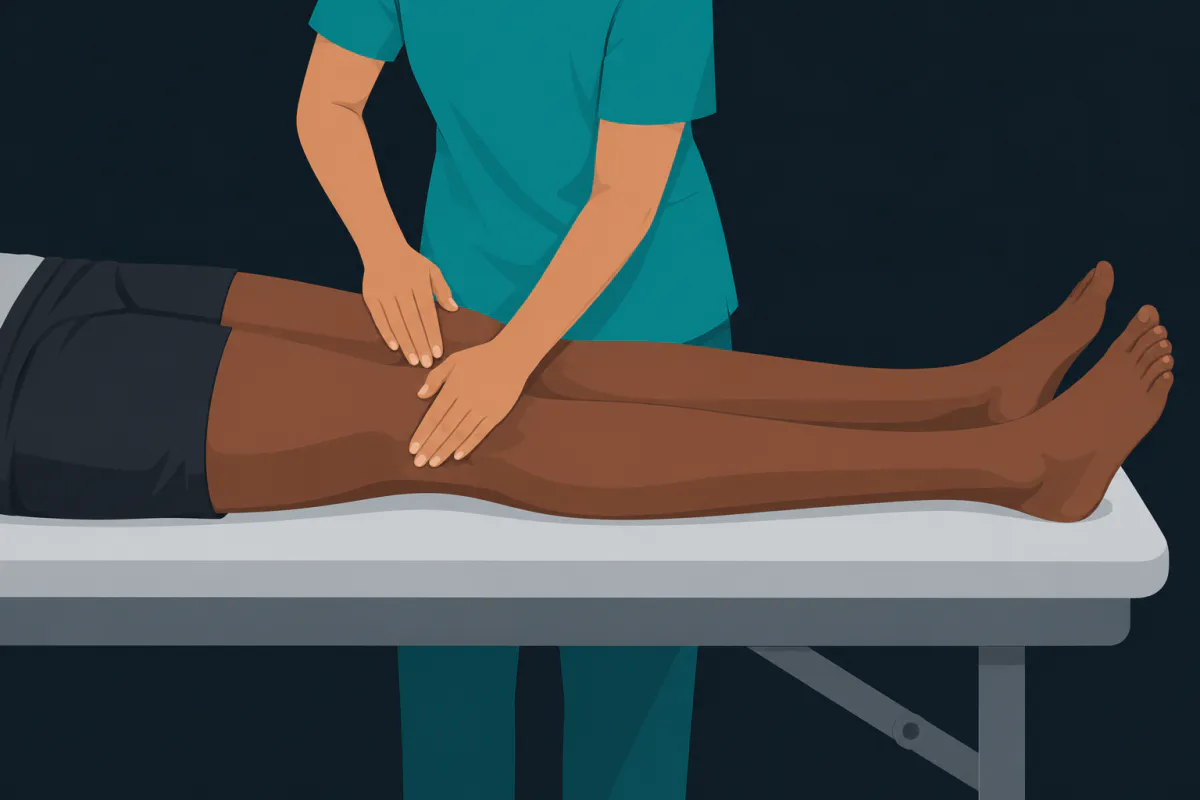
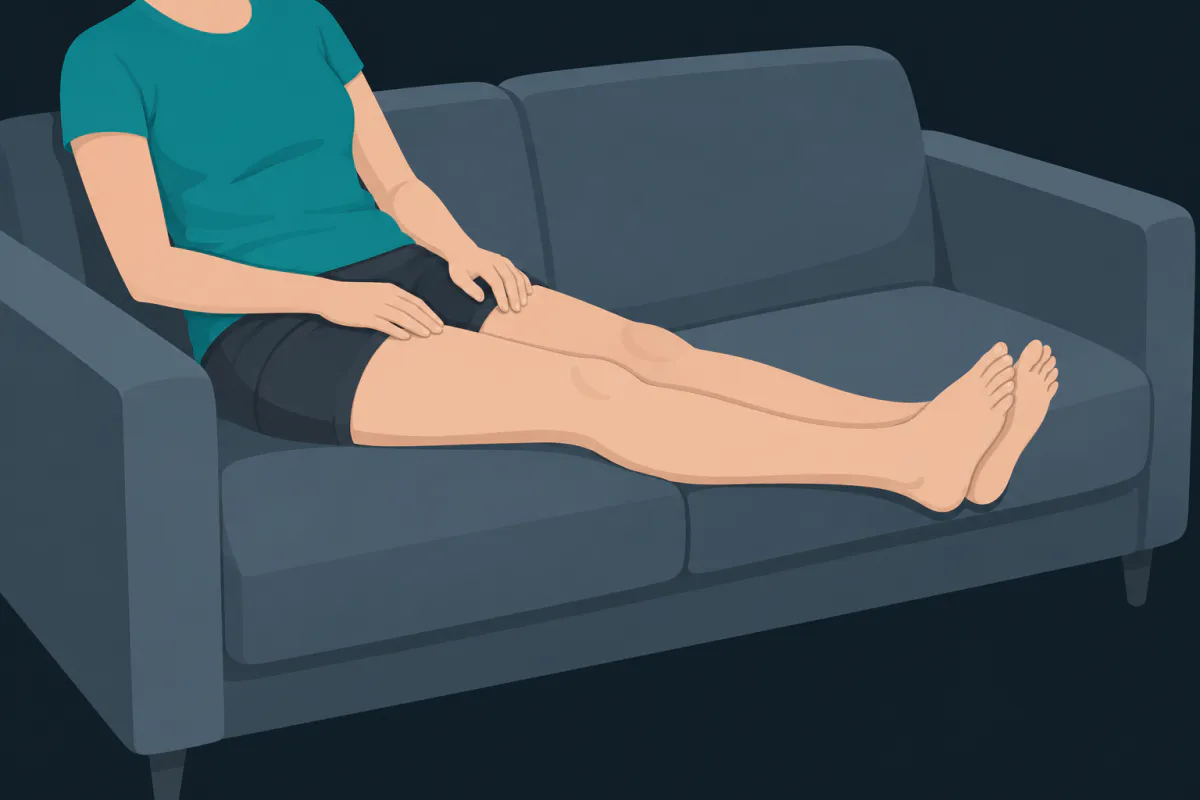
In practice, a knee that feels warmer, tighter and fuller than the other one on the morning after a session was loaded with more than it could absorb. That is not an injury in itself and not a reason to panic. It is information about the dose.
The questions a physiotherapist asks
Before reaching for these, one honest caveat. The 2023 Aspetar clinical practice guideline, led by Kotsifaki and colleagues, reviewed the evidence behind ACL rehabilitation and concluded that although return to running and return to training are key milestones, there is no evidence on which progression or discharge criteria should be used. The familiar figures — pain under a certain score, no swelling after exercise, settling within a day — are clinical convention and consensus, not thresholds that trials have validated. They are still the best available, and they are how a clinician thinks:
- Has it settled? Ordinary soreness is a curve: worse for a day or two, then steadily better. Discomfort that is the same or worse three or four days later is behaving differently.
- Muscle or joint? Soreness you can find with a thumb, in a muscle, on both sides of an exercise you did with both legs, reads differently from a deep ache inside the knee.
- Did the swelling change? A knee that is visibly fuller the next morning, and stays that way, is the most useful single observation you can bring to an appointment.
- Did the straightening go backwards? The last few degrees of extension are the measurement protocols watch most closely, and losing them is treated more urgently than an ache. The longer account is in why won’t my knee straighten.
- Did something happen? A pop, a shift, the knee giving way, a twist or a fall is an event rather than a symptom. Events get reported regardless of how they feel afterwards.
None of that is a self-discharge test. What it does is turn “my knee felt bad on Tuesday” into something a physiotherapist can act on.
What gets reported the same day
A few things are not for sorting out at home, and they are worth knowing by heart because they can be mistaken for a rough rehabilitation week:
- a calf that is hot, red, swollen or painful
- a fever, with redness spreading from the incision or discharge coming from it
- new weakness or numbness in the foot
- a knee that locks and will not move
Any of those means contacting your surgical team, your GP or an urgent care service the same day rather than waiting for the next appointment. The NHS lists the same set for people recovering from this surgery.
The conditions behind them are uncommon, which is the argument for making the call rather than sitting with it. Bokshan and colleagues looked at 9,146 ACL reconstructions and found 46 patients, 0.5 per cent, with a deep vein thrombosis and 8, 0.1 per cent, with a pulmonary embolism. For infection inside the joint, Kraus Schmitz and colleagues linked 26,014 reconstructions in the Swedish Knee Ligament Registry to national health records and identified 298 events of septic arthritis, 1.1 per cent, counted from diagnosis codes and antibiotic prescriptions in the first 90 days after surgery. Small numbers, and both are treatable when they are found early.
Where the app fits
Pain and swelling are written into the progression criteria of ACL Recovery Tracker rather than left to judgement: Level 1 asks for no more than 5 out of 10 and minimal swelling compared with the other side, Level 2 for no more than 3 and no swelling, Level 3 for none and no swelling after exercise, and Level 10 for no swelling confirmed by a stroke test. What our free ACL rehab app for iPhone and Android is useful for in this topic is the record those judgements need: the pain diary takes a 0 to 10 score with the location on a body map, whether it hurts at rest, during exercise, in the morning or at night, and a note on what brought it on, while each set you log during a session carries its own pain score, so the exercise the knee objects to can be picked out of the list.
Most bad days in ACL rehabilitation turn out to be the ordinary kind: a session that asked for slightly more than the knee was ready for, answered by a quieter day and a smaller dose next time. Telling those from a real setback takes a particular sort of patience — waiting the two or three days it takes for soreness to declare itself, and looking at the knee rather than only feeling it. The handful of things that genuinely cannot wait are short enough to memorise, and none of them are subtle.
The illustrations in this article were generated with AI.
Sources
- Cheung K, Hume PA, Maxwell L. Delayed onset muscle soreness: treatment strategies and performance factors. Sports Med. 2003;33(2):145-164.
- Adams D, Logerstedt DS, Hunter-Giordano A, Axe MJ, Snyder-Mackler L. Current concepts for anterior cruciate ligament reconstruction: a criterion-based rehabilitation progression. J Orthop Sports Phys Ther. 2012;42(7):601-614.
- Sturgill LP, Snyder-Mackler L, Manal TJ, Axe MJ. Interrater reliability of a clinical scale to assess knee joint effusion. J Orthop Sports Phys Ther. 2009;39(12).
- Kotsifaki R, et al. Aspetar clinical practice guideline on rehabilitation after anterior cruciate ligament reconstruction. Br J Sports Med. 2023.
- Bokshan SL, DeFroda SF, Panarello NM, Owens BD. Risk factors for deep vein thrombosis or pulmonary embolus following anterior cruciate ligament reconstruction. Orthop J Sports Med. 2018.
- Kraus Schmitz J, Lindgren V, Edman G, Janarv PM, Forssblad M, Stålman A. Risk factors for septic arthritis after anterior cruciate ligament reconstruction: a nationwide analysis of 26,014 ACL reconstructions. Am J Sports Med. 2021.
- van Melick N, et al. Evidence-based clinical practice update: practice guidelines for anterior cruciate ligament rehabilitation based on a systematic review and multidisciplinary consensus. Br J Sports Med. 2016;50:1506-1515.
- Noyes FR, Barber-Westin SD, eds. Noyes' Knee Disorders: Surgery, Rehabilitation, Clinical Outcomes. 2nd ed. Elsevier; 2017.
- NHS. ACL (anterior cruciate ligament) surgery: recovering.