The guide · Progression, Daily life
Rest days in ACL rehab: why they are part of the plan
Rest days are part of ACL rehab: muscles gain from recovery, and Delaware's running plan never runs two days in a row. Walking and icing usually carry on.
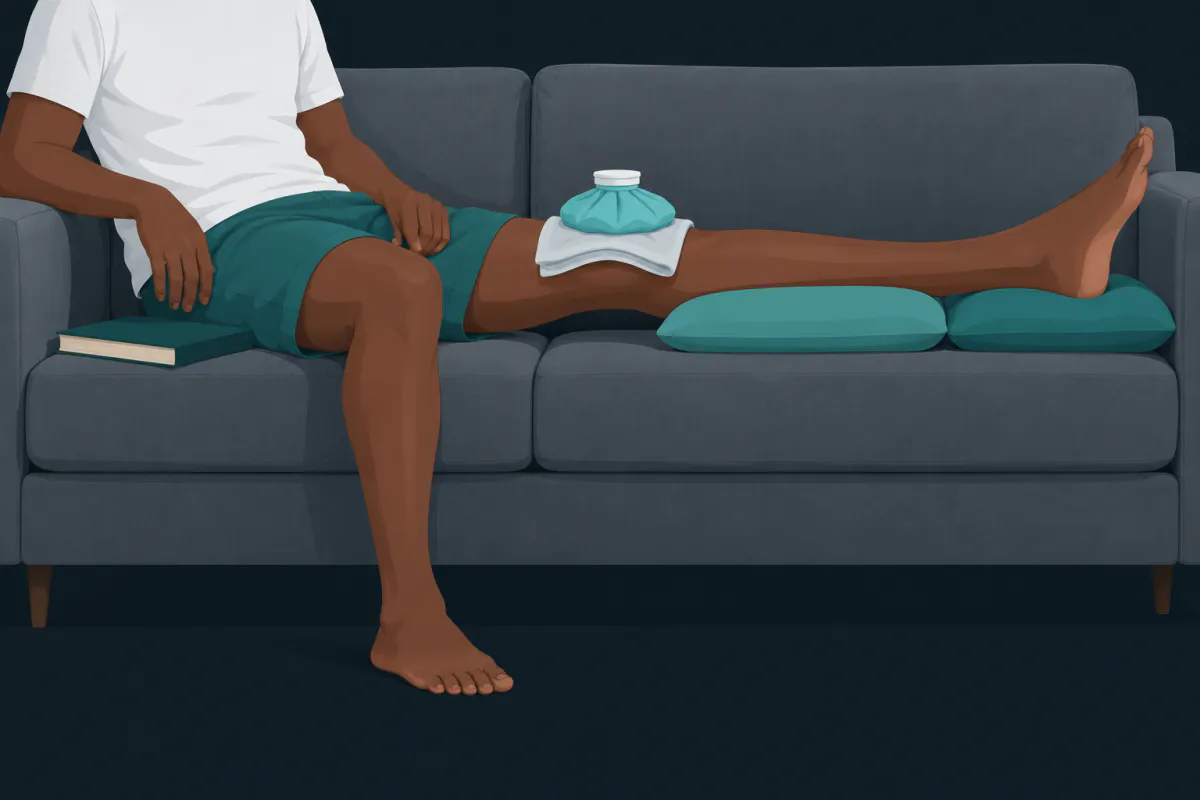
The short answer: a rest day is part of an ACL rehabilitation programme, not a break from it. Muscles get stronger from the load of a session and the recovery after it, which is why the American College of Sports Medicine recommends strength training two to three days a week for people new to it, and why the University of Delaware’s running progression after ACL reconstruction allows running no more than four times a week and never on two days in a row. A rest day is rarely a day in bed: walking, keeping the swelling down and the knee’s daily movement usually carry on. How many days you train and which ones are set by your physiotherapist and surgeon, and their plan comes first; this article explains the reasoning behind the days off.
Why recovery counts as training
Strength work is meant to tire a muscle more than daily life does, and the muscle adapts in the days after the session rather than during it. For healthy adults, the American College of Sports Medicine’s position stand on resistance training recommends two to three training days a week for beginners, three to four for people with about six months of regular training, and four to five for the experienced. The position stand is written for healthy adults rather than people after surgery, and ACL programmes set their own numbers, as the next section shows.
Soreness is part of the same picture. Cheung and colleagues’ review of delayed onset muscle soreness, the ache after unfamiliar or heavier work, describes it building over the first day, peaking between 24 and 72 hours and fading within five to seven days, with a temporary loss of strength and range of motion along the way. A muscle in that state is weaker for a while, which is one reason hard sessions are spaced out rather than repeated the next morning.
Taking days off does not seem to cost strength, as long as the week’s work gets done. Grgic and colleagues pooled 22 studies comparing how often people trained. More frequent training gave larger strength gains overall, but when the total amount of weekly work was the same, the number of sessions it was split into made no significant difference. Most participants were healthy adults new to strength training, not people after knee surgery, so the finding describes muscles in general rather than a reconstructed knee. It still answers a common worry: a rest day between two sessions does not undo the first one.
Rest days written into ACL protocols
Rehabilitation programmes after ACL reconstruction build the same spacing in, and some of them say so in plain numbers. The criterion-based progression from the University of Delaware, published by Adams and colleagues, gives several:
- the running progression is done no more than four times in a week, no more often than every other day, and moves up no more than two levels in seven days;
- a running level is only passed once it can be done without more swelling or pain;
- electrical stimulation of the quadriceps, where it is used, runs three sessions a week.

The same paper reproduces a set of soreness rules, originally written for athletes returning to weight training, in which a day off is a response to how the knee answered the last session. Soreness the day after lifting, other than ordinary muscle soreness, means one day off and no move to the next level. Soreness during the warm-up that does not go away, or that goes away and then returns during the session, means two days off and a step down a level. These rules are used under a physiotherapist’s guidance, and the difference between ordinary soreness and a setback has its own article.
The Delaware programme also checks swelling inside the joint, an effusion, with a stroke test before a patient moves on. A knee that is fuller the morning after a session is one reason a programme spaces the hard days out in the first place.
What a rest day usually looks like
In the first weeks after surgery, a day without a training session is still a day with things to do. The NHS recovery guidance asks people to get up and walk around as their physiotherapist advises, to lower the risk of a blood clot, to keep the leg raised when resting, and to use an ice pack for 15 to 20 minutes every two to three hours to bring swelling down. None of that stops on a day off. The movement work your physiotherapist gave you, such as the exercises for getting the knee fully straight, may well be meant for every day even when the strengthening is not, because it is a different kind of work; your programme says which.
Later in rehabilitation, when sessions are longer and harder, a rest day is more clearly a day off. The reasoning above leads to a few general points, which your physiotherapist may adjust for you:
- Spacing matters. Three sessions spread across a week leave a day between each; three on consecutive days do not.
- A missed session is not doubled. Two hard sessions back to back remove the recovery the plan was built around.
- Light activity is usually fine. Walking and ordinary daily life are not what a rest day is meant to avoid. Whether cycling, swimming or anything else counts as rest in your programme is a question for your physiotherapist.

The Dutch clinical practice guideline by van Melick and colleagues recommends that rehabilitation lasts 9 to 12 months, passed on criteria rather than dates. Over that length of time, a rest day spent recovering is worth more than a session squeezed in on a knee that has not settled.
When rest is not the answer
A rest day is for a knee that is responding normally to its training. It is not the way to manage a knee that is getting worse. Swelling that stays up for days, a knee that has lost some of its straightening, or soreness that is no better after two or three days are worth raising with your physiotherapist rather than resting through.
Some signs need contact the same day: a calf that is hot, red, swollen or painful; a fever with spreading redness at the incision or discharge from it; new weakness or numbness in the foot; or a knee that locks and will not move. Any of those means calling your surgical team, your GP or an urgent care service, not waiting for the next appointment.
Where the app fits
Our free ACL rehab app, ACL Recovery Tracker for iOS and Android, lets you choose the training days for each workout on your current level’s screen. On Levels 1 and 2 the main session is daily by default, and you can switch days off for real rest days, keeping at least one training day; from Level 3 the workouts are weekly, the app shows the recommended range, such as two to three times a week, and suggests evenly spaced days. You can use it to keep the days off where you and your physiotherapist decided they go: on a rest day the Today card shows when the next workout is, workout reminders arrive only on your training days, care routines such as icing stay on the list every day, and the pain diary records how the knee felt the morning after a session.
A programme with rest days in it can feel slow to someone who wants their knee back. In the protocols above, though, the day off is where the progress from a session is kept, and where the knee shows whether it is ready for the next one.
The illustrations in this article were generated with AI.
Sources
- American College of Sports Medicine. American College of Sports Medicine position stand. Progression models in resistance training for healthy adults. Med Sci Sports Exerc. 2009;41(3):687-708.
- Grgic J, Schoenfeld BJ, Davies TB, Lazinica B, Krieger JW, Pedisic Z. Effect of resistance training frequency on gains in muscular strength: a systematic review and meta-analysis. Sports Med. 2018;48(5):1207-1220.
- Cheung K, Hume PA, Maxwell L. Delayed onset muscle soreness: treatment strategies and performance factors. Sports Med. 2003;33(2):145-164.
- Adams D, Logerstedt DS, Hunter-Giordano A, Axe MJ, Snyder-Mackler L. Current concepts for anterior cruciate ligament reconstruction: a criterion-based rehabilitation progression. J Orthop Sports Phys Ther. 2012;42(7):601-614.
- NHS. ACL (anterior cruciate ligament) surgery: recovering.
- van Melick N, van Cingel RE, Brooijmans F, et al. Evidence-based clinical practice update: practice guidelines for anterior cruciate ligament rehabilitation based on a systematic review and multidisciplinary consensus. Br J Sports Med. 2016;50(24):1506-1515.