The guide · Daily life, Early recovery
Flying after ACL surgery: timing and clot risk
No guideline we found sets a date for flying after ACL surgery. Surgery and long flights both raise clot risk, most of all a long flight in the first weeks.
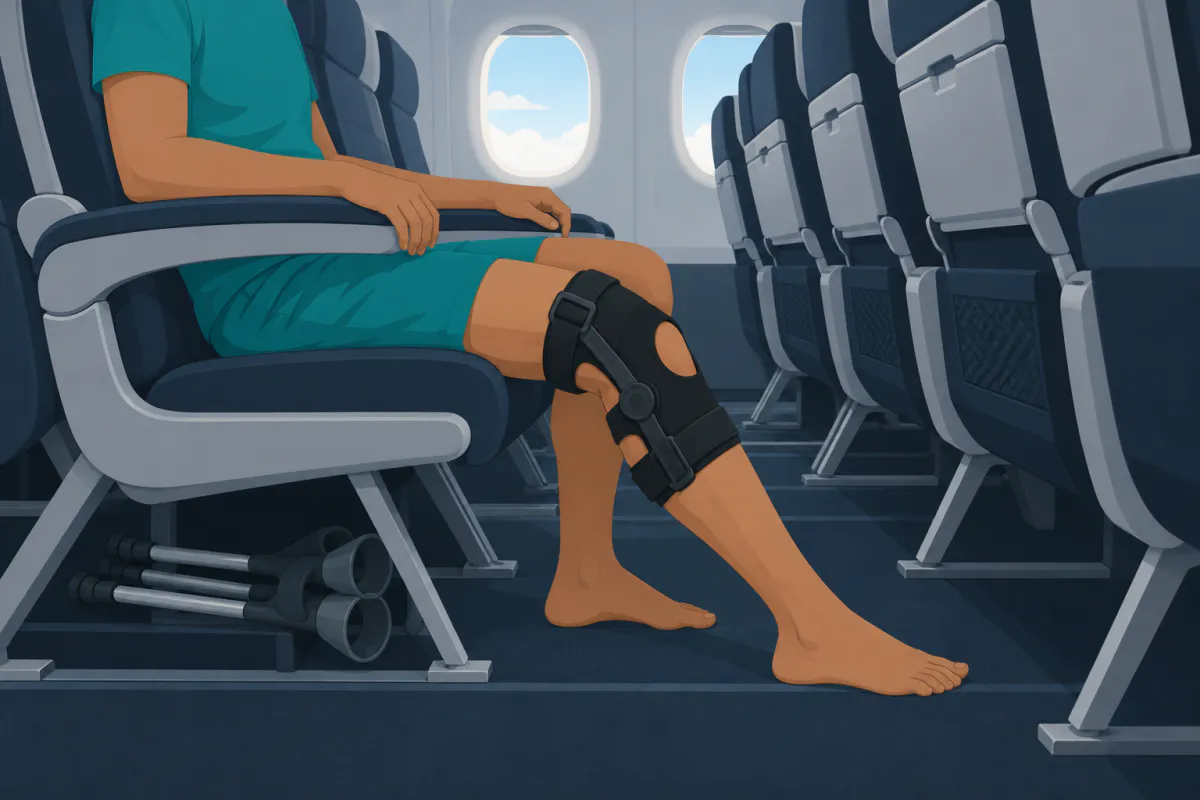
The short answer: no guideline we found sets a number of weeks before you can fly after an ACL reconstruction. The real question is blood clots: recent surgery and long journeys each raise the risk of a clot in the leg, and the British guideline on travel-related clots names major surgery in the previous month as a likely mark of a traveller at the highest risk on journeys of more than three hours. The added risk grows with the length of the flight, so the cautious case is a long flight in the first weeks.
Your surgeon knows what was done to your knee and whether you were given anything to reduce clotting, and when you can fly is their call; ask before you book, not at the gate. This article covers what the travel research found and what the guidelines describe.
Why surgery and a long flight add up
After an ACL reconstruction, clots that cause symptoms are uncommon. Forlenza and colleagues counted them in nearly 12,000 people in a US insurance database and found venous thromboembolism (a clot in a deep vein of the leg, or one that has travelled to the lungs) in 1.01 per cent within 30 days of surgery and 1.22 per cent within 90 days. Most of the first three months’ events had happened in the first month. The fuller account, with the signs, is in blood clots after knee surgery.
Travel adds a risk of its own. Chandra and colleagues pooled 14 studies with 4,055 cases of venous thromboembolism. Travellers had about twice the risk of people who had not travelled, and nearly three times once the studies with a biased choice of comparison group were set aside. The risk rose with the length of the trip: 26 per cent higher for every two hours of air travel. In absolute terms it stays low. The British Society for Haematology guideline by Watson and Baglin puts it at about 1 in 4,656 flights longer than four hours.
The Dutch MEGA study by Cannegieter and colleagues, of 1,906 people with a first clot, found that the risk was highest in the first week after a journey, and that flying carried a risk similar to a long trip by car, bus or train. Some groups had a much higher risk after travel than the average, among them people with a body mass index over 30 and women taking oral contraceptives.
What none of these studies measured is flying after an ACL reconstruction. Their figures are for travellers in general. Recent surgery is among the risk factors the travel guidelines name, but no study we found has put a number on the two together for this operation.
How soon: what the guidance says and what it leaves open
Watson and Baglin say the risk should be assessed for each traveller, and that recent major surgery, within a month, is likely to mark the travellers at the highest risk, along with active cancer and a previous clot without an obvious cause. The guideline does not list which operations count as major, which is one more reason the call belongs to your surgeon.
The lack of a fixed date is not peculiar to ACL surgery. Oputa and colleagues asked hip and knee replacement surgeons in the UK how long they would advise patients to avoid flying. For a long-haul flight in a patient with no other risk factors, the answers ranged from 35 to 180 days, with a median of 90, and the authors concluded that the advice was neither standardised nor based on evidence. A knee replacement is a bigger operation than an ACL reconstruction, so those numbers do not transfer. The spread does.
Airlines decide who boards. The UK Civil Aviation Authority advises contacting the airline if your doctor is not sure you are fit to fly. Most airlines, it says, have an assisted travel or medical clearance team, which may ask your doctor to fill in a medical information form.
What the guidelines describe for higher-risk travellers
The guidelines agree on movement. Watson and Baglin call staying mobile a reasonable precaution for every traveller on journeys over three hours. The NHS suggests loose clothing, plenty of water, no alcohol and walking around when you can on journeys of four hours or more.
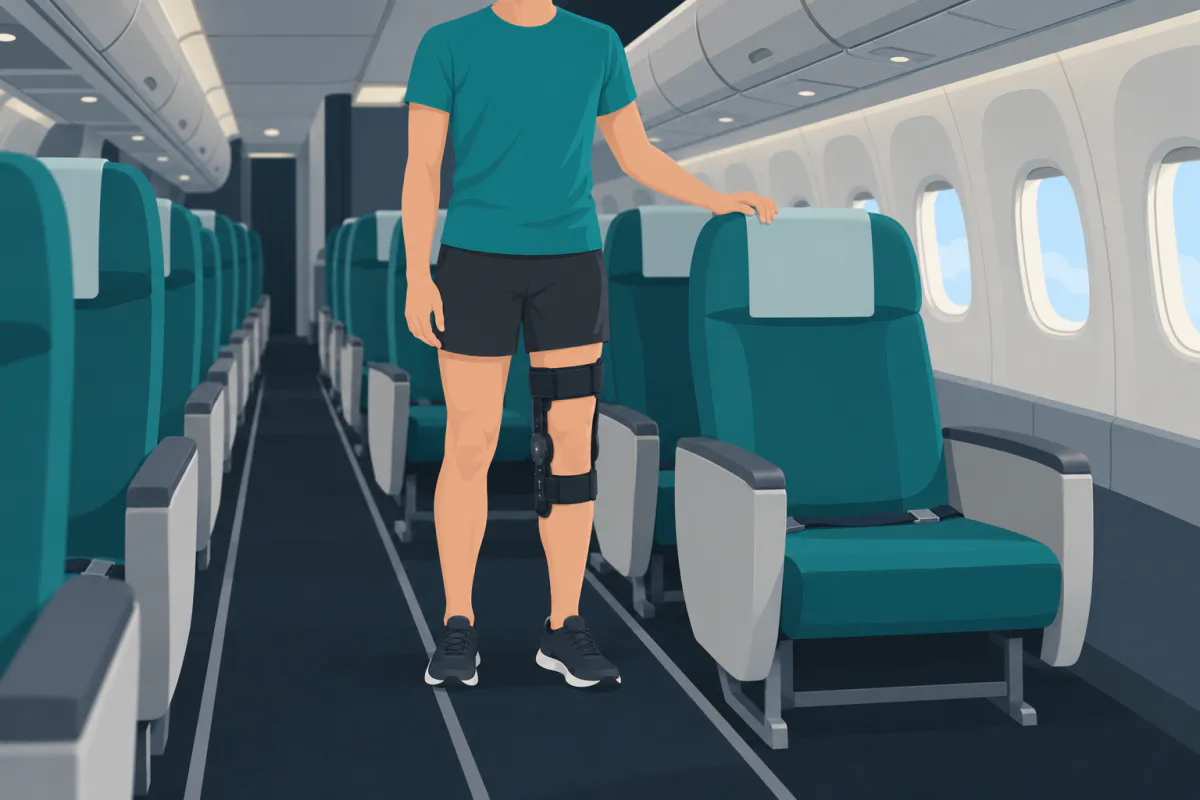
Compression stockings have the strongest trial evidence. A Cochrane review by Clarke and colleagues pooled randomised trials in passengers on flights of more than five hours. Of 2,637 passengers followed up in the trials of stockings on both legs, 50 developed a clot without symptoms: 3 who wore stockings and 47 who did not. The review rated that evidence high certainty. Whether stockings prevent clots that cause symptoms, or a clot in the lungs, it could not say. Watson and Baglin do not recommend stockings for every long-distance traveller; for those at the highest risk on journeys over three hours, they advise well-fitted compression stockings below the knee. If you were sent home from surgery with stockings or injections, whether they should cover the flight is a question for the team that prescribed them.
Medicine for the journey is not routine either. The CAA notes that routine aspirin has not been shown to reduce the risk of clotting. Watson and Baglin do not recommend anticoagulants for long-distance travel in general, and where medicine is thought right for a traveller at high risk, they prefer an anticoagulant to an antiplatelet drug such as aspirin. That is a prescribing decision, and it stays with your care team.
The knee on board
Part of the trip has nothing to do with clots. Sitting for hours with the foot down tends to swell a recently operated knee, and an aircraft seat leaves little room to raise it. A brace and crutches need room too. The CAA says you can take up to two mobility items free of charge, that hypodermic syringes and needles you need during the journey can go in your hand luggage, though they may be checked separately at security, and that you must contact the airline before the flight if you will need help at the airport.
After you land
Watson and Baglin say a clot may be put down to travel if it appears up to eight weeks after the journey; in the MEGA study the risk was highest in the first week. The signs are the same as after surgery at home. Contact your surgical team, a doctor or an urgent care service the same day for:
- a calf that is hot, red, swollen or painful;
- a fever, or redness or discharge at the incision;
- new weakness or numbness in the foot;
- a knee that locks.
Sudden breathlessness, chest pain that is worse when you breathe in, or coughing up blood can mean a pulmonary embolism, a clot in the lungs. The NHS treats that as an emergency: call an ambulance rather than driving yourself. Abroad, that means knowing the local emergency number before you need it.
Where the app fits
ACL Recovery Tracker, a free ACL recovery app for iOS and Android, keeps its records on your phone and works without a connection. On a trip you can use its pain diary as a record of the leg: a score from 0 to 10, the place on the body map and a note, so if a calf starts to hurt after you land you can say when it began and how it has changed. If a weekly workout falls on the travel day, the week screen can move it to a later day of the same week, and its reminder moves with it.
The research gives no safe date for flying after an ACL reconstruction, only a risk that is highest early after surgery, on long flights and in the first week after landing. Your surgeon is the one who can weigh that against your knee and the trip.
The illustrations in this article were generated with AI.
Sources
- Watson HG, Baglin TP. Guidelines on travel-related venous thrombosis. Br J Haematol. 2011;152(1):31-34.
- Chandra D, Parisini E, Mozaffarian D. Meta-analysis: travel and risk for venous thromboembolism. Ann Intern Med. 2009;151(3):180-190.
- Cannegieter SC, Doggen CJ, van Houwelingen HC, Rosendaal FR. Travel-related venous thrombosis: results from a large population-based case control study (MEGA study). PLoS Med. 2006;3(8):e307.
- Clarke MJ, Broderick C, Hopewell S, Juszczak E, Eisinga A. Compression stockings for preventing deep vein thrombosis in airline passengers. Cochrane Database Syst Rev. 2021;4:CD004002.
- Forlenza EM, Parvaresh KC, Cohn MR, et al. Incidence and risk factors for symptomatic venous thromboembolism following anterior cruciate ligament reconstruction. Knee Surg Sports Traumatol Arthrosc. 2022;30(5):1552-1559.
- Oputa TJ, Patil A, Amissah-Arthur JB, et al. Is there a consensus on air travel following hip and knee arthroplasty? Cureus. 2023;15(8):e43814.
- UK Civil Aviation Authority. Air travel and your health.
- UK Civil Aviation Authority. Travelling with medicines, mobility and medical equipment.
- NHS. DVT (deep vein thrombosis).
- NHS. Pulmonary embolism.