The guide · Early recovery, Daily life
Do you need a brace after ACL reconstruction?
What post-operative and functional braces do, what the randomised trials found when the brace was taken away, and why two surgeons give different instructions.
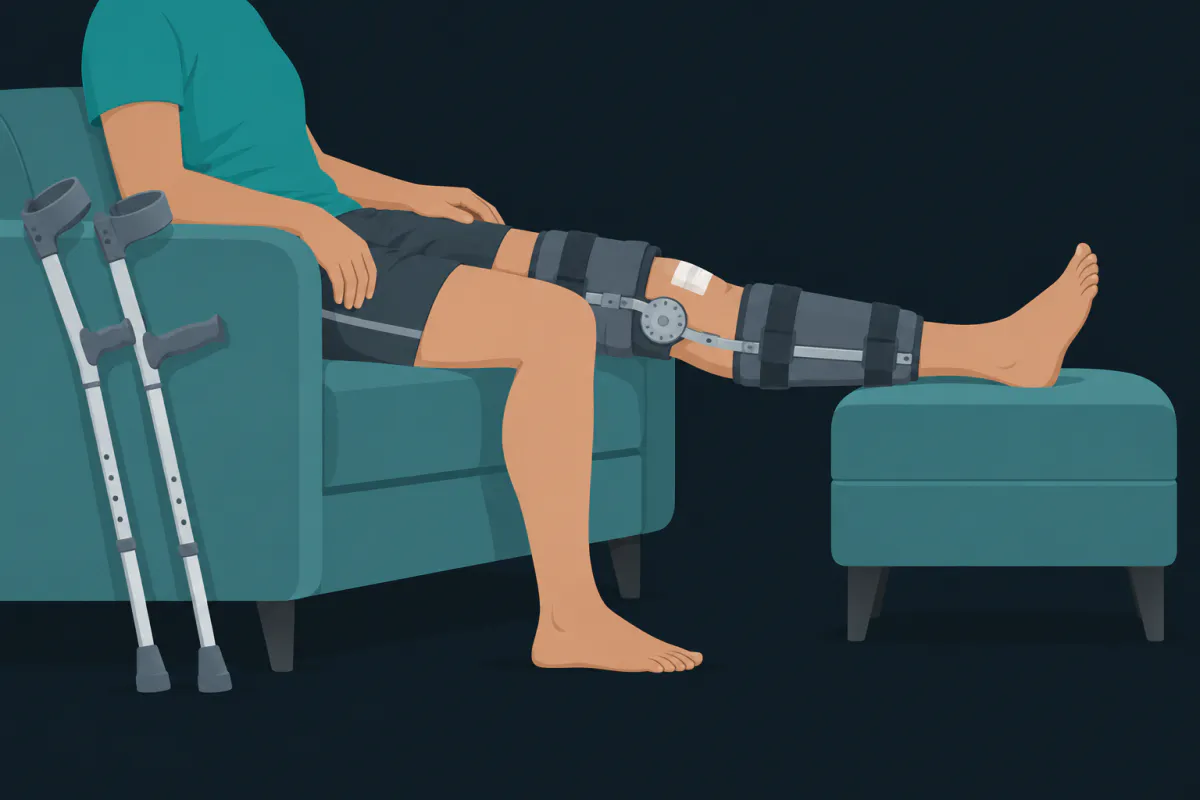
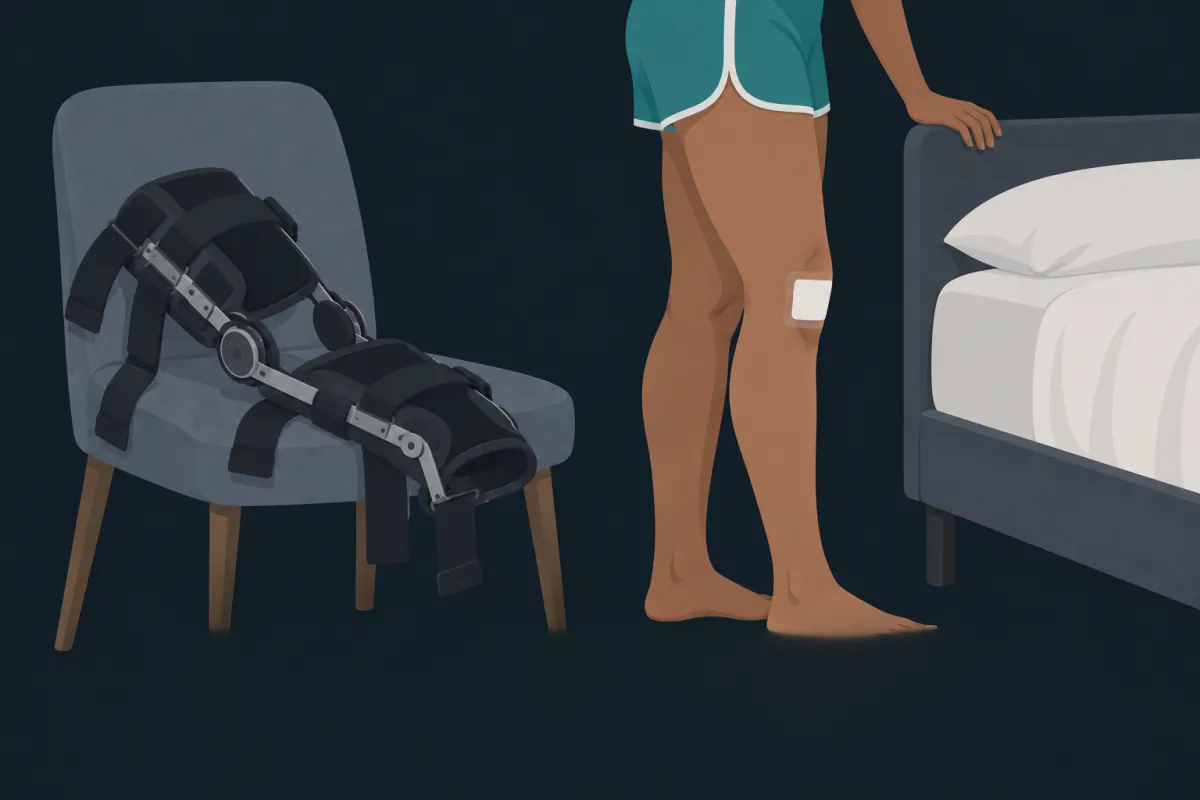
Some people leave hospital in a long hinged brace with a dial on the side, some leave in nothing at all, and both were operated on by a competent surgeon. Bracing is one of the better-studied questions in ACL rehabilitation, and the answer is mostly a description of what braces do not do. This article covers the different kinds of brace, what happened in the trials that took the brace away, and why the instruction you were given may still differ from what the papers conclude.
Whether you wear a brace, how it is set and when it comes off is your surgeon’s decision, and that instruction comes first — particularly if anything besides the ligament was repaired. Nothing here is a reason to take one off.
The word “brace” covers three different things
A post-operative or rehabilitative brace is the bulky hinged one issued in the first weeks. It is usually set to hold the knee straight for walking and sleeping, or to allow a limited arc of bend that is widened week by week. A functional brace is the lighter sports brace worn months later, on return to activity, and is meant to resist the rotational and forward shearing loads the graft dislikes. A prophylactic brace is worn by people who have never had the injury, in the hope of preventing one.
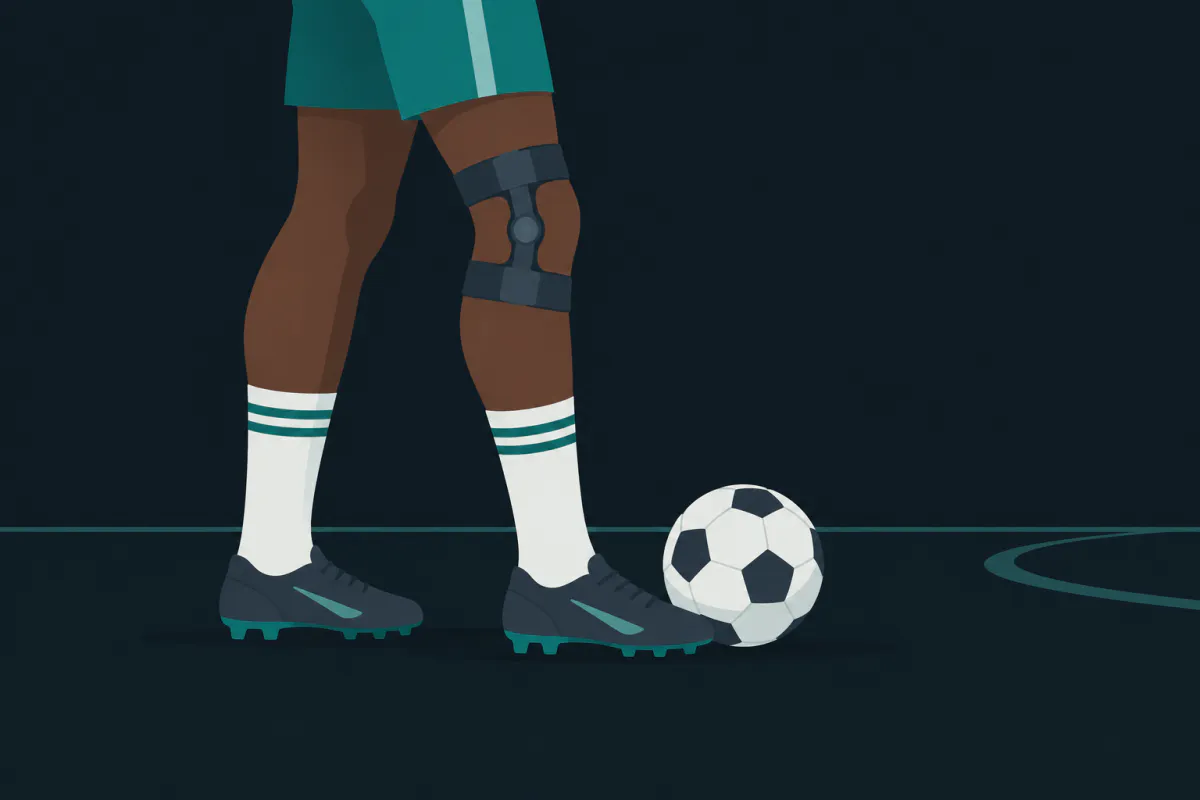
The three get discussed as if they were one product, which is part of why advice sounds contradictory. Geeslin and colleagues reviewed the clinical practice guidelines on ACL bracing in 2024 and set out an updated classification precisely because the naming is inconsistent enough to confuse the clinicians prescribing them. It is worth knowing which one you are being asked about, because the evidence differs by type and by timing.
One more thing is called a brace and is not one: an internal brace is a suture tape placed inside the knee during surgery to support the graft or a repair. It is a surgical technique, not something you put on in the morning.
What happened when trials took the brace away
The clinical picture has been stable for a long time. Wright and Fetzer reviewed the Level I evidence on bracing after reconstruction — twelve randomised controlled trials — and found no evidence that pain, range of motion, graft stability or protection from a subsequent injury were affected by wearing one. They concluded there was no evidence to support routine use of either functional or rehabilitative bracing.
Yang and colleagues pooled seven randomised trials and 440 participants more recently. Objective International Knee Documentation Committee grades were no different between braced and unbraced groups, and at final follow-up neither were Lysholm scores, Tegner activity scores, the side-to-side laxity difference, the single-leg hop test or pain on a visual analogue scale. Their conclusion was that bracing should not be recommended routinely after reconstruction.
The most direct test is a trial designed to ask exactly this. Schoepp and colleagues randomised 114 adults having an isolated reconstruction with a hamstring tendon autograft to six weeks in a knee brace (58 people) or no brace at all (56 people), with the patients’ own International Knee Documentation Committee score at one year as the primary outcome. Brace-free rehabilitation was not inferior, and their reading was that a brace might reasonably be avoided after that operation. The two qualifiers matter, though: an isolated reconstruction, with a hamstring autograft.
The guidelines read the same way. The American Academy of Orthopaedic Surgeons, in its clinical practice guideline on ACL injuries, does not recommend functional knee braces for routine use after an isolated primary reconstruction, on the grounds that they confer no clinical benefit. The same guideline advises against prophylactic bracing to prevent a first ACL injury. Both recommendations carry a strength of Limited, which in that system is an explicit invitation to clinical judgement and patient preference rather than a prohibition — a detail that matters if your surgeon prescribes one anyway.
The case for braces is not quite empty. Lowe and colleagues reviewed fifteen studies of functional bracing with follow-up from three to forty-eight months and found some data suggesting a brace may improve in vivo knee kinematics and may offer the graft some added protection without costing function, range of motion or proprioception. Their conclusion was still that evidence supporting routine functional bracing to reduce reinjury is limited. Geeslin and colleagues landed in a similar place: a role in selected patients, with the evidence presently too thin either to support or to refute routine use.
Reinjury, and why you may still be given one
This is the hope behind the sports brace, and it is the weakest part of the case. Marois and colleagues searched for studies comparing braced and unbraced knees on return to sport with at least eighteen months of follow-up, and found three, covering 1,196 patients. The results pointed in different directions. One study reported a lower reinjury rate among those wearing a brace, and one found a significant protective effect in patients aged seventeen or under. Their conclusion was that the current data cannot support the claim that wearing a brace on return to sport reduces reinjury after reconstruction.
The research that does bear on a second injury is about criteria and timing rather than equipment — Grindem and colleagues’ Delaware-Oslo cohort on how long rehabilitation runs before a return to sport, and Kyritsis and colleagues’ work on the discharge criteria a knee meets first. That is the criterion-based logic Noyes’ Knee Disorders sets out for progression and return-to-sport testing, and it is where the evidence is strongest.
Look again, then, at who those trials enrolled. Isolated, primary reconstructions, in adults, mostly with one graft type. If your operation also involved a meniscus repair, a cartilage procedure, a second ligament or a revision, the trials above do not describe you, and the brace is often there to enforce a limit on bending or loading that protects the repair rather than the ACL graft. A brace is also sometimes used for a few weeks simply as armour on crowded pavements and stairs, or where quadriceps control is poor enough that the knee is prone to giving way.
The counterweight is that a brace can become a substitute for the work the programmes are actually built around — quadriceps strength, full extension and neuromuscular control — and that it is one more thing to take off, wash around and fit correctly. A brace that is set wrong, or worn over a knee that is still swelling, can be uncomfortable in ways worth reporting rather than tolerating.
Separately, a few things are not a brace problem and are not worth waiting out: a calf that is hot, red, swollen or painful; a fever with spreading redness or discharge at the incision; new weakness or numbness in the foot; or a knee that locks and will not move. Any of those means contacting your surgical team, your GP or an urgent care service the same day.
Where this sits in your rehab
The weeks when a brace is worn are the weeks ACL Recovery Tracker covers with Levels 0 to 2 — crutches and gait drills, early recovery, then progressive strengthening — and their goals are a fair summary of what the brace is not doing for you. Level 1 aims at regaining full knee extension, quadriceps strength and a walk without a limp; full extension is one of the criteria for leaving Level 2. The mobility log records extension and flexion in degrees, by hand or with the phone’s gyroscope, and the pain diary records where and when it hurts, so the fortnight either side of a brace coming off is described rather than remembered. The app has no setting for a brace, because the brace is your surgeon’s instruction and not part of the programme. What you can use it for is the part that is yours to do: it is a free ACL rehab app for iPhone and Android that keeps the sessions, the angles and the pain scores in one place.
Braces are visible, and rehabilitation mostly is not, so it is easy to treat the hardware as the treatment. The evidence suggests the opposite: for an ordinary reconstruction the brace looks close to neutral, and what happens to the knee over the following year is shaped far more by the quadriceps work, the extension, and the patience to meet criteria before moving on.
The illustrations in this article were generated with AI.
Sources
- Wright RW, Fetzer GB. Bracing after ACL reconstruction: a systematic review. Clin Orthop Relat Res. 2007;455:162-168.
- Lowe WR, Warth RJ, Davis EP, Bailey L. Functional bracing after anterior cruciate ligament reconstruction: a systematic review. J Am Acad Orthop Surg. 2017;25(3):239-249.
- Yang XG, Feng JT, He X, Wang F, Hu YC. The effect of knee bracing on the knee function and stability following anterior cruciate ligament reconstruction: a systematic review and meta-analysis of randomized controlled trials. Orthop Traumatol Surg Res. 2019;105(6):1107-1114.
- Schoepp C, Ohmann T, Martin W, et al. Brace-free rehabilitation after isolated anterior cruciate ligament reconstruction with hamstring tendon autograft is not inferior to brace-based rehabilitation: a randomised controlled trial. J Clin Med. 2023;12(5):2074.
- Marois B, Tan XW, Pauyo T, Dodin P, Ballaz L, Nault ML. Can a knee brace prevent ACL reinjury: a systematic review. Int J Environ Res Public Health. 2021;18(14):7611.
- Geeslin AG, Moatshe G, Engebretsen L, et al. Functional anterior cruciate ligament braces may have a role in select patient groups although there is presently limited evidence supporting or refuting their routine use: a scoping review of clinical practice guidelines and an updated bracing classification. Knee Surg Sports Traumatol Arthrosc. 2024;32(7):1690-1699.
- American Academy of Orthopaedic Surgeons clinical practice guideline summary: management of anterior cruciate ligament injuries. J Am Acad Orthop Surg. 2023;31(11):531-537.
- Grindem H, Snyder-Mackler L, Moksnes H, Engebretsen L, Risberg MA. Simple decision rules can reduce reinjury risk by 84% after ACL reconstruction: the Delaware-Oslo ACL cohort study. Br J Sports Med. 2016;50(13):804-808.
- Kyritsis P, Bahr R, Landreau P, Miladi R, Witvrouw E. Likelihood of ACL graft rupture: not meeting six clinical discharge criteria before return to sport is associated with a four times greater risk of rupture. Br J Sports Med. 2016;50(15):946-951.
- Noyes FR, Barber-Westin SD, eds. Noyes' Knee Disorders: Surgery, Rehabilitation, Clinical Outcomes. 2nd ed. Elsevier; 2017.