The guide · Early recovery, Daily life
How to sleep after ACL surgery: positions and side sleeping
Sleeping positions after ACL surgery: why your back comes first, when you can sleep on your side, the brace at night, and what helps until it settles.
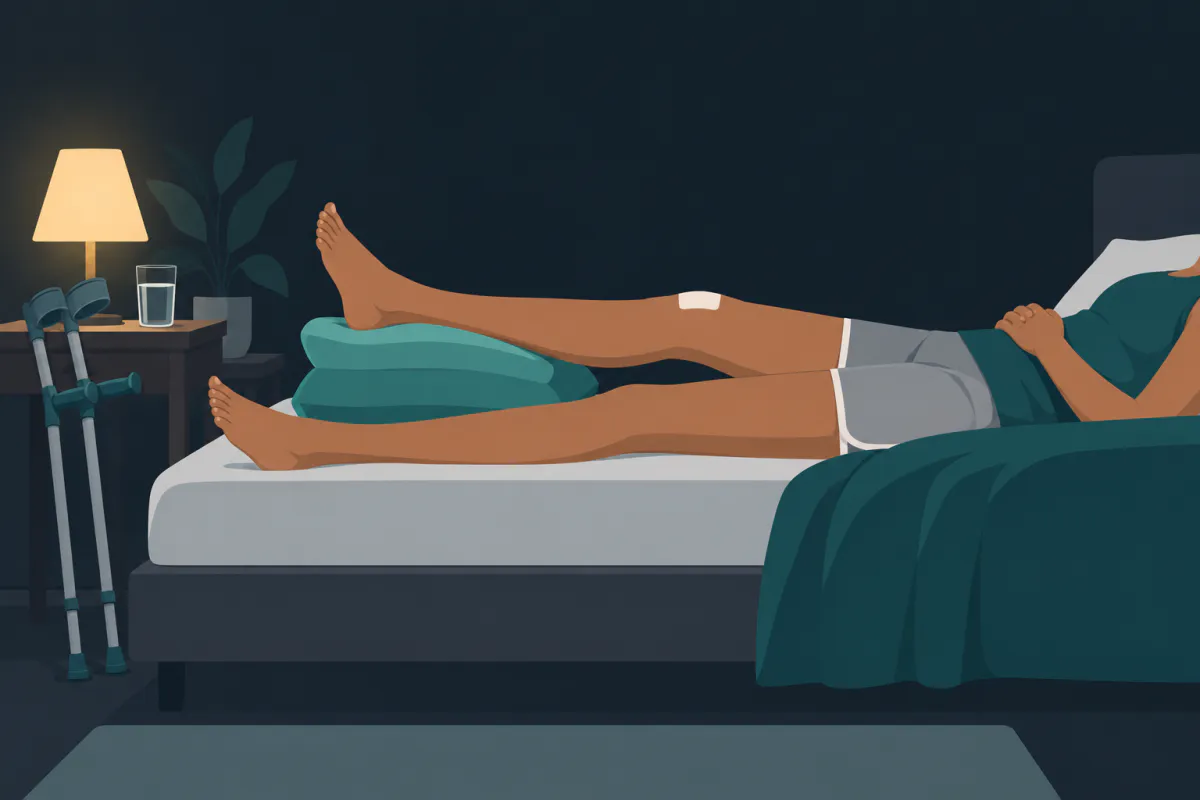
Most people are told what the exercises will be like and almost nothing about the nights. Then the first week arrives: a leg that cannot get comfortable, a brace in the way, and two hours of sleep in pieces. This article covers why the early nights are as bad as they are, which sleeping positions fit what the knee needs, whether you can sleep on your side, and what usually helps until it settles.
Your surgeon’s instructions about the brace, weight-bearing and how far the knee may bend come first. Nothing here replaces them.
Why the first nights are the worst
Several things land at once. If you had a nerve block for the operation, it wears off within roughly the first day, and the pain it was hiding arrives fairly suddenly. Anaesthetists call this rebound pain: Barry and colleagues, studying nerve blocks for day-case surgery of all kinds, described a sharp increase in pain as the block recedes, usually inside twenty-four hours, more common after bone surgery and in younger patients. An ACL reconstruction involves drilling bone tunnels, so it sits in that group. If your block wore off in the evening, your first night was the worst of it.
On top of that, the joint is swollen, and swelling is what makes the knee feel tight and hot at rest. You cannot shift position easily, the brace holds the leg in one shape, and the painkillers you were sent home with are wearing thin by the small hours.
None of this means anything has gone wrong. It means the first nights are a pain and swelling problem, and they improve as those improve.
What the knee needs while you sleep
The one thing worth knowing before you arrange the pillows: a pillow under the knee is the most comfortable thing in the world after this surgery, and it is also how people lose full extension. Rehabilitation guidelines are unusually consistent on this. The consensus guideline from van Melick and colleagues puts regaining full extension among the goals of the earliest phase, alongside controlling swelling and getting the quadriceps working. Noyes’ Knee Disorders sets out the same reasoning behind that priority: a knee that settles into a slightly bent position is harder to straighten later than a stiff knee is to bend, and extension is protected from the first days rather than recovered afterwards.
In practice, that turns into a simple distinction. Supporting the leg from underneath the heel or the calf lets the knee hang straight; supporting it under the knee itself holds the joint bent for eight hours at a stretch. Hospital leaflets ask for the first and warn against the second. The one Worcestershire Acute Hospitals NHS Trust gives its ACL patients, for example, says to rest with the knee straight, with no pillow or other support under it, and with a rolled towel under the heel when lying down.
Elevation is separate from position. For swelling the aim is the whole leg raised so the knee sits above the heart, which usually means pillows from the calf down to the ankle rather than a single one in the middle.
Sleeping positions: back first, then side, then front
No trial has compared sleeping positions after this operation, and hospital leaflets talk about the knee rather than the body. A position that keeps the knee straight and unsupported from beneath is a candidate; one that holds it bent all night is not. That gives the usual order:
- On your back. The default early on, because it is the only position that keeps the leg straight without effort and lets you raise the whole leg.
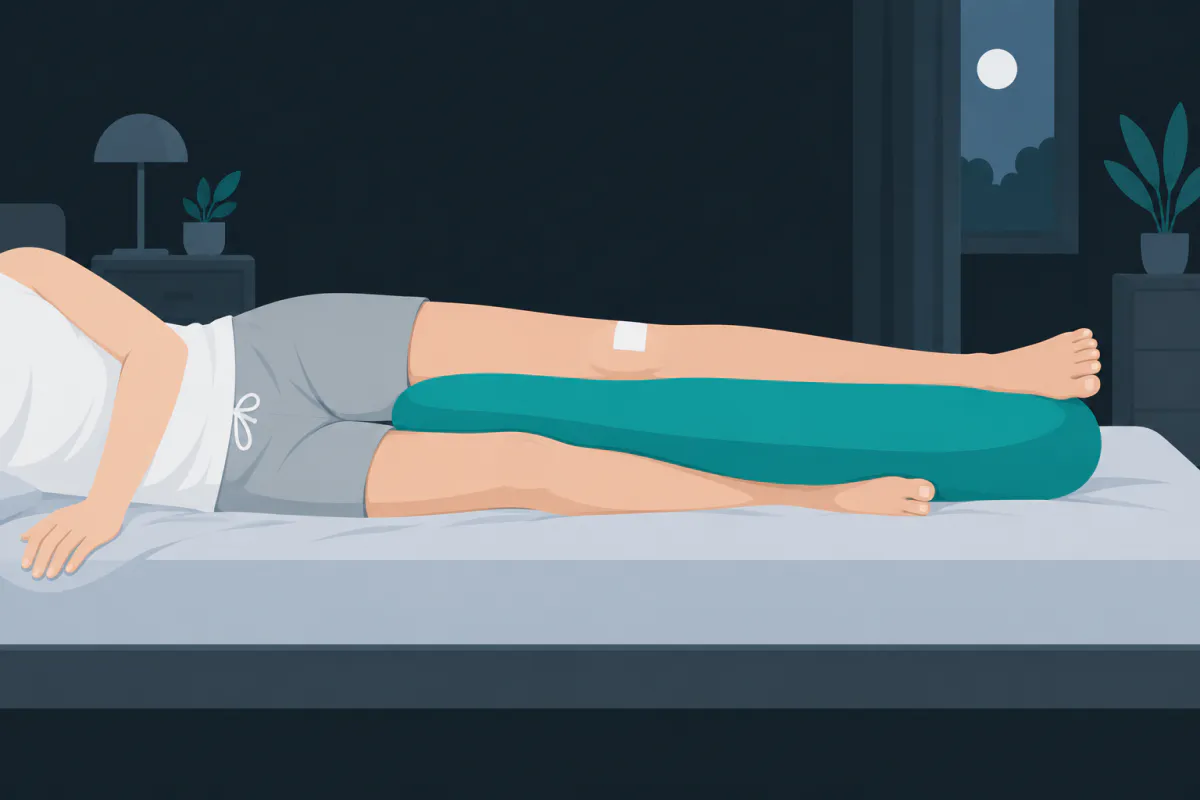
- On your side. An option for many people once bending that far is allowed and the brace, if there is one, is manageable in bed. More on this below.
- On your front. Usually the last to come back, once the knee is comfortable lying flat.
Can you sleep on your side after ACL surgery?
Usually yes, in time, and the timing is your surgeon’s call rather than a number of days. Two things decide it. The first is the brace: locked straight, it makes side-lying clumsy rather than harmful, and if you were told to wear it overnight it stays on whichever way you lie. The Worcestershire leaflet tells patients who were prescribed one to wear it all the time, overnight included. The second is how far the knee may bend, because people curl up on their side without deciding to, and a knee that spends the night bent is the same problem as a pillow under it.
If side-lying is allowed, the arrangement that follows from the same logic is lying on the unoperated side with a pillow between the legs from knee to ankle, so the operated leg is carried level and as straight as is comfortable. Lying on the operated side is usually uncomfortable for longer, since the body’s weight rests on the swollen knee and the incisions. None of this has been tested in trials, and if your instructions say back only for now, they override it.
The brace, and why instructions differ
Instructions about the brace vary enormously between surgeons, and that is not sloppiness. Some ask for it locked straight at night for the first weeks; some allow it off in bed after a few days; some do not issue one at all. Wright and Fetzer reviewed the trials and found no evidence supporting routine use of a brace after ACL reconstruction, but that review is about braces in general, not night-time wear, and it is not a licence to abandon the one your surgeon prescribed. It is a question for your next appointment rather than for the middle of a bad night. The longer version is in Do you need a brace after ACL reconstruction?.
Small things that make the night easier
- Take the medication on the schedule you were given, rather than waiting until the pain wakes you. Timing questions, including what to take before bed, go to whoever prescribed it.
- Ice before settling down. In Raynor and colleagues’ meta-analysis of trials after ACL reconstruction, cryotherapy improved postoperative pain control, though it made no difference to range of motion or drainage. The risk at bedtime is falling asleep on the pack: skin cooled for too long can be injured, which is why instructions specify a number of minutes and a layer between pack and skin.
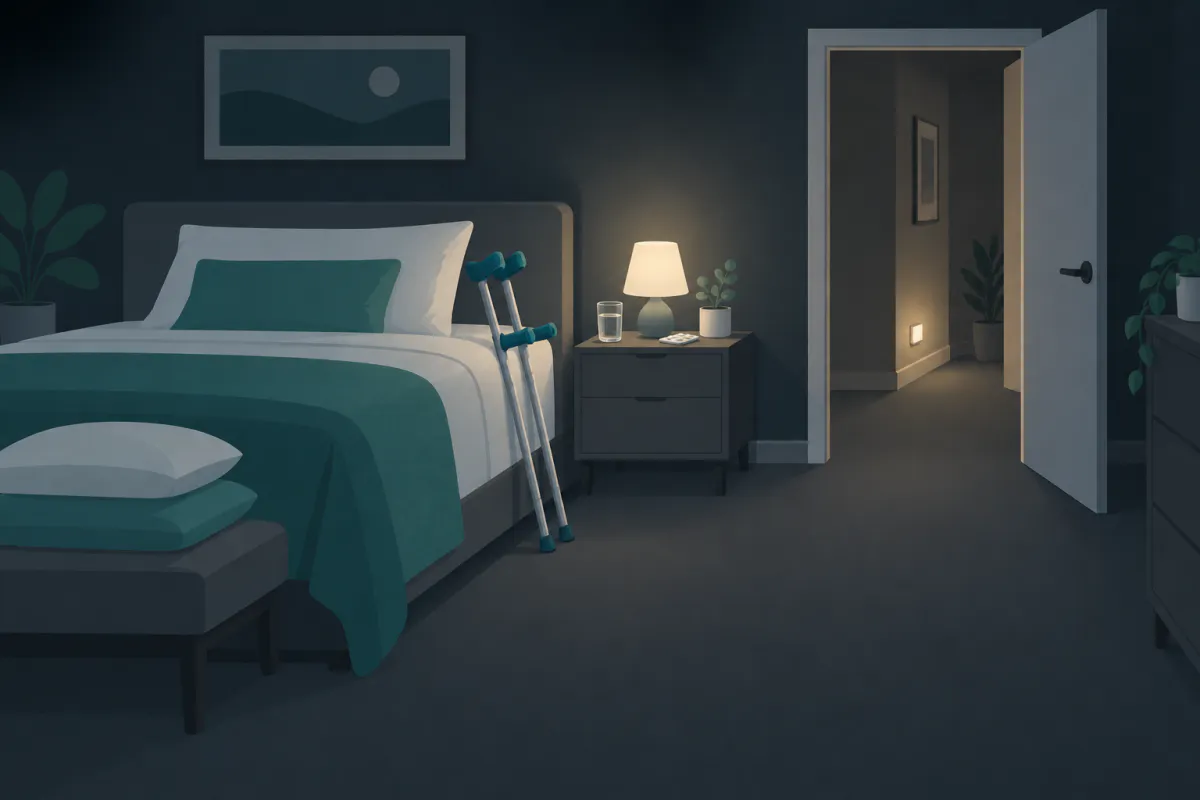
- Set the bed up in advance. Pillows stacked, crutches leaning where you can reach them lying down, water and a light within arm’s length.
- Plan the trip to the bathroom. Clear the floor between the bed and the door before you go to sleep; crutches in the dark are an easy way to fall.
- Keep the rest of it ordinary. Short naps rather than long ones, a dark, cool room and a consistent bedtime still apply; surgery does not suspend the basics.
When it settles, and what is worth reporting
The nights usually ease as the swelling comes down and the strongest painkillers taper off, which is why the earliest ones tend to be the hardest. That does not mean it is over quickly. Brinkman-Holland and colleagues interviewed twelve people one to three months after ACL reconstruction and found they still reported significant sleep disturbance, and that they connected it to how they felt during the day and how their rehabilitation was going. It was a small qualitative study, so it does not tell you how common that is or how long it lasts. It does mean that broken sleep at week eight is a normal thing to be experiencing, and worth mentioning at an appointment rather than treating as a personal failure.
Some night-time symptoms are not part of the picture and need same-day attention. The NHS recovery guidance lists the standard warning signs after this surgery: a calf that is hot, red, swollen or painful, or new shortness of breath or chest pain, which can indicate a blood clot; spreading redness at the incision, discharge from the wound or a fever; new weakness or numbness in the foot; and a knee that locks and cannot be moved. Waking with any of those means contacting your surgical team, your GP or an urgent care service, not waiting until morning.
Logging the bad nights
If you use ACL Recovery Tracker, the pain diary is the place to put a bad night: rate it from 0 to 10, mark the location on the body map and add a note saying it woke you. A few of those entries in a row is something concrete to show your physiotherapist. The care routines on the early levels include icing slots with times you can edit, so an evening slot and its reminder can sit where you actually want them, shortly before bed. It is a free ACL rehab app for iOS and Android, and you can use it alongside whatever your surgeon and physio have told you about the nights.
Sleep is not a side issue in the first weeks; it is most of how the days feel. It gets better on roughly the same schedule as the swelling, which is slower than anyone wants and faster than it seems at four in the morning.
The illustrations in this article were generated with AI.
Sources
- van Melick N, et al. Evidence-based clinical practice update: practice guidelines for anterior cruciate ligament rehabilitation based on a systematic review and multidisciplinary consensus. Br J Sports Med. 2016;50:1506-1515.
- Noyes FR, Barber-Westin SD, eds. Noyes' Knee Disorders: Surgery, Rehabilitation, Clinical Outcomes. 2nd ed. Elsevier; 2017.
- Wright RW, Fetzer GB. Bracing after ACL reconstruction: a systematic review. Clin Orthop Relat Res. 2007;455:162-168.
- Barry GS, et al. Factors associated with rebound pain after peripheral nerve block for ambulatory surgery. Br J Anaesth. 2021;126(4):862-871.
- Raynor MC, Pietrobon R, Guller U, Higgins LD. Cryotherapy after ACL reconstruction: a meta-analysis. J Knee Surg. 2005;18(2):123-129.
- Brinkman-Holland CA, et al. Qualitatively characterizing sleep behaviors after ACL reconstruction. J Athl Train. 2026.
- Worcestershire Acute Hospitals NHS Trust. Anterior cruciate ligament (ACL) reconstruction: post-operative physiotherapy advice and rehabilitation. Patient leaflet, version 3.
- NHS. ACL (anterior cruciate ligament) surgery: recovering.