The guide · Daily life, Early recovery
When can you have sex after ACL surgery?
Usually once the wound has closed and the swelling settles, in positions that keep the knee straight and unloaded. No ACL study gives a date; the surgeon does.
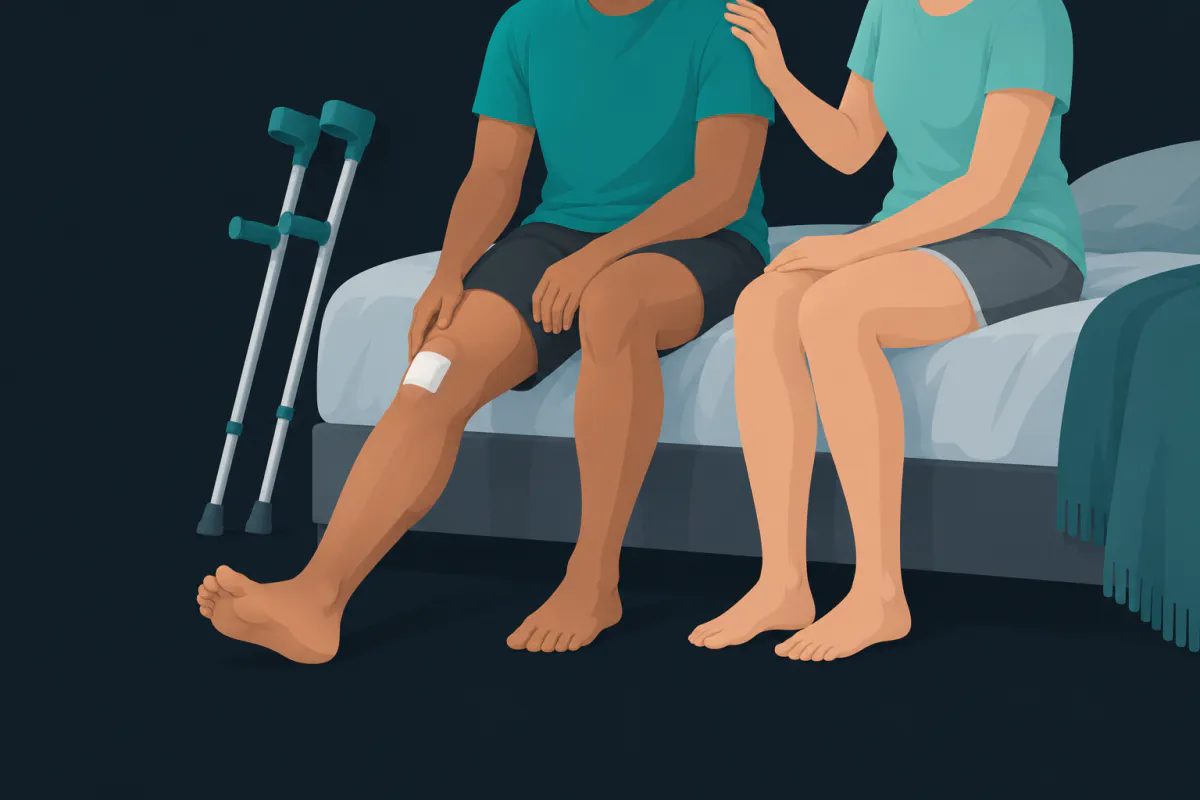
The short answer: usually once the wound has closed and the first swelling is settling, which for most people means a few weeks rather than months, in positions that keep the operated knee straight, supported and carrying no weight. No ACL study has measured when people resume sex; the nearest research, on knee replacement, found an average of about two and a half months with an enormous range. What moves the date for you is the limits your surgeon set on bending, weight-bearing and twisting, and how the knee feels. Those instructions, and your physiotherapist’s, come before anything written here.
Why nobody has told you, and what research there is
Hospital leaflets after this operation cover crutches, ice, driving and work and say nothing about sex: the Worcestershire NHS physiotherapy leaflet, a typical one, is silent on it, and so is the NHS overview of recovery.
The best evidence on it comes from surveys about hip replacement, where surgeons were asked. In a survey published in 2004, Dahm and colleagues asked members of the American Association of Hip and Knee Surgeons about sex after hip replacement: 80 per cent rarely or never discussed it with patients, and most, 67 per cent, recommended waiting one to three months. Harmsen and colleagues put a similar questionnaire to Dutch hip surgeons, published in 2017: about 78 per cent almost never raised it, the commonest reason, from 47 per cent, was that patients do not ask, and the authors concluded that there is no common advice about when it is safe to resume. Those surveys are about hips, but there is no reason to think the conversation after a knee operation goes any differently.
Two studies have looked at sex and this operation in particular, and neither answers the question of timing. D’Ambrosi and colleagues followed 303 patients, average age 32, for a mean of 63 months after reconstruction, rating sexual satisfaction before the injury, before surgery and at follow-up. Satisfaction fell after the injury and was back at its pre-injury level by follow-up, regardless of age, sex or graft type. Mazlum and colleagues found the same dip in 27 men, with sexual function scores tracking the knee’s function scores. That is the whole literature: a painful, unstable knee gets in the way, a reconstructed one eventually stops doing so, and the weeks in between have to be reasoned from what the knee can tolerate.
The nearest evidence: knee replacements
People who have a knee replaced are older and the operation is different, but the obstacles are the same ones: pain, a knee that will not bend far, and weight pressing on it. Kazarian and colleagues surveyed 91 sexually active patients about two years after total knee replacement. They had resumed sex after an average of 2.4 months, with a range from zero to 18 months. Before surgery 55 per cent had been adjusting their positions because of the knee, and 28 per cent still were afterwards; 97 per cent had avoided putting weight on the knee during sex, and 79 per cent still did.
Two things carry over. The knee is not something people put weight on during sex, even long after it has been fixed. And “when” is less a date than the point at which the knee stops dictating the arrangement.
What the knee is dealing with, week by week
Rehabilitation after this operation is organised in phases with goals, the structure described in Noyes’ Knee Disorders, and the early goals decide the question.
The first two weeks. The wound is fresh, the knee is swollen, and the work is getting it fully straight, waking the quadriceps and keeping the swelling down, the first-phase goals in the consensus guideline from van Melick and colleagues. Many people are on crutches or in a brace, and the NHS schedules the first review at about two to three weeks. Add the painkillers, the broken sleep described in how to sleep after ACL surgery and a knee that bends grudgingly, and sex in this fortnight is mostly a planning exercise. The American Heart Association’s statement on sexual activity, written for people with heart disease, puts its exertion at about three to five METs, a unit of energy cost in which a brisk walk sits in the same range; in week one, many people do not feel like a brisk walk.

Weeks two to six. The wound is usually closed, the swelling is settling and bending is coming back. The limits that still apply are the surgeon’s: how far the knee may bend, whether it takes full weight, whether the brace is worn in bed. The Worcestershire leaflet tells patients prescribed a brace to wear it at all times, bed included, while other surgeons allow it off at rest; your own instructions decide.
From six weeks on. Bending has usually come a long way and walking is close to normal. Kneeling tends to stay uncomfortable for months, because the incisions sit at the front of the knee and, with some grafts, so does the donor site (kneeling after ACL reconstruction explains why), and twisting the knee under load is what the whole programme protects the graft from until the final levels.
Positions: a rule rather than a diagram
No study has measured sexual positions after knee surgery. The only motion-capture study of sex after joint replacement, by Charbonnier and colleagues, concerns hips, whose limits are different. So instead of a chart, a rule that follows from the early limits and fits any arrangement:
- The operated knee stays straight, or bent only as far as it is allowed, and nothing pushes it further. A pillow or rolled towel under the heel keeps a straight leg comfortable; a pillow under the knee holds it bent, the same problem it causes at night.
- It carries no body weight. Kneeling on it, squatting on it and bracing against it with a bent knee are out until your physiotherapist clears kneeling and squatting.
- It is not twisted. The shin and the thigh turn together or not at all, and the foot does not get caught, hooked or pinned.
- The other person does the moving. Lying on your back with the leg straight and supported, or on your unoperated side with a pillow between the legs from knee to ankle, satisfy all three points without effort, and are the arrangements the sleeping article arrives at too.
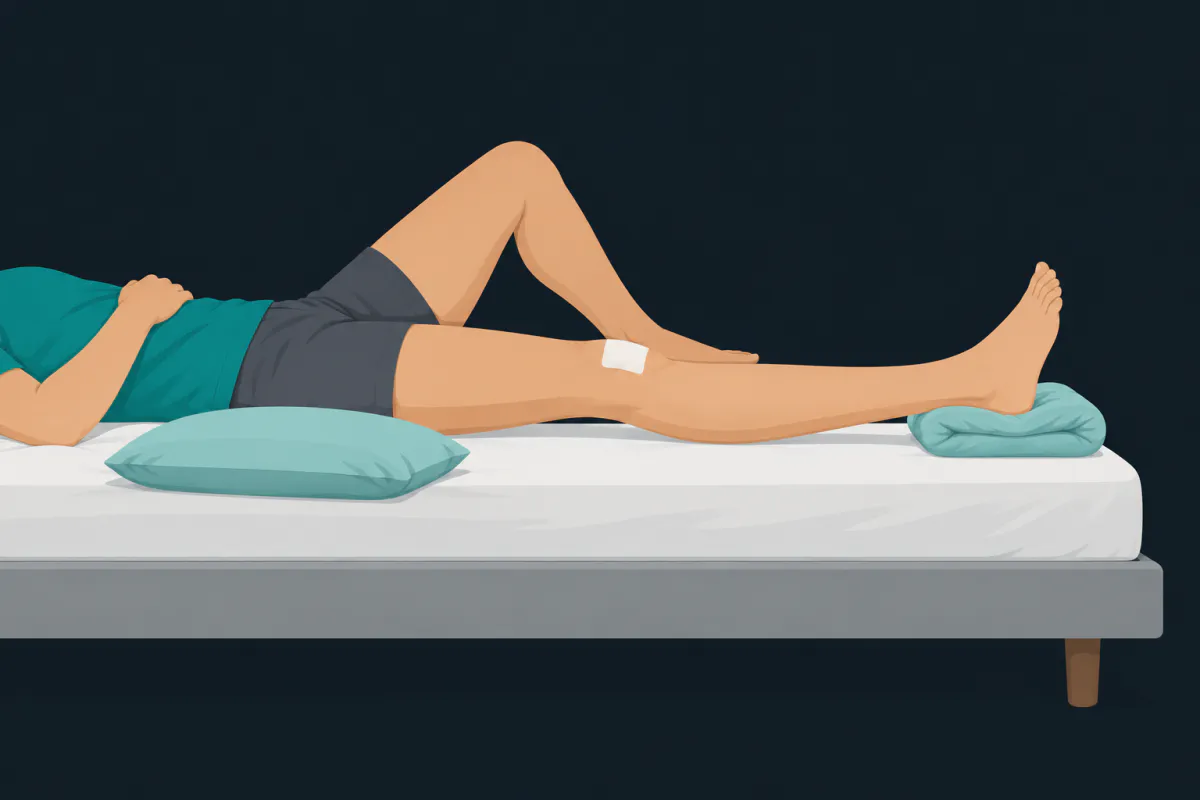
The rule says nothing about what sex is, deliberately: it covers intercourse and everything else, and the early weeks tend to shift the balance towards the things that do not need the operated leg. A brace is clumsy rather than dangerous.
What is worth noticing afterwards
A knee that is more swollen the next morning has been asked to do more than it was ready for; the reasonable response is a quieter few days and a mention at the next appointment. The signs that need same-day attention are the same ones that apply at any other time after this surgery: a calf that is hot, red, swollen or painful, or new breathlessness or chest pain; spreading redness at the incision, discharge from the wound or a fever; new weakness or numbness in the foot; or a knee that locks and will not move. Any of them means contacting your surgical team, your GP or an urgent care service, not waiting for the morning.
The harder part is often not the knee. Tiredness, painkillers and broken sleep flatten desire for a while; some people dislike being seen with a brace and a swollen leg; a partner can be more frightened of hurting the knee than the knee warrants, and say nothing. The D’Ambrosi cohort is the comfort here: satisfaction dipped with the injury and came back. Saying out loud what the knee can and cannot do this week is a short conversation, and a more useful one than any list of positions.
Where the app fits
This question belongs to Levels 1 and 2 of the programme, the weeks when extension, swelling and quadriceps control are the whole job. If you use ACL Recovery Tracker, a free ACL recovery app for iOS and Android, the number that answers the positions question is already in it: the mobility log shows how far the knee bends against your healthy-leg baseline, and the pain diary, logged by location and moment, will tell you the next morning whether the knee minded.
Nobody will bring this up at your review unless you do, and the surveys say that is exactly why it never gets discussed. It is a reasonable question to put to the person who set your limits, and they have heard it before.
The illustrations in this article were generated with AI.
Sources
- Dahm DL, Jacofsky D, Lewallen DG. Surgeons rarely discuss sexual activity with patients after THA: a survey of members of the American Association of Hip and Knee Surgeons. Clin Orthop Relat Res. 2004;(428):237-240.
- Harmsen RTE, Nicolai MPJ, Den Oudsten BL, et al. Patient sexual function and hip replacement surgery: a survey of surgeon attitudes. Int Orthop. 2017;41(12):2433-2445.
- D'Ambrosi R, Valli F, D'Ambrosi F, Ursino N, Meena A. Improved sexual activity and quality of life after anterior cruciate ligament reconstruction. Ann Joint. 2025;10:23.
- Mazlum EC, Gunay AE, Kahraman M, Sahbaz E, Ekici M, Ozan F. Effects of anterior cruciate ligament rupture and reconstruction on sexual activity of male patients. Jt Dis Relat Surg. 2023;34(1):138-143.
- Kazarian GS, Lonner JH, Hozack WJ, Woodward L, Chen AF. Improvements in sexual activity after total knee arthroplasty. J Arthroplasty. 2017;32(4):1159-1163.
- Levine GN, Steinke EE, Bakaeen FG, et al. Sexual activity and cardiovascular disease: a scientific statement from the American Heart Association. Circulation. 2012;125(8):1058-1072.
- Charbonnier C, Chagué S, Ponzoni M, Bernardoni M, Hoffmeyer P, Christofilopoulos P. Sexual activity after total hip arthroplasty: a motion capture study. J Arthroplasty. 2014;29(3):640-647.
- NHS. ACL (anterior cruciate ligament) surgery: recovering.
- Worcestershire Acute Hospitals NHS Trust. Anterior cruciate ligament (ACL) reconstruction: post-operative physiotherapy advice and rehabilitation. Patient leaflet, version 3.
- van Melick N, et al. Evidence-based clinical practice update: practice guidelines for anterior cruciate ligament rehabilitation based on a systematic review and multidisciplinary consensus. Br J Sports Med. 2016;50:1506-1515.
- Noyes FR, Barber-Westin SD, eds. Noyes' Knee Disorders: Surgery, Rehabilitation, Clinical Outcomes. 2nd ed. Elsevier; 2017.