The guide · Daily life, Pain and swelling
Kneeling after ACL reconstruction: why it hurts
Why kneeling is still sore long after the knee feels normal, how much of it depends on which graft was taken, and what usually changes with time.
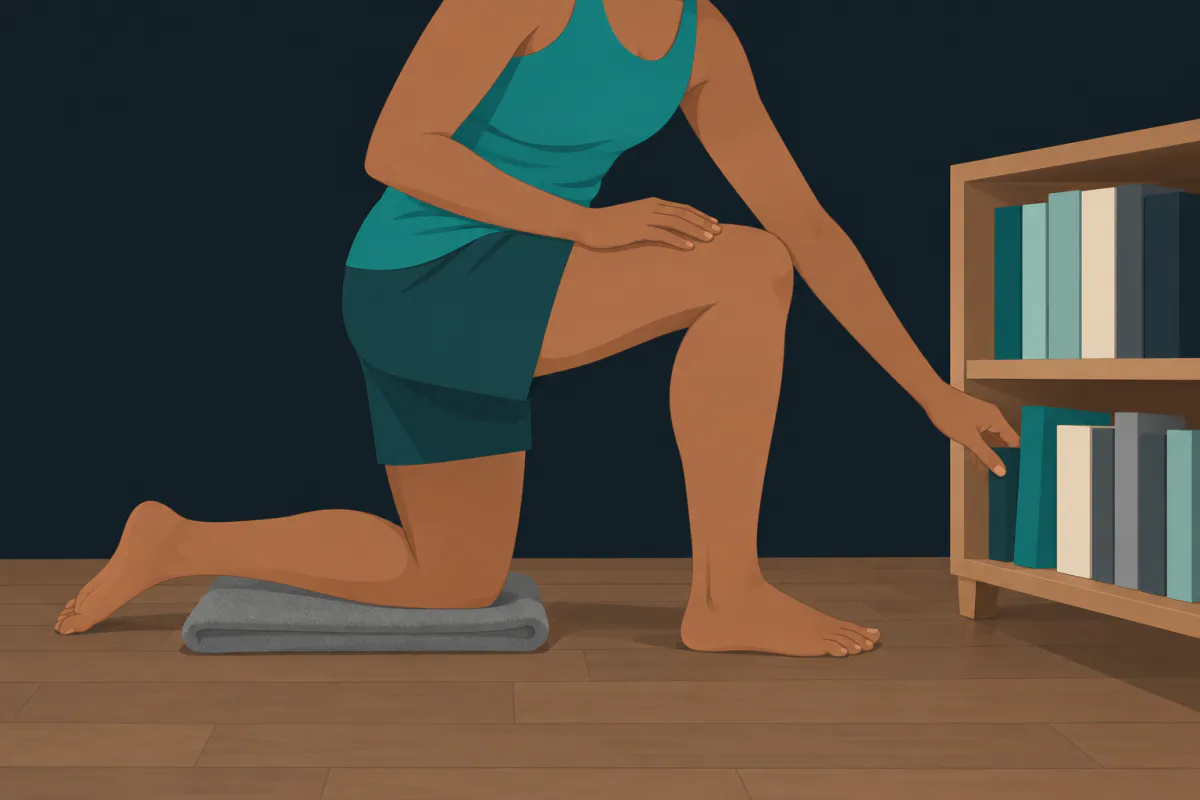
Kneeling is usually the last ordinary thing to come back, and often the one people stop mentioning because it seems too small to raise. The knee walks, cycles and eventually runs, and then you put it down on a hard floor and the front of it objects. This article covers what is sore when you kneel, how much of it depends on which graft was taken, and what tends to change with time.
Anything specific about your own knee is a question for your surgeon and physiotherapist, and their answer comes first. That is particularly true if a meniscus was repaired, because deep knee bend is often restricted in the early months and the limits vary between surgeons.
What is sore when you kneel
Kneeling is a small-area, high-pressure activity. Most of your upper body weight goes through the skin, the soft tissue beneath it, the kneecap and the tendon just below it — and after a reconstruction, that is the part of the knee the operation went through.
With a bone-patellar tendon-bone graft, the middle third of the patellar tendon is taken with a block of bone from the kneecap and another from the top of the shin, through an incision down the front. A hamstring graft is harvested through a smaller incision on the upper inner shin, but the front of the knee is still where you land. Either way, what meets the floor is scar.
Reviewing donor-site problems after ACL reconstruction, Kartus and colleagues put the figure for symptoms at 40 to 60 per cent of patients, and their list is worth reading as a list: tenderness, anterior knee pain, altered sensitivity of the skin, and an inability to kneel. Those are four separate complaints, and people have them in different combinations. Kneeling pain is not simply anterior knee pain in another position.
Altered sensitivity has its own explanation, set out in the article on numbness beside the scar. The infrapatellar branch of the saphenous nerve crosses the front of the knee on its way to the skin, and Kerver and colleagues, dissecting twenty knees, found its course varies enough between people that no definite safe zone could be identified. Skin whose nerve supply was interrupted can feel numb, oddly sharp, or both at once, which makes pressure on it hard to read.
What is worth saying plainly is that none of this is about the graft inside the joint. The new ligament sits between the thigh bone and the shin bone; the floor never touches it.
How common it is, and which graft it follows
The honest answer to “how common” is that the published range is enormous. Peebles and colleagues reviewed level I randomised trials from 1980 to 2023 and reported that the incidence of anterior knee pain after reconstruction with a bone-patellar tendon-bone graft ranged from 5.4 to 48.4 per cent across studies, and kneeling pain from 4.0 to 75.6 per cent. A spread that wide is not a measurement of patients so much as a measurement of questionnaires: what counts as kneeling pain, and when you ask, decides most of the answer.
Registries ask everyone the same question, which makes their numbers easier to compare. In the New Zealand ACL Registry, Rahardja and colleagues looked at 10,999 reconstructions and found that at two years, 9.3 per cent of patients reported consequential knee pain, defined as a score of 72 or below on the pain section of a standard knee questionnaire, and 12.0 per cent reported severe kneeling difficulty, meaning they described kneeling as severely or extremely difficult. The strongest predictor of that difficulty was the graft: 21.3 per cent after a bone-patellar tendon-bone graft against 9.4 per cent after a hamstring graft, an adjusted odds ratio of 3.12. Their conclusion was specific: the patellar tendon graft was associated with difficulty kneeling, but not with a more painful knee overall.
The Norwegian register points the same way at five years. Vuletic and colleagues followed 10,329 primary reconstructions and found hamstring grafts carried a 43 per cent lower risk of reporting problems with kneeling than bone-patellar tendon-bone grafts, with comparable results for pain and for knee extension.
Two things follow. Graft choice is the largest single influence on this symptom, and it is settled before the operation, weighing things — graft strength, re-rupture rates, your sport — that matter more to most surgeons than kneeling does. And even after the graft most associated with it, four in five people in the New Zealand data did not report severe difficulty.
Does it get better
Usually it eases, more slowly than the rest of recovery. Beyond that the studies do not support a confident number: long-term series disagree enough that quoting one would mislead.
There is useful perspective on what the pain costs, though. McAleese and colleagues followed 1,407 reconstructions with pain questionnaires at six months, one year, two years and five years, and concluded that knee pain associated with bone-patellar tendon-bone grafts did not limit activity levels, sports participation or quality of life. That is not the same as saying it goes away. For most people it stays a nuisance rather than a restriction — noticed on a hard floor, not in a game.
The list of things that hurt tends to narrow before it empties: bare knees on tile stay uncomfortable long after carpet is fine. Gardening, praying, playing with small children and trade work all involve real kneeling, and people who do them daily notice the residue for longer. The broader shape of recovery is in how long ACL recovery takes.
Getting the front of the knee used to pressure again
Once the wound has healed, the approach physiotherapists use for a tender scar is graded exposure: loading the area in small, repeated doses that are tolerable, and increasing them as it settles, rather than avoiding it until it feels ready. NHS patient information on scar desensitisation after joint replacement describes it that way — getting the scar and the skin around it used to being touched, starting with light contact and different textures. We could not find a trial testing this for kneeling after ACL reconstruction, so treat it as standard practice rather than a proven protocol, and set it up with your physiotherapist.
The principle behind the rest of the programme applies here too. The consensus guideline from van Melick and colleagues gates progression on a correct movement pattern, no pain, no effusion (fluid inside the joint) and no increase in symptoms afterwards, and the criterion-based structure described in Noyes’ Knee Disorders works the same way: what the knee tolerates decides the next step. Kneeling is rarely a formal criterion for moving up a rehabilitation level, which is part of why it gets so little attention in clinic unless you raise it.
Soreness at the front of the knee under pressure is not, by itself, a warning sign. The warning signs are different, and the NHS recovery guidance lists them: a calf that is hot, red, swollen or painful; a fever with spreading redness or discharge at the incision; new weakness or numbness in the foot; a knee that locks and will not move. Any of those means contacting your surgical team, your GP or an urgent care service the same day.
Where the app fits
Kneeling is not one of the exercises in ACL Recovery Tracker, and it is not a progression criterion in any of its levels — Levels 3 to 6 span roughly weeks 6 to 20 after surgery and are built around range of motion and then gym strength. What our free ACL rehab app for iPhone and Android is useful for here is the record: the pain diary takes a 0 to 10 score with the location marked on a body map and a note about what brought it on, so “kneeling on tile, 5” becomes a data point, and the pain history chart shows whether those entries are getting further apart. That is worth bringing to an appointment, because two years of vague memory is not.
Kneeling sits awkwardly in recovery because it is both trivial and not. Nobody tests it and no protocol has a milestone for it, yet it is the thing that tells a lot of people whether their knee is properly theirs again. It usually comes back quietly, later than the rest, and without anyone announcing it.
The illustrations in this article were generated with AI.
Sources
- Peebles LA, Akamefula RA, Aman ZS, Verma A, Scillia AJ, Mulcahey MK, Kraeutler MJ. Following anterior cruciate ligament reconstruction with bone-patellar tendon-bone autograft, the incidence of anterior knee pain ranges from 5.4% to 48.4% and the incidence of kneeling pain ranges from 4.0% to 75.6%: a systematic review of level I studies. Arthrosc Sports Med Rehabil. 2024;6(2):100902.
- Rahardja R, Love H, Clatworthy MG, Young SW. Comparison of knee pain and difficulty with kneeling between patellar tendon and hamstring tendon autografts after anterior cruciate ligament reconstruction: a study from the New Zealand ACL Registry. Am J Sports Med. 2023.
- Vuletic F, Inderhaug E, Martin RK, et al. Use of hamstring autografts for ACL reconstruction significantly decreased the risk of reporting problems with kneeling at a 5-year follow-up. J Exp Orthop. 2025;12(4):e70577.
- McAleese T, et al. Knee pain associated with bone-patellar tendon-bone autografts does not limit activity levels, sports participation or quality of life after ACL reconstruction. Knee Surg Sports Traumatol Arthrosc. 2026.
- Kartus J, Movin T, Karlsson J. Donor-site morbidity and anterior knee problems after anterior cruciate ligament reconstruction using autografts. Arthroscopy. 2001;17(9):971-980.
- Kerver AL, Leliveld MS, den Hartog D, Verhofstad MH, Kleinrensink GJ. The surgical anatomy of the infrapatellar branch of the saphenous nerve in relation to incisions for anteromedial knee surgery. J Bone Joint Surg Am. 2013;95(23):2119-2125.
- NHS Golden Jubilee. Scar desensitisation following joint replacement surgery. Patient information leaflet.
- van Melick N, et al. Evidence-based clinical practice update: practice guidelines for anterior cruciate ligament rehabilitation based on a systematic review and multidisciplinary consensus. Br J Sports Med. 2016;50:1506-1515.
- Noyes FR, Barber-Westin SD, eds. Noyes' Knee Disorders: Surgery, Rehabilitation, Clinical Outcomes. 2nd ed. Elsevier; 2017.
- NHS. ACL (anterior cruciate ligament) surgery: recovering.