The guide · Daily life, Early recovery
How to manage stairs after ACL surgery
Why the good leg leads going up and the operated leg goes down first, how much knee bend a staircase needs, and when step-over-step comes back.
Stairs are usually the first ordinary thing that turns out to be genuinely hard after ACL reconstruction. A staircase asks more of a knee than a flat corridor does, and asks for it in exactly the way the operation has left you least able to give. This article covers why, the sequence physiotherapy departments teach, what the knee does for months afterwards, and what decides when step-over-step stairs come back.
How you take the stairs now, and with what, is your physiotherapist’s and surgeon’s instruction — particularly if you have a weight-bearing restriction, a braced range limit, or something besides the ligament was repaired. The technique you were shown before leaving hospital comes first.
Why a staircase asks more than a corridor
Walking on the flat keeps the knee close to straight for most of the step. A stair does not. Livingston and colleagues measured stairclimbing across three staircases of different riser and tread dimensions and found the knee flexion required ranged from 83 to 105 degrees depending on the staircase. They also found people adapt to steeper or shallower steps mostly by changing what the knee does rather than the hip or ankle — the knee absorbs the difference.
That is more bend than level walking needs, and it has to be produced under load rather than with the foot in the air. Protopapadaki and colleagues, studying 33 healthy young adults on a four-step staircase, found ascent to be the more biomechanically demanding of the two directions — contrary to the common assumption that coming down is the hard part.
Both directions are demanding, then, but in different ways, and that difference is the key to the whole business. Going up, the leg on the higher step lifts your body weight, the quadriceps shortening under load. Going down, the leg left behind on the higher step lets your body weight down slowly, controlling the descent while the muscle lengthens. That second job is the one a recently operated knee is worst at, which is why people who manage a flight upwards often come down one step at a time, sideways, or backwards holding the rail.
Up with the good, down with the bad
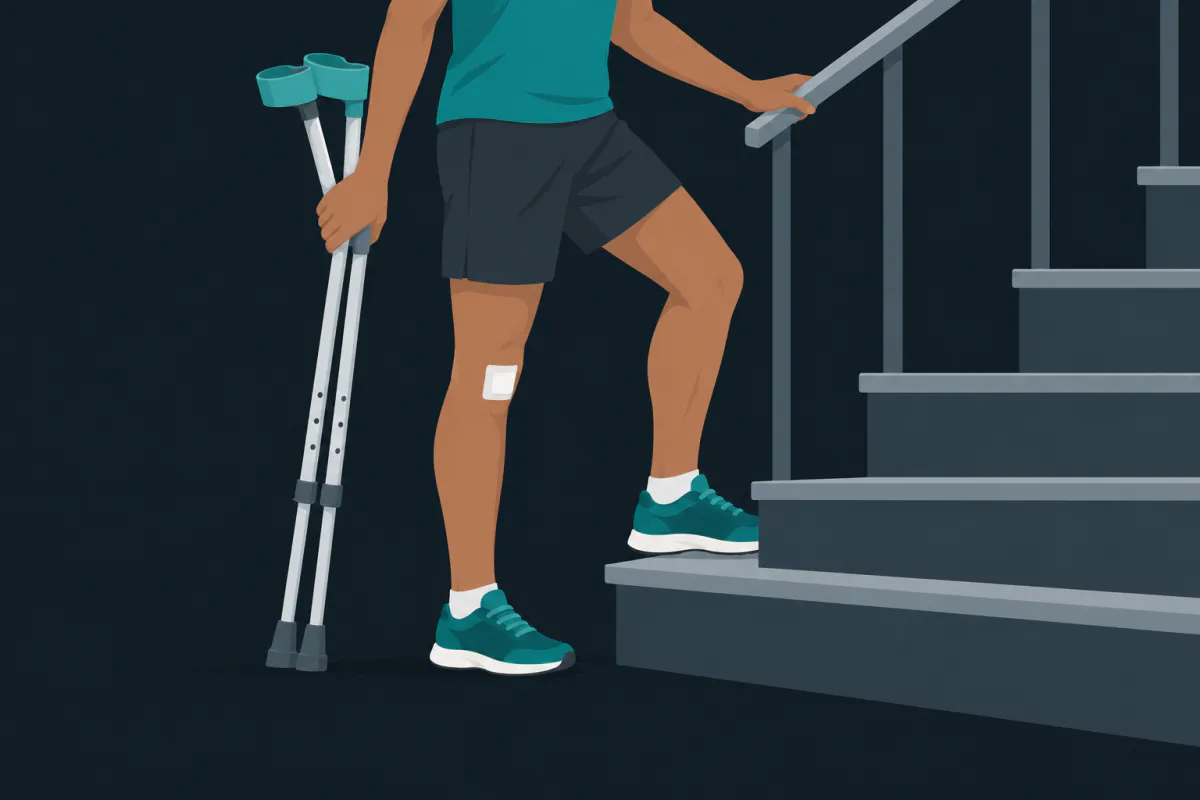
The sequence taught in NHS physiotherapy departments is a rhyme for the mechanics above: going up, the un-operated leg leads; coming down, the operated leg goes first. Crutches or a stick travel with the operated leg.
Going up, that means: good leg onto the step, then the operated leg and the crutches up to join it. Coming down: crutches onto the step below, then the operated leg, then the good leg. A rail is worth more than a crutch: most guidance has you hold it with one hand and carry both crutches in the other.
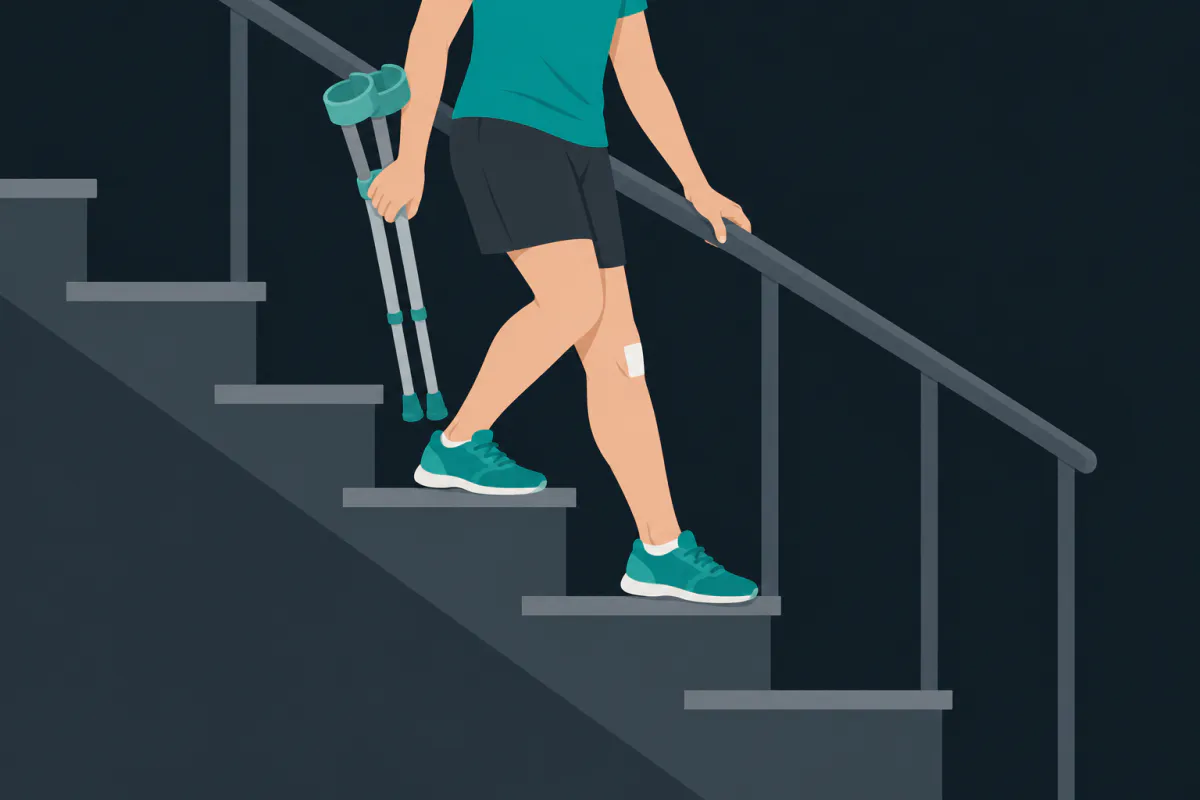
The logic is the same in both directions even though the order looks reversed. Going up, the good leg leads because leading is the working position; coming down, the leg that stays behind you is the one doing the lowering, so putting the operated leg down first is what spares it. The rhyme only sounds contradictory if you assume the hard job belongs to the leg in front.
The NHS notes that staff will show you how to use crutches properly, including on stairs, before you go home. It is not a technique to be worked out by trial on a dark staircase.
What the knee actually does for the next few months
The sequence gets you up and down safely. What it does not do is make the knee behave normally, and that takes longer than most people expect.
Yona and colleagues tracked people negotiating stairs in real-world settings at three and five months after reconstruction. At three months the operated knee bent noticeably less than the other — a mean difference of 11.3 degrees going up and 6.3 degrees coming down. By five months the ascent difference had narrowed to 4.7 degrees, but the asymmetry had not gone. At the point someone is walking normally, in other words, stairs are still being taken with a knee quietly avoiding its own range.
Hajizadeh and colleagues pooled nine studies of stair negotiation in ACL-injured and reconstructed knees. External knee flexion moments — a proxy for how much the quadriceps is asked to do — were lower in reconstructed knees than in uninjured controls and than in the person’s own other leg, both going up and coming down. Their conclusion was that these are long-term compensatory and asymmetric patterns rather than a short-lived limp.
Markström and colleagues looked specifically at the moment of weight acceptance coming down, comparing 49 athletes after reconstruction — early (under 6 months), middle (6 to 18 months) and late (over 18 months) — with 18 uninjured athletes. All three groups showed atypically large knee angles and moments at that instant, in both legs, which the authors read as a lasting strategy for keeping the knee under control; atypical hip and ankle mechanics were confined to the early group. Their recommendation was that rehabilitation should train the control of weight acceptance early rather than assume it returns on its own.
Underneath much of this sits the quadriceps. Palmieri-Smith and Lepley tested 73 people cleared to return to activity and found the size of the quadriceps strength deficit tracked with how asymmetric their knee mechanics and functional performance were. A staircase is a quadriceps test you take several times a day, and it is unforgiving about the answer.
When step-over-step comes back
There is no week number for this. Rehabilitation after this operation is organised around what the leg can do rather than how long ago it happened — the criterion-based logic set out in Noyes’ Knee Disorders — and the consensus guideline from van Melick and colleagues states the underlying gate for loading plainly: weight bearing is progressed where there is a correct movement pattern, with crutches if necessary, and no pain, no effusion (fluid inside the joint) and no increase in symptoms afterwards.
Applied to a staircase, a physiotherapist is generally watching for:
- Enough comfortable knee bend to clear the step without hitching the hip or swinging the leg round.
- Quadriceps control as the foot takes weight, with no sense of the knee giving way.
- Coming down under control rather than dropping onto the lower leg.
- Swelling and pain that settle after stairs rather than building the next day.
Going up step-over-step usually returns before coming down does, and coming down is often the last part to feel ordinary. Using the rail after you no longer strictly need it is not a setback, and nor is going back to one step at a time on a swollen day.
Separately, some things are not stair problems and are not worth working through. The NHS recovery guidance lists the standard warning signs after this surgery: a calf that is hot, red, swollen or painful; a fever with spreading redness or discharge at the incision; new weakness or numbness in the foot; a knee that locks and will not move. Any of those means contacting your surgical team, your GP or an urgent care service the same day.
Where stairs sit in your rehab
Stairs span Levels 1 to 3 in ACL Recovery Tracker — early recovery, progressive strengthening, advanced strengthening — and the levels’ criteria explain much of the difficulty. Level 1 asks for at least 90 degrees of knee flexion and walking without a limp before moving on; Level 2 asks for 125 degrees and full extension. Set those against the 83 to 105 degrees Livingston and colleagues measured for a staircase and it is clear why stairs feel out of reach at first and manageable later. The mobility log records extension and flexion in degrees, by hand or with the phone’s gyroscope, so what your knee did on the stairs this fortnight is described at your follow-up rather than remembered. From Level 3 the staircase becomes equipment: Assisted Step Ups are done on the bottom step of your own stairs, holding the rail. The app is a free ACL rehab tracker for iOS and Android, and you can use it to follow those sessions at home between physio visits.
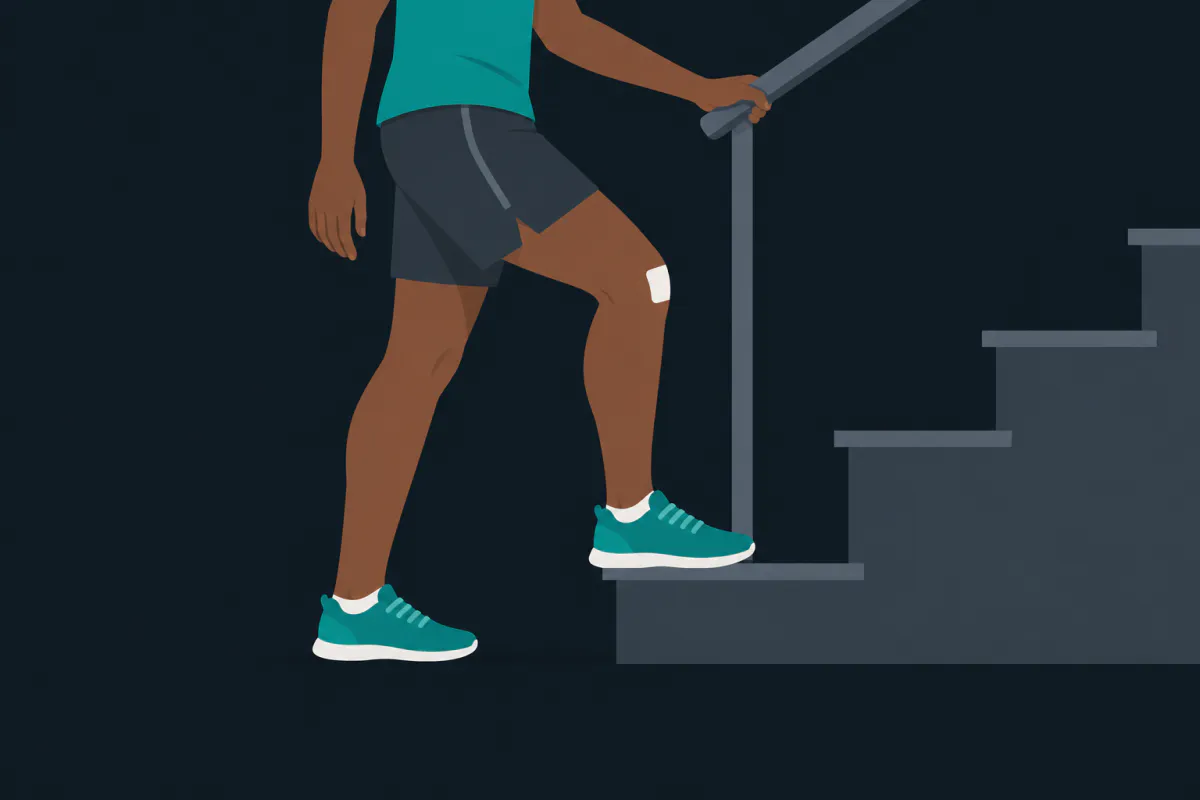
Stairs are a poor way to judge recovery day to day, because one flight tells you more about the house than the knee. Over months, though, they are an honest test: the day you come down a strange staircase without thinking about it is a real marker, and it arrives later than walking does.
The illustrations in this article were generated with AI.
Sources
- Livingston LA, Stevenson JM, Olney SJ. Stairclimbing kinematics on stairs of differing dimensions. Arch Phys Med Rehabil. 1991;72(6):398-402.
- Protopapadaki A, Drechsler WI, Cramp MC, Coutts FJ, Scott OM. Hip, knee, ankle kinematics and kinetics during stair ascent and descent in healthy young individuals. Clin Biomech. 2007;22(2):203-210.
- Hajizadeh M, Hashemi Oskouei A, Ghalichi F, Sole G. Knee kinematics and joint moments during stair negotiation in participants with anterior cruciate ligament deficiency and reconstruction: a systematic review and meta-analysis. PM R. 2016;8(6):563-579.e1.
- Yona T, et al. Lower limb kinematic changes during stair navigation 3 and 5 months after anterior cruciate ligament reconstruction: a longitudinal analysis in real-world settings. PM R. 2025;17(6):663-672.
- Markström JL, Liebermann DG, Schelin L, Häger CK. Atypical lower limb mechanics during weight acceptance of stair descent at different time frames after anterior cruciate ligament reconstruction. Am J Sports Med. 2022;50(8):2125-2133.
- Palmieri-Smith RM, Lepley LK. Quadriceps strength asymmetry after anterior cruciate ligament reconstruction alters knee joint biomechanics and functional performance at time of return to activity. Am J Sports Med. 2015;43(7):1662-1669.
- van Melick N, et al. Evidence-based clinical practice update: practice guidelines for anterior cruciate ligament rehabilitation based on a systematic review and multidisciplinary consensus. Br J Sports Med. 2016;50:1506-1515.
- Noyes FR, Barber-Westin SD, eds. Noyes' Knee Disorders: Surgery, Rehabilitation, Clinical Outcomes. 2nd ed. Elsevier; 2017.
- NHS. ACL (anterior cruciate ligament) surgery: recovering.
- University Hospitals Sussex NHS Foundation Trust, Physiotherapy department. Managing the stairs (unrestricted weight bearing).