Questions · Early recovery, Daily life
How to use the toilet after ACL surgery
Sit down with your operated leg forward and both hands on the seat; a raised seat helps a stiff knee. Plus constipation and peeing after a spinal.
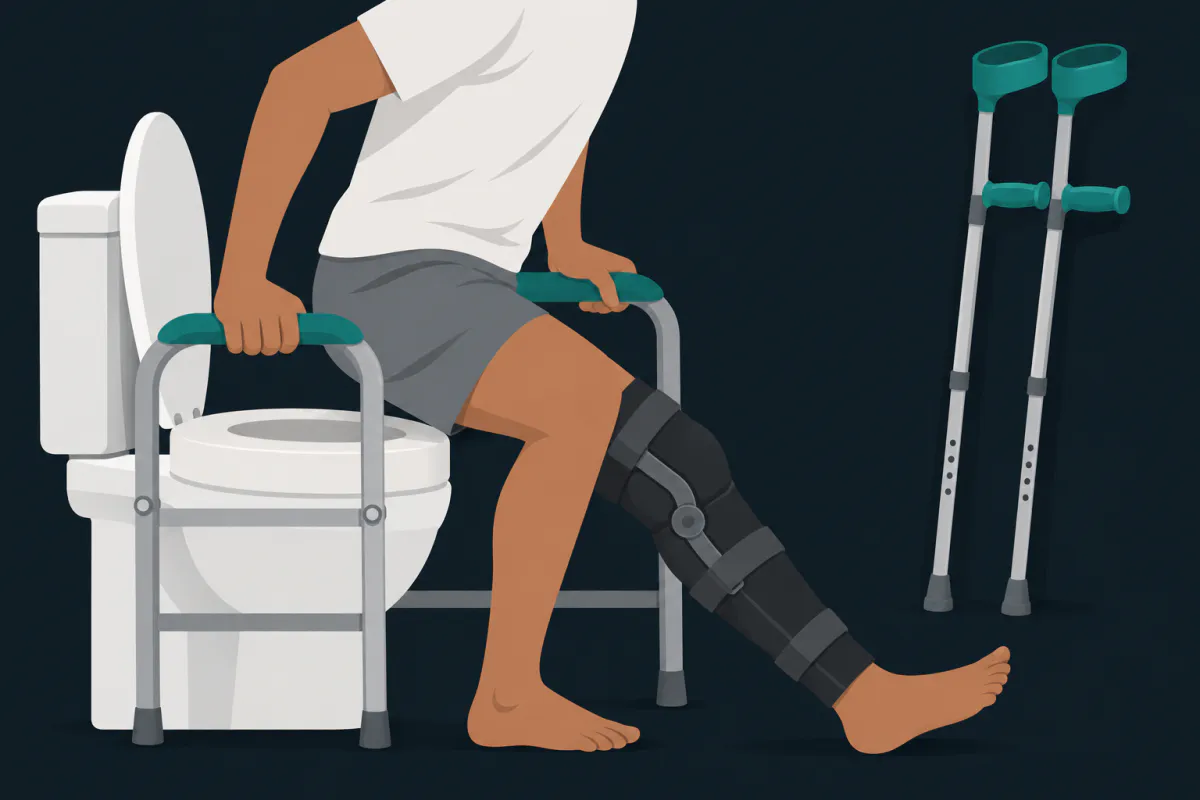
The short answer: you can use an ordinary toilet from the first day after anterior cruciate ligament (ACL) surgery. Back up until you feel the seat behind your legs, slide your operated leg forward and lower yourself with both hands on the seat. While your knee bends only a little, a raised seat helps.
Two other things may surprise you. Strong painkillers commonly cause constipation. And after a spinal anaesthetic, passing urine can be hard at first.
Your surgeon and physiotherapist decide how far you may bend your knee and whether you wear a brace. If they told you something different from this article, do what they said.
How to sit down on the toilet
Your healthy leg and your arms take your weight, so the operated knee does not have to bend far. Hospitals teach the same steps for a chair and a toilet after knee surgery.
To sit down:
- Walk to the toilet with your crutches and turn round until you feel the seat against the back of your legs.
- Slide your operated leg a little forward.
- Let go of the crutches. Reach back with both hands for the seat, or for the arms of a toilet frame if you have one.
- Lower yourself slowly. Let your operated knee bend only as far as is comfortable, or as far as your brace allows.
To stand up:
- Slide forward to the front of the seat, keeping your operated leg a little forward.
- Push up with both hands from the seat or the frame.
- Get your balance, then take your crutches.
Your physiotherapist may show you another way, with the crutches in your hands. Use the way you were shown.
Going to the toilet in a brace
Not everyone gets a brace after ACL surgery. It is more common when the meniscus was repaired as well. If you have one, it is usually worn day and night and taken off only to wash and dress. So you go to the toilet with it on.
Your surgeon or physiotherapist decides how far the brace lets your knee bend. If it is set straight, your operated leg stays out in front of you while you sit. Leave the setting alone unless your physiotherapist or surgeon changes it.
If you take the brace off to wash, keep your leg straight until the brace is back on.
When a raised toilet seat helps
A toilet is often the lowest seat in the home. In a small study of older adults, sitting down on a chair and getting up again took 90 to 120 degrees of knee bend.
Programmes usually aim for about 90 degrees of bend in the first week or two. Until you get there, or while your brace keeps your leg straight, a low toilet can be hard. The weekly targets are in the article on knee bend after ACL surgery.
Two pieces of equipment help:
- a raised toilet seat, which sits on top of the toilet and makes it higher;
- a toilet frame, which stands around the toilet and gives you arms to push on.
Some hospitals provide them when you go home, so ask before the operation whether you will need one. If your only toilet is upstairs, ask too whether a commode or a urine bottle would help in the first days.
At night
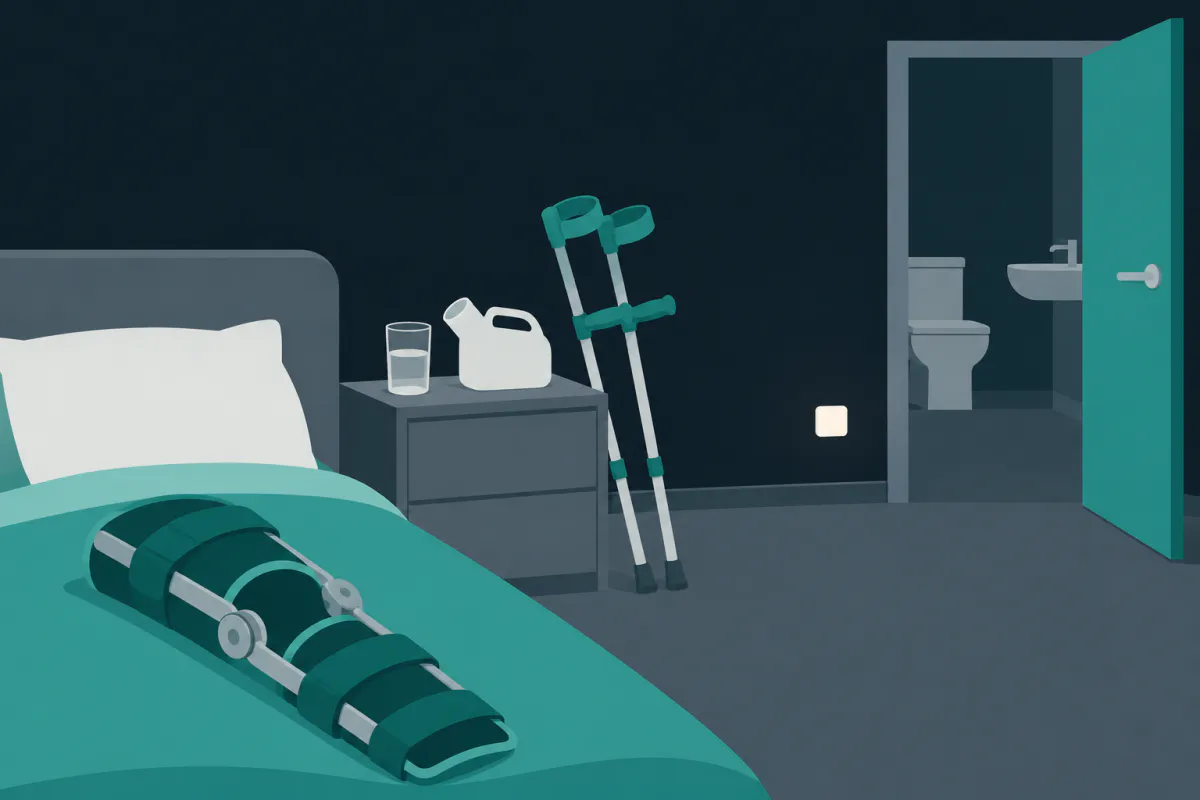
Before you go to bed, clear the floor between the bed and the toilet, and keep your crutches where you can reach them. If you wear a brace, keep it on for the trip.
A urine bottle by the bed can save the walk on the first nights. There is more about the first nights in the article on sleeping after ACL surgery.
Constipation from painkillers
Constipation is a common side effect of strong painkillers such as codeine. In the first days you also lie down a lot and move less, and that makes it more likely.
You are probably constipated if you poo less often than usual, the poo is hard and dry, or you have to strain.
What helps:
- drink plenty of water and other fluids;
- add fibre slowly, with fruit, vegetables and oats;
- go as soon as you feel the urge, rather than waiting;
- walk about as much as your physiotherapist allows.
If that is not enough, a pharmacist can suggest a laxative. Most work within 3 days and are meant for a short time only.
See your GP if the constipation does not get better with treatment, or if you have tummy pain or blood in your poo. Do not stop a prescribed painkiller on your own: talk to your GP first.
Passing urine after a spinal anaesthetic
A spinal anaesthetic is an injection in your back that numbs you from the waist down. ACL surgery is often done under one. Afterwards, passing urine for the first time can be difficult. Men with prostate problems are more likely to have trouble. A few people need a thin tube to drain the bladder (a catheter) at first.
That is why many hospitals check that you can pass urine before you go home.
Do not drink less to save trips to the toilet. Drinking enough lowers the risk of a blood clot and helps against constipation.
When to get help
After a spinal anaesthetic, contact the hospital where you had the operation straight away, or go to an emergency department, if:
- you cannot pass urine;
- you lose control of your bladder or bowel;
- the skin around your bottom or genitals goes numb.
Contact your surgical team, your GP or urgent care the same day if:
- redness is spreading around a cut, a cut is leaking, or you have a fever;
- your calf is hot, red, swollen or painful;
- you have new weakness or numbness in your foot;
- your knee has locked and will not move.
Call an ambulance if you suddenly feel breathless or have chest pain.
Your knee bend and the app
Sitting down gets easier as your knee bends further. ACL Recovery Tracker is our free ACL rehab app for iPhone and Android. You can follow your bend under Measure Mobility, typed in or measured with your phone, and Level 1’s checklist asks for at least 90 degrees.
If the toilet is still a struggle, tell your physiotherapist at your next appointment. They can watch how you sit down and stand up, and say whether a raised seat would help.
The illustrations in this article were generated with AI.
Sources
- Manchester University NHS Foundation Trust. Knee replacement information: my recovery at home. Patient information.
- University Hospitals Sussex NHS Foundation Trust. Advice following anterior cruciate ligament (ACL) reconstruction. Patient information, ref. 2255. 2023.
- The Robert Jones and Agnes Hunt Orthopaedic Hospital NHS Foundation Trust. Day case ACL. Information for patients. 2023.
- Adams D, Logerstedt DS, Hunter-Giordano A, Axe MJ, Snyder-Mackler L. Current concepts for anterior cruciate ligament reconstruction: a criterion-based rehabilitation progression. J Orthop Sports Phys Ther. 2012;42(7):601-614.
- York and Scarborough Teaching Hospitals NHS Foundation Trust. Getting ready for your joint replacement: practical advice on managing at home. PIL1581. 2025.
- Rowe PJ, Myles CM, Walker C, Nutton R. Knee joint kinematics in gait and other functional activities measured using flexible electrogoniometry: how much knee motion is sufficient for normal daily life? Gait Posture. 2000;12(2):143-155.
- NHS. Side effects of codeine.
- NHS. Constipation.
- Queen Victoria Hospital NHS Foundation Trust. Information following a spinal anaesthetic. Patient information, ref. 0327. 2023.
- West Suffolk NHS Foundation Trust. Spinal anaesthesia. Day surgery unit patient information, ref. 5254-9. 2024.
- National Institute for Health and Care Excellence. Venous thromboembolism in over 16s: reducing the risk of hospital-acquired deep vein thrombosis or pulmonary embolism. NICE guideline NG89.