Questions · Mobility, Measuring progress
Knee bend after ACL surgery: how much, and by when
Protocols usually aim for 90° in week 1, more than 110° by week 2 and a full bend, matching your other knee, by weeks 6 to 8. What each angle lets you do.
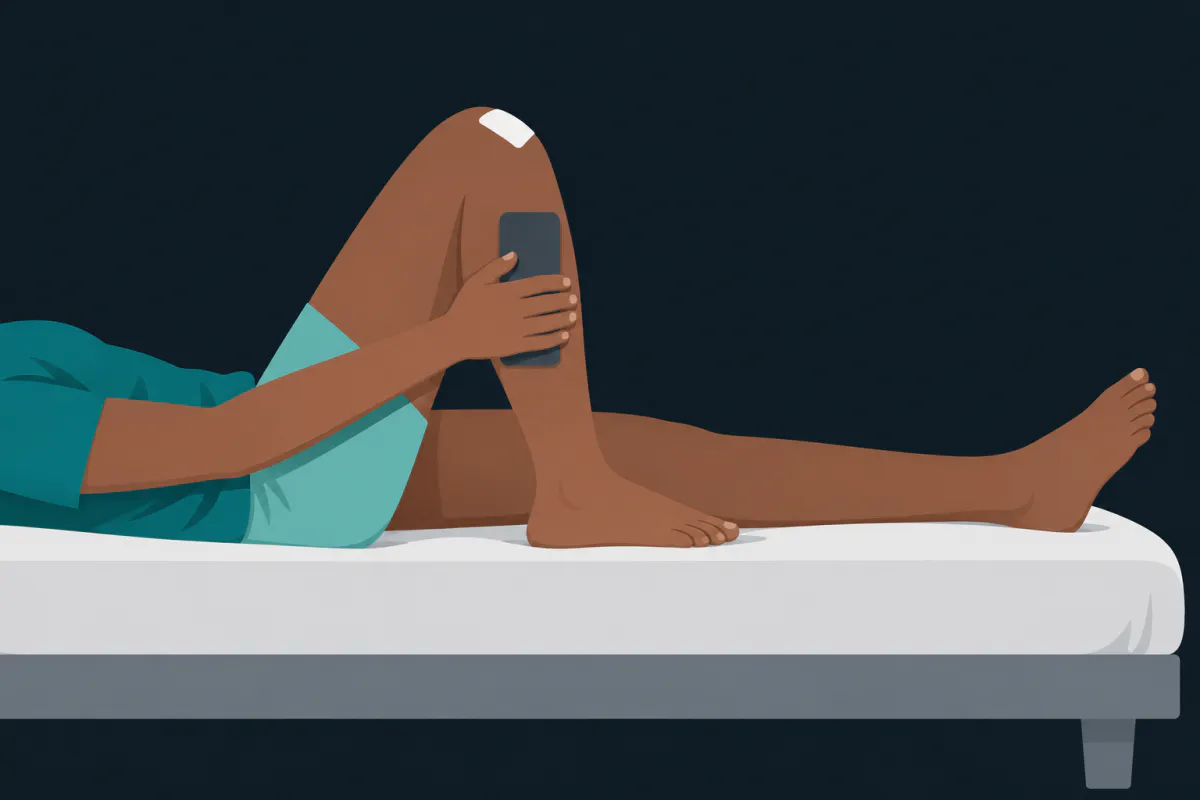
The short answer: published protocols usually aim for about 90 degrees of bend in week 1 and more than 110 degrees by the end of week 2. By weeks 6 to 8 the aim is a full bend, as far as your other knee goes. A healthy knee usually bends to about 133 to 142 degrees. A meniscus repair can slow the plan on purpose.
Your surgeon and physiotherapist set your own targets and limits. If they have told you to keep the bend under a certain angle, that comes before anything here.
How much should your knee bend each week?
The clearest week-by-week plan comes from a published criterion-based programme. From week 3 it compares your bend with your other knee, and it asks for a straight knee at the same time as the bend:
| When | Bend (flexion) | Straightening (extension) |
|---|---|---|
| Week 1 | 0 to 90 degrees | Aiming for straight (0 degrees) |
| Week 2 | More than 110 degrees | Full, walking with a straight knee |
| Weeks 3 to 5 | Within 10 degrees of your other knee | Full |
| Weeks 6 to 8 | Full, compared with your other knee | Full |
Another published guideline sets similar early targets. Its first phase lasts about two weeks. To move on, you need 110 degrees of active bend and a knee that is nearly straight. Its goal for weeks 2 to 6 is full range of motion. It calls its weeks approximate times for an average patient, not rules for progressing.
A meniscus repair changes this. With a stitched meniscus, that guideline keeps the bend under 90 degrees for the first 4 weeks. It then stays under 120 degrees until week 6. Your surgeon may use different limits, and theirs are the ones that count.
Why straight comes before bent
Both plans protect extension first. If your knee is not fully straight by week 2, the programme in the table adds gentle, long stretches to get it there. A knee that cannot straighten changes how you walk, so both programmes watch the last few degrees closely.
If yours is stuck short of straight, why a knee won’t straighten after ACL surgery explains what is usually done about it.
What “full” means: your other knee
Full does not mean one fixed number. A study of 674 healthy people measured how far their knees bent. Adults aged 20 to 44 reached about 138 to 142 degrees. People aged 45 to 69 reached about 133 to 138. Women bent a little further than men.
That is why your physio compares the operated knee with your healthy one. One study followed patients for at least 10 years after reconstruction. There, normal motion meant extension within 2 degrees of the other knee and flexion within 5 degrees. Losing normal motion was linked with worse knee function. It observed the patients of one centre, so it shows a link rather than proof.
What each angle lets you do
The numbers matter because daily life needs them. These figures come from healthy people, so they are a guide to what to expect rather than a pass mark:
- Walking, including slopes: less than 90 degrees.
- Stairs and getting in and out of a chair: about 90 to 120 degrees.
- A full turn on a standard exercise bike: about 110 degrees, at the top of the stroke. A higher saddle needs less.
- Getting into and out of a bath: about 135 degrees.
- Squatting down with your heels lifted: about 157 degrees.
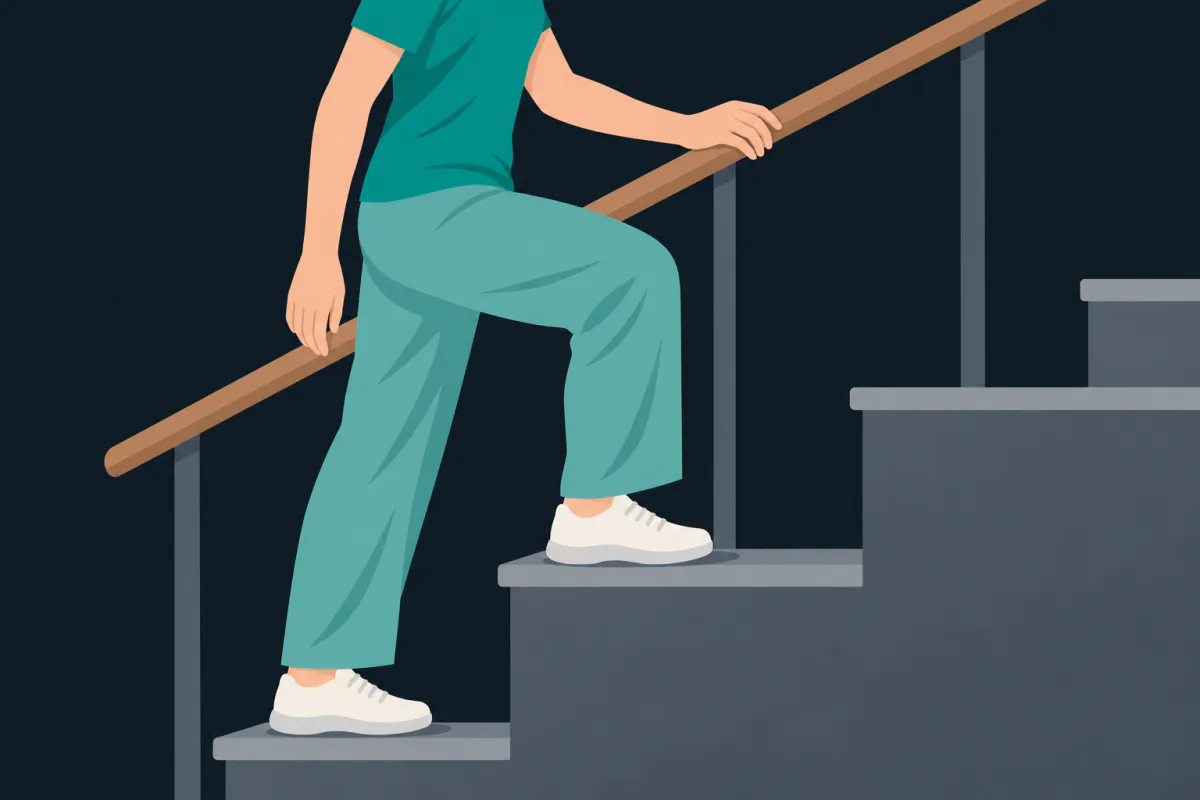
The study of daily activities measured 20 healthy adults with an average age of 67. It suggested 110 degrees as a reasonable goal for everyday life. After ACL surgery the aim is higher, because running, sport and kneeling ask for more bend. Before you return to running, a clinical guideline asks for full extension and at least 95 per cent of your other knee’s bend.
How to measure your bend at home
You can follow your bend between appointments with a phone laid flat along your bare shin. Use the same position and the same time of day each time. Bend to a firm stretch, not to pain, and measure both legs. The method, step by step, is in how to measure knee flexion at home with your phone. The straightening direction has its own method, in how to measure knee extension at home.
A few degrees up or down on one day means little. Swelling, a hard session or a stiff morning can all cost you some. Look at the trend across a week or two.
When to tell your physiotherapist
Being a few degrees behind the table is common, and it is not an emergency. Tell your physio at your next visit if your bend has not moved for a few weeks despite the exercises. Tell them too if your knee is getting less straight. Both are easier to deal with early.
A knee that suddenly locks and will not straighten needs a call to your surgical team the same day.
Using the app to follow your bend
The first four levels of ACL Recovery Tracker, our free ACL rehab app for iOS and Android, each put a bend on the checklist you tick before you move on. Level 1 asks for at least 90 degrees of flexion. Level 2 asks for 115 degrees and a knee as straight as the other. Level 3 asks for a bend within 10 degrees of your other knee. Level 4 asks for a knee that bends and straightens as far as the other.
You can log both angles in its mobility log, typed in or measured with your phone. Record your healthy leg too, as the baseline to compare against.
Your bend usually comes back in steps, with good weeks and flat ones. A dated log of both knees shows your physio how it is going. The gap between your two legs is the number to watch.
The illustrations in this article were generated with AI.
Sources
- Adams D, Logerstedt DS, Hunter-Giordano A, Axe MJ, Snyder-Mackler L. Current concepts for anterior cruciate ligament reconstruction: a criterion-based rehabilitation progression. J Orthop Sports Phys Ther. 2012;42(7):601-614.
- MOON Group. ACL rehabilitation guidelines. 2017.
- Kotsifaki R, Korakakis V, King E, et al. Aspetar clinical practice guideline on rehabilitation after anterior cruciate ligament reconstruction. Br J Sports Med. 2023;57(9):500-514.
- Rowe PJ, Myles CM, Walker C, Nutton R. Knee joint kinematics in gait and other functional activities measured using flexible electrogoniometry: how much knee motion is sufficient for normal daily life? Gait Posture. 2000;12(2):143-155.
- Soucie JM, Wang C, Forsyth A, et al. Range of motion measurements: reference values and a database for comparison studies. Haemophilia. 2011;17(3):500-507.
- Shelbourne KD, Gray T. Minimum 10-year results after anterior cruciate ligament reconstruction: how the loss of normal knee motion compounds other factors related to the development of osteoarthritis after surgery. Am J Sports Med. 2009;37(3):471-480.
- Ericson MO, Nisell R, Nemeth G. Joint motions of the lower limb during ergometer cycling. J Orthop Sports Phys Ther. 1988;9(8):273-278.
- Hemmerich A, Brown H, Smith S, Marthandam SS, Wyss UP. Hip, knee, and ankle kinematics of high range of motion activities of daily living. J Orthop Res. 2006;24(4):770-781.