The guide · Mobility, Measuring progress
How to measure knee extension at home
Why zero degrees is the wrong target, the two ways extension is measured, and how much of a day-to-day change is real rather than noise.
In the first weeks after an ACL reconstruction, a physiotherapist asks one question more often than any other: how straight is it? Extension — those last few degrees of straightening — is what early rehabilitation is organised around, and it is also the number most people have no idea of between appointments. This article explains what the measurement is, how it is taken without a clinic, and how much of a change from one day to the next is real.
A reading you take yourself is for watching a trend. What to do about a knee that will not straighten, and how hard it should be pushed, belongs to your physiotherapist and surgeon: they can see the joint and they know what was done to it.
Extension, and why zero is not the target
Extension is how far the knee straightens. A completely flat leg is zero degrees, and a knee that stops short of flat has an extension deficit, written as the degrees it is missing — “lacking 5 degrees”. Bend is the other direction and a separate number, covered in how to measure knee flexion with your phone.
Zero, though, is the wrong thing to aim at, because plenty of knees carry on a few degrees past flat. That is hyperextension, and in a knee that has always had it, it is simply that knee’s normal. This is why the figure clinicians work with is the difference between your two legs rather than the distance from zero. Cristiani and colleagues make the point from the other end: in 10,692 patients having a first ACL reconstruction at one Stockholm clinic, extension loss was present before surgery in 6.3%, and one of the factors associated with it was a physiologic extension deficit in the other knee. The uninjured side is the reference, and the uninjured side is not always flat either.
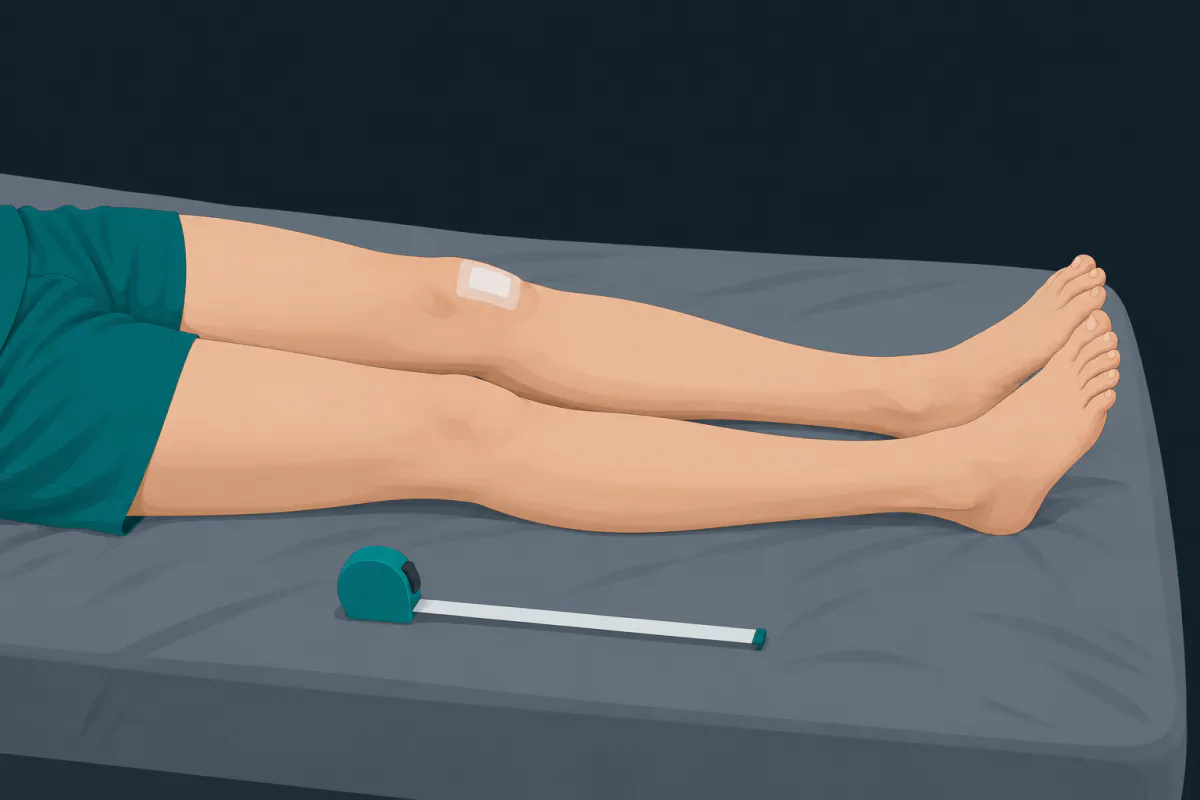
So a useful home reading is really two: whatever method you use, take the healthy leg as well and record the gap.
Why the number is worth taking at all
Because extension deficits are common, and they last longer than most people expect. Scholes and colleagues pooled 53 randomised trials covering 4,991 participants and found that, on average, around one patient in three still showed a loss of extension of at least three degrees at twelve months after reconstruction, falling to roughly one in four at two years; time since surgery and graft type both influenced the figures. A few degrees short of straight is not a rare complication; it is one of the ordinary ways this operation turns out.
It also travels with other problems. Georgoulis and colleagues reviewed twelve publications covering 976 patients, followed for a mean of 77.9 months, and found a moderate but consistent correlation between how much extension a group had lost and how much anterior knee pain it reported, with both patellar tendon and hamstring grafts. That is a relationship between study averages rather than proof that a stiff knee causes pain in any one person, but it is one reason the first few degrees are treated as urgent rather than cosmetic. The longer version of why is in why won’t my knee straighten after ACL surgery.
The guidelines are consistent here. The consensus update by van Melick and colleagues lists full extension range of motion, no extension lag and absent or minimal swelling among the targets of the early phase, and the 2023 Aspetar guideline concludes that early mobilisation can improve both flexion and extension range in the early phase without compromising knee laxity, whichever graft was used. The phase structure this sits inside, with range of motion as one of the gates between stages, is set out at length in Noyes’ Knee Disorders.
Two ways the number gets taken
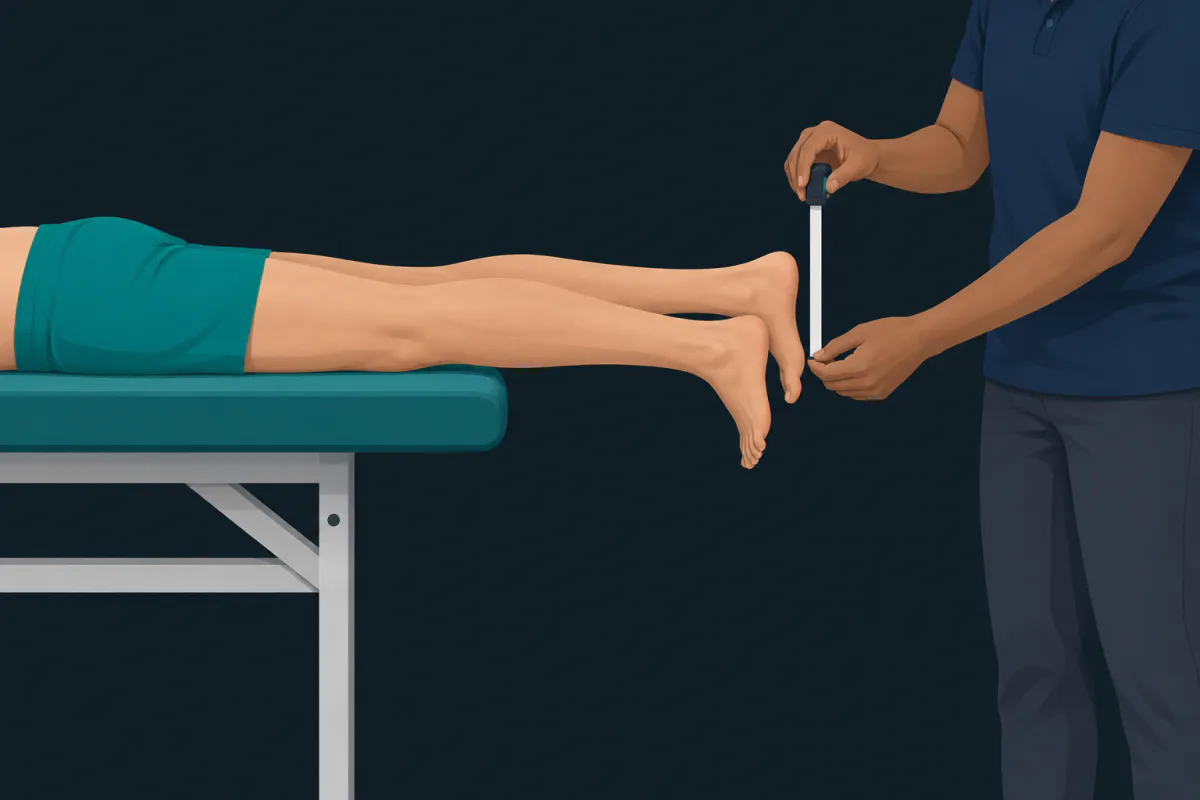
The first needs nothing but a tape measure. In the heel-height method the patient lies face down with the thighs supported and both knees clear of the end of a bed, so the lower legs hang and gravity does the straightening; the vertical gap between the heels is then measured. Schlegel and colleagues validated it against standard goniometry, found a high correlation between the two, and reported that it picks up subtle flexion contractures — a knee held short of straight — of less than ten degrees more easily than a goniometer does; roughly a centimetre of heel-height difference corresponds to about a degree. Differences in thigh girth and in where the kneecap sat did not affect its accuracy. Its advantage at home is that it is a comparison by construction: there is no zero to argue about, only a gap between two heels.
The second is to measure the angle itself, with a goniometer, a bubble inclinometer or a phone. Pantouveris and colleagues compared all three in patients with ACL injuries. When the same examiner repeated the measurement, all three were excellent, with intraclass correlations of 0.92 to 0.94 and the inclinometer best; between two different examiners the inclinometer and the smartphone app held up at 0.80 and 0.79 while the universal goniometer fell to 0.36. Milanese and colleagues had already found both a smartphone app and a universal goniometer highly reliable for repeated knee angle measurements, in experienced and novice hands alike.
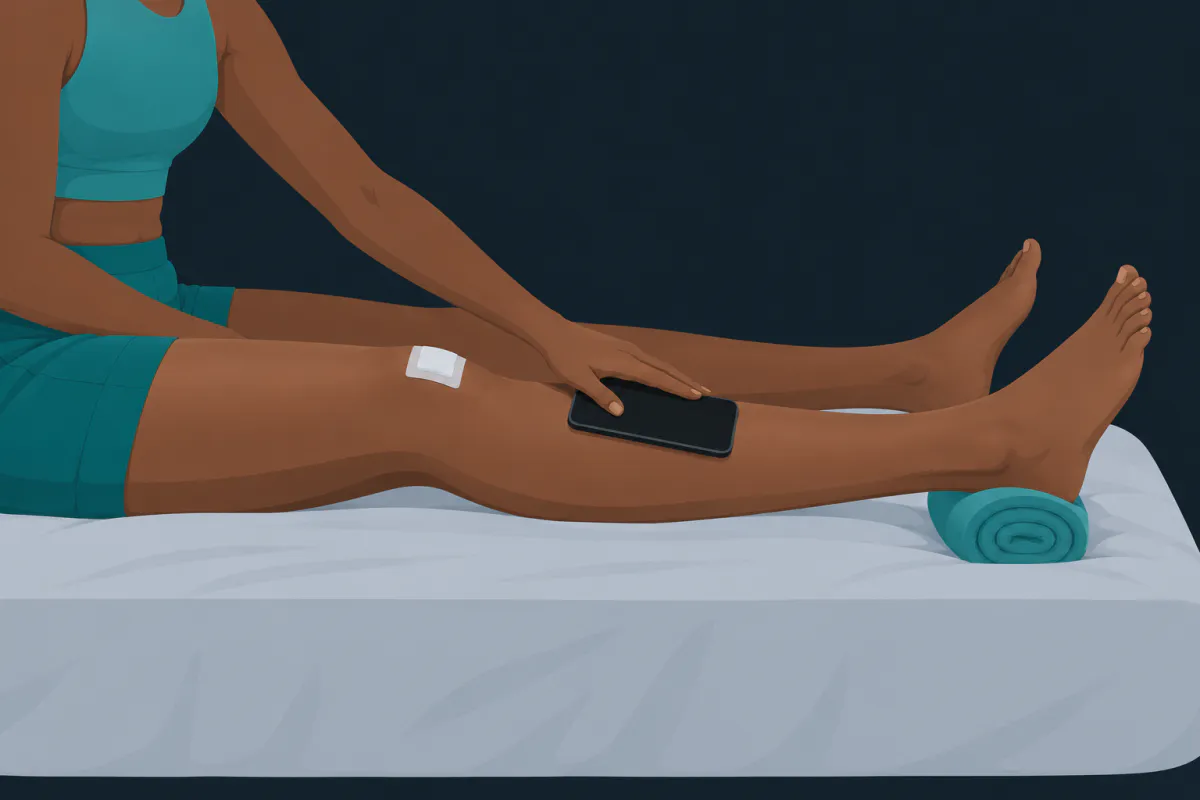
The practical reading is that the instrument matters less than the consistency of whoever uses it. At home that works in your favour: always the same person, same room, same bed.
Taking a reading you can trust
The habits that make home readings comparable are the dull ones.
- Same position every time. Lying on your back with the heel propped and the thigh unsupported, or face down with the legs hanging free, give different numbers. Pick one and write down which.
- Same time of day. Knees are stiffer in the morning and looser after exercise.
- Relaxed, not forced. Let the leg settle under its own weight and stop there. Stretching into the last degrees is part of a physiotherapy plan, not part of a measurement.
- Bare skin, and the phone along the shin bone rather than on the calf, if you are measuring the angle.
- Both legs, every time. The gap is the number that means something.
- Twice, and log the middle value if the two disagree by more than a couple of degrees.
Then there is what counts as progress. Pantouveris and colleagues also reported the smallest change that can be distinguished from measurement error: about 2.0 to 3.5 degrees when one person repeats the measurement, and 2.6 to 5.4 degrees on retesting. Two degrees better than yesterday is, on that evidence, indistinguishable from noise. Three weeks of readings trending towards the other leg is not.
One distinction is easy to miss. A propped heel measures how straight the knee can be made to go. Whether you can hold it straight yourself, with the quadriceps, is a separate thing — the extension lag that the consensus guideline lists as its own early target — and it is assessed in clinic rather than by a number you can take alone.
Finally, a few stubborn degrees are a different matter from a knee that suddenly cannot straighten at all or catches and locks: that, along with a calf that is hot, red, swollen or painful, a fever or redness or discharge at the incision, and new weakness or numbness in the foot, means a same-day call to your surgical team, your GP or an urgent care service.
Where the app fits
Extension is one of the two mobility readings our free ACL rehab app for iPhone and Android is built around, and it is a progression criterion at several of the early levels. In ACL Recovery Tracker you can type a figure in from a tape measure, a goniometer or your physiotherapist’s notes, or take the angle with the phone’s own sensor, set your healthy leg as the baseline, and watch the two converge on the Mobility Trends chart instead of trying to remember last fortnight’s number. A knee that stops short of flat goes in as a positive number of degrees: the app keeps minus figures for a knee that goes past straight, so a deficit written on your notes as “−5” is entered as 5.
A single home reading tells you very little, and that is fine, because nobody needs it to. What the measurement gives you is a line on a chart and something specific to say at your next appointment — and, if the line stops moving for a few weeks, a reason to say it sooner.
The illustrations in this article were generated with AI.
Sources
- Scholes C, Ektas N, Harrison-Brown M, et al. Persistent knee extension deficits are common after anterior cruciate ligament reconstruction: a systematic review and meta-analysis of randomised controlled trials. Knee Surg Sports Traumatol Arthrosc. 2023;31(8):3172-3185.
- Schlegel TF, Boublik M, Hawkins RJ, Steadman JR. Reliability of heel-height measurement for documenting knee extension deficits. Am J Sports Med. 2002;30(4):479-482.
- Pantouveris M, Kotsifaki R, Whiteley R. Inclinometers and apps are better than goniometers, measuring knee extension range of motion in anterior cruciate ligament patients: reliability and minimal detectable change for the three devices. J Knee Surg. 2024;37(12):821-827.
- Georgoulis JD, Savvidou OD, Patras K, et al. Association of anterior knee pain with extension deficit after anterior cruciate ligament reconstruction: a systematic review. Orthop J Sports Med. 2024;12(10).
- Cristiani R, Sandström E, von Essen C, et al. Early surgery, meniscal injury and physiologic contralateral knee extension deficit are associated with extension loss prior to anterior cruciate ligament reconstruction. Knee Surg Sports Traumatol Arthrosc. Published online 2026.
- Milanese S, et al. Reliability and concurrent validity of knee angle measurement: smart phone app versus universal goniometer used by experienced and novice clinicians. Man Ther. 2014;19(6):569-574.
- van Melick N, et al. Evidence-based clinical practice update: practice guidelines for anterior cruciate ligament rehabilitation based on a systematic review and multidisciplinary consensus. Br J Sports Med. 2016;50:1506-1515.
- Kotsifaki R, Korakakis V, King E, et al. Aspetar clinical practice guideline on rehabilitation after anterior cruciate ligament reconstruction. Br J Sports Med. 2023;57:500-514.
- Noyes FR, Barber-Westin SD, eds. Noyes' Knee Disorders: Surgery, Rehabilitation, Clinical Outcomes. 2nd ed. Elsevier; 2017.