Questions · Early recovery, Daily life
How to get home after ACL surgery in a brace
Someone else drives you, best by car with room to keep the operated leg straight. How to get into the car in a brace, when to stop, and what to do at home.
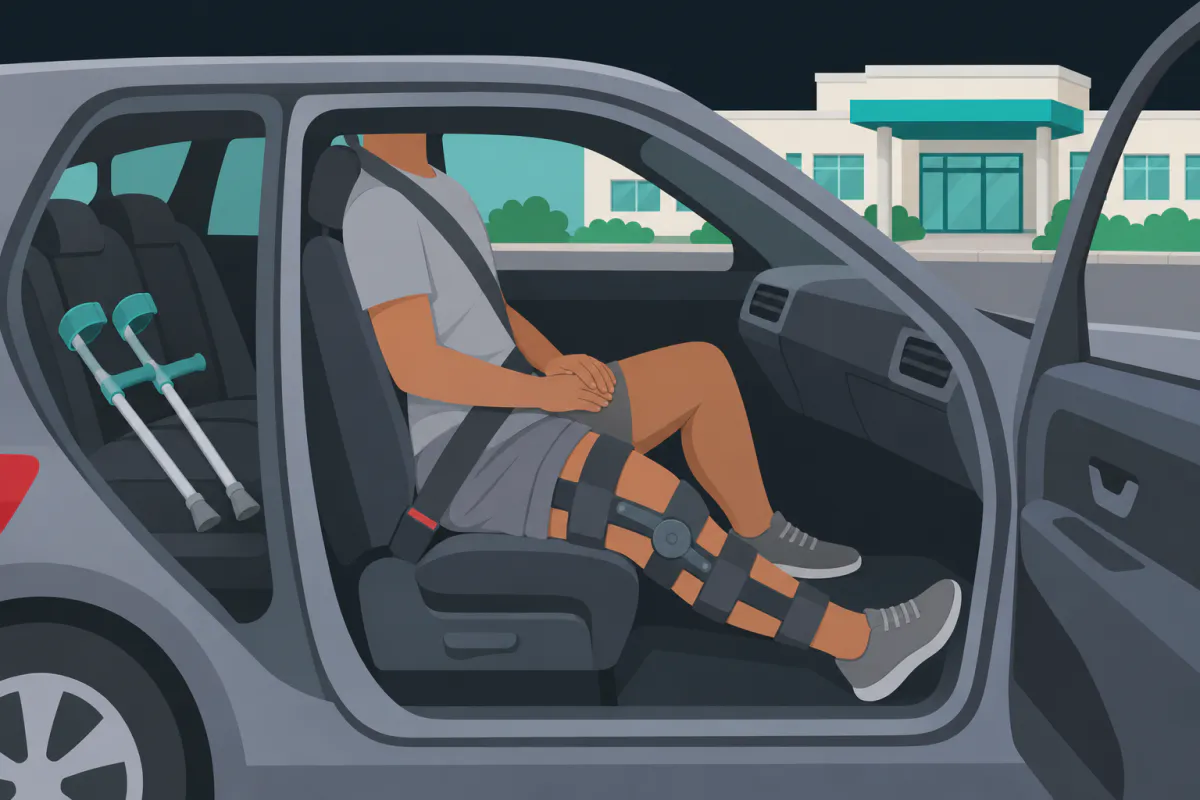
You cannot drive yourself home after anterior cruciate ligament (ACL) surgery, so another adult takes you, best by car. Sit where the operated leg can lie straight. That means the front seat pushed all the way back, or the back seat with your leg along it and the seatbelt on. A brace, if you were given one, usually stays on for the journey. On a long drive, stop now and then and walk a little.
Your surgeon and physiotherapist decide when you go home, whether you need a brace and how it is set. If the hospital told you something different from this article, do what they said.
Who takes you home
After a general anaesthetic you cannot drive for the first 24 hours, and with the operated leg you will not be driving for several weeks. So arrange the journey before the day. An adult collects you from hospital, and someone stays with you at home for the first 24 hours. Some hospitals may cancel the operation if this is not arranged.
A car is the easiest way home. It is more comfortable, and if something goes wrong on the way, a car gets you back to the hospital faster. Hospitals differ on other transport. Some rule out public transport, while others accept a taxi or a bus if an adult travels with you. So ask your hospital before the operation.
After an ACL reconstruction you often go home the same day, sometimes the next. Before you leave, a physiotherapist checks that you walk safely on crutches and can manage stairs.
The brace on the journey
Not everyone gets a brace. It is more common when a meniscus was repaired or cartilage was treated along with the ACL. Some hospitals do not use one after an ACL reconstruction on its own, and others give one for a long journey home, for comfort. Your surgeon decides whether you need one, and the article on braces explains why the advice varies.
If you have a brace, you usually wear it all the time. It comes off only to wash and dress, or while you lie with the leg raised. So in the car you sit in the brace.
The brace limits how far the knee bends, and your surgeon decides how far. With the leg nearly straight in the brace, you need plenty of room in the car.
How to get into the car with a straight leg
Before you get in, push the front passenger seat all the way back. If the seat is low, a cushion helps. It helps if the seat’s surface lets you slide easily.
To get in:
- Get in from street level, not from the kerb or a step.
- Turn your back to the seat until you feel its edge against the back of your legs.
- Sit down carefully.
- Slide back on the seat and turn your whole body to face forwards. As you turn, have someone lift your legs into the car.
- Fasten the seatbelt.
To get out, do the same in reverse. Hospitals also suggest a car big enough for you to sit in the back with your foot up on the seat and the seatbelt on.
If you had a nerve block, the knee can stay numb for up to 12 hours. While it works, the muscles around the knee may not respond either, and the knee can give way. So do not get up or walk on your own: get out of the car with someone standing beside you.
As the block wears off, the pain often rises fairly quickly, usually within the first day. Keep the painkillers from the hospital within reach, and ask there when to take them.
On a long journey
An operation on the knee and a journey of more than 4 hours both raise the risk of a blood clot in the leg. So hospitals advise stopping on a long drive, getting out of the car and walking a little. How often varies between leaflets, from every 30 minutes in the first 6 weeks to every 45 to 60 minutes.
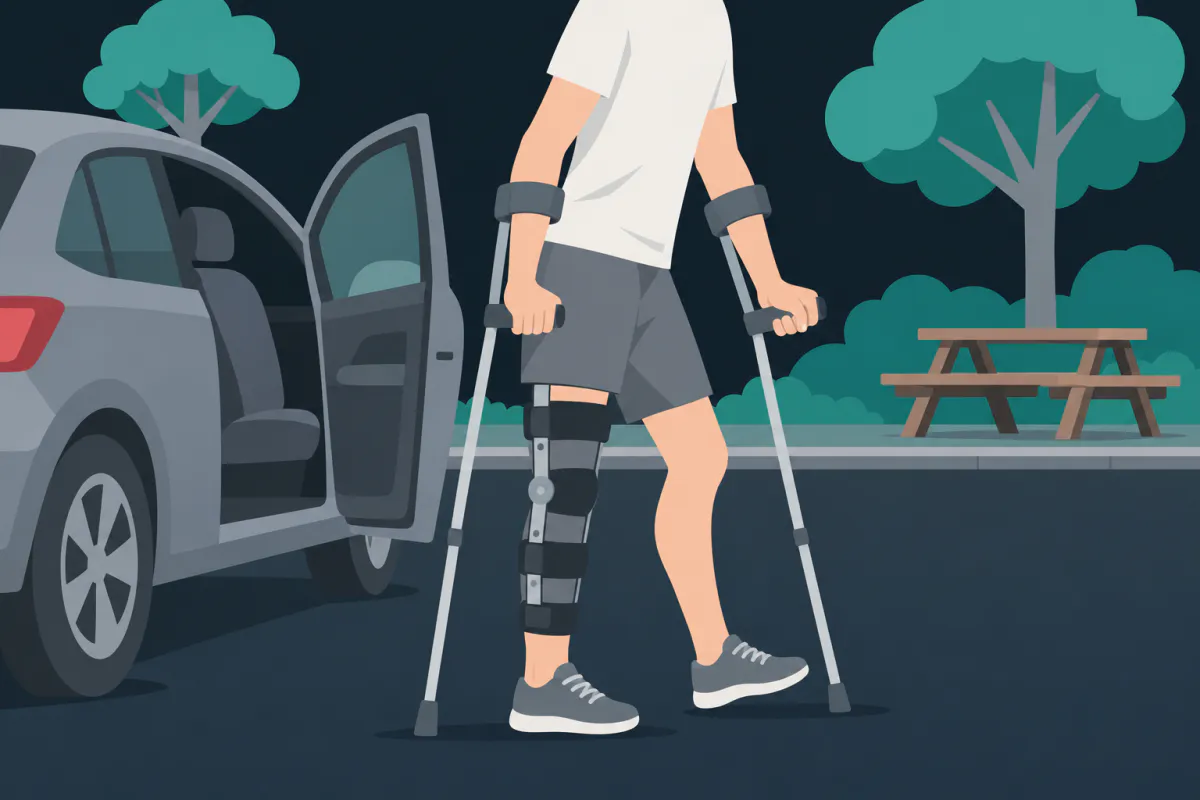
While you ride, move your feet up and down at the ankle. Drink plenty of water, and leave out alcohol.
Once you are home
You walk from the car to the door on crutches. If there are steps on the way, use them as the hospital showed you. Going up, the healthy leg goes first; coming down, the crutches and the operated leg go first. The article on stairs has the details.
At home, the first thing is to lie down and raise the leg. Put 3 or 4 pillows under the whole leg from the heel, so your toes are above your nose. Stay like that for half an hour. Ice goes on for 20 minutes over a damp cloth, with at least 20 minutes between applications.
When to get help
Contact your surgical team, your GP or urgent care the same day if:
- your calf is hot, red, swollen or painful;
- redness spreads around a cut, it leaks, or you have a fever;
- your foot has new weakness or numbness after the block should have worn off;
- your knee locks and will not move.
Call an ambulance if you suddenly become breathless or have chest pain.
Getting home and the app
ACL Recovery Tracker is our free ACL rehab app for iOS and Android. In the first days at home, its “Ice and raise the leg” care routine reminds you when to lie down with the leg up again. When the block wears off and the knee starts to hurt, note it in “Log Pain & Swelling”. You record a score from 0 to 10, where it hurts and when.
The hardest part of the journey is getting into the car and out of it. Once the car, the company and the painkillers are sorted beforehand, the day itself is simple: get home and lie down with the leg raised.
The illustrations in this article were generated with AI.
Sources
- NHS. Having an operation (surgery): after surgery.
- Oxford University Hospitals NHS Foundation Trust. Anterior cruciate ligament reconstruction: information about your operation and recovery. Leaflet OMI 107548. 2026.
- NHS Golden Jubilee. Anterior cruciate ligament (ACL) reconstruction surgery. Patient information, version 5. 2024.
- NHS Golden Jubilee. Hunter canal block. Patient information, version 1. 2023.
- The Robert Jones and Agnes Hunt Orthopaedic Hospital NHS Foundation Trust. Day case ACL. Information for patients. 2023.
- University Hospitals Sussex NHS Foundation Trust. Physiotherapy advice after your anterior cruciate ligament (ACL) reconstruction. Patient information, ref. 2651. 2025.
- West Suffolk NHS Foundation Trust. Anterior cruciate ligament reconstruction surgery: advice to patients. Ref. 5233-2. 2024.
- The Royal Wolverhampton NHS Trust. Anterior cruciate ligament (ACL) reconstruction surgery. Patient information. 2025.
- MedlinePlus, US National Library of Medicine. Taking care of your new knee joint. 2025.
- NHS. Deep vein thrombosis (DVT).
- Barry GS, et al. Factors associated with rebound pain after peripheral nerve block for ambulatory surgery. Br J Anaesth. 2021;126(4):862-871.