Questions · Early recovery, Daily life
When can you shower after ACL surgery?
Usually after 48 hours, if the cuts have a waterproof dressing. A bath waits until the stitches are out and the wound has healed. How to shower in a brace.
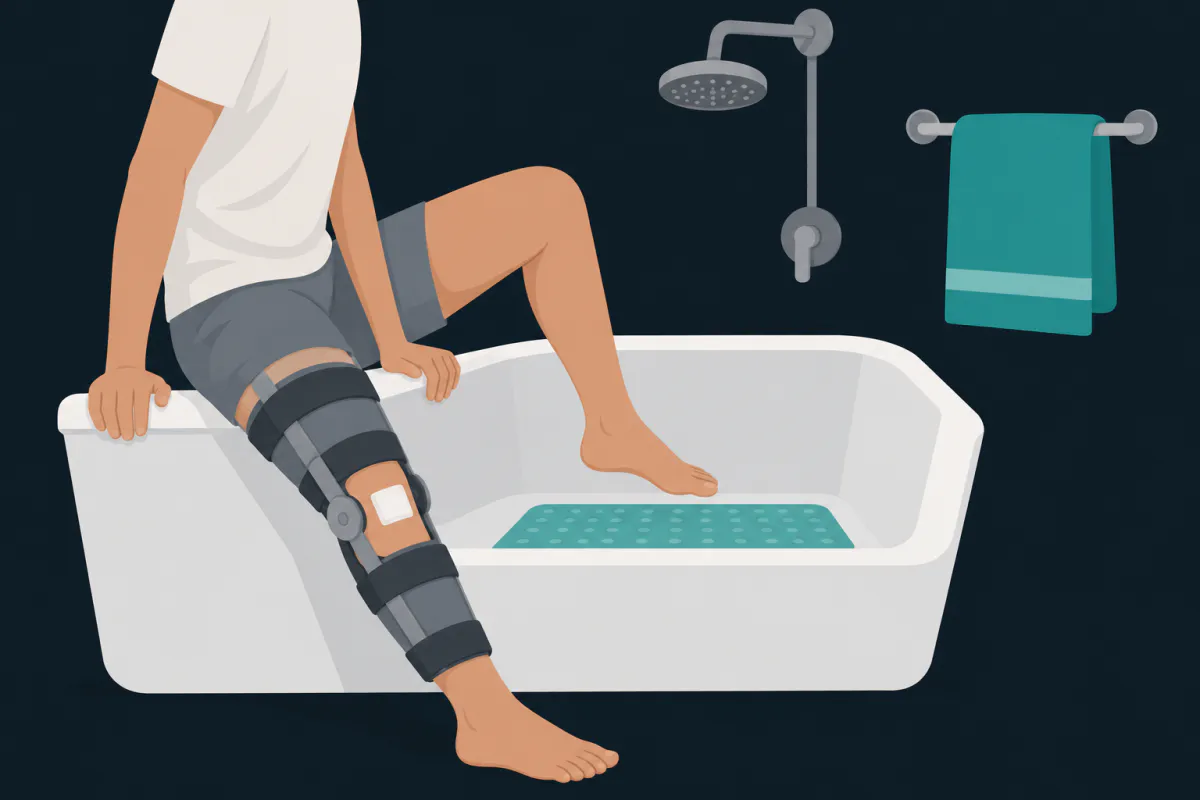
You can usually shower 48 hours after anterior cruciate ligament (ACL) surgery. The small cuts are most often covered with a waterproof dressing, so the dressing can get wet. A bath has to wait until the stitches are out and the wound has fully healed. Stitches usually come out 10 to 14 days after the operation.
The bigger risk in the shower is the wet floor, not the water. If you wear a brace, it is safer to keep it on as you step in and out. Take it off only once you are inside.
Your surgeon and nurse decide how to care for the wound and when the brace may come off. If they told you something different from this article, do what they said.
When can you shower after ACL surgery?
Guidelines say showering is safe from 48 hours after surgery. The small cuts from an ACL reconstruction are usually covered with a waterproof dressing. Water runs off it and does not reach the wound, so you can stand under the shower with it on.
Not every hospital does this. Some ask you to keep the dressing dry and wash at the sink until the wound has been checked. The wound itself should not get wet, and your hospital will tell you how to wash. So ask before you go home whether your dressing is waterproof.
The bulky bandage you went home in comes off when the nurse says so. If the dressing starts to peel, or water gets under it, tell the nurse who looks after your wound.
Why a bath has to wait
In a bath the wound lies in water for a long time. So baths, pools and hot tubs usually wait until the stitches are out and the wound has fully healed, not just dried.
A nurse usually takes stitches or clips out 10 to 14 days after the operation. Some stitches dissolve on their own, and then nothing needs taking out. Whoever checks the wound decides when it has healed. When you can get into a pool is in the article on swimming after ACL surgery.
Getting ready for the shower
If you still wear compression stockings (anti-embolism stockings), take them off before the shower. They come off once a day anyway, so you can wash and check your skin. Put them back on once your skin is dry.
A brace, if you have one, is usually worn day and night and taken off only to wash and dress. Not everyone gets one: after an ACL reconstruction alone a brace is often not needed, and after a meniscus repair the rules can be stricter. How to use the toilet with a brace on is in the article on using the toilet after ACL surgery.
So ask your surgeon whether you may take the brace off to shower. There is more on this in the article on whether you need a brace.
Before you start:
- if the shower floor is slippery, put a non-slip mat on it;
- put your towel where you can reach it without stepping out;
- if you have a plastic shower stool, washing sitting down is safer still.
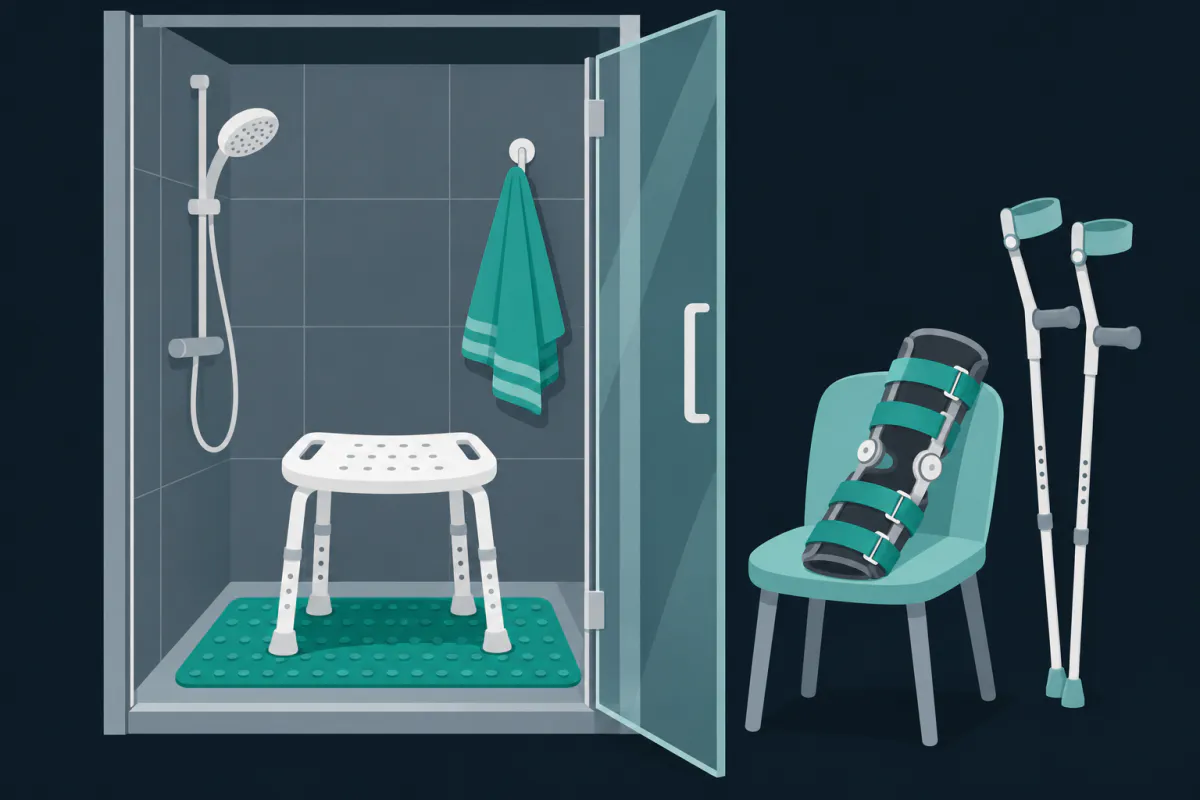
How to shower in a cubicle with a brace
The graft is at its weakest in the first 6 to 12 weeks. If you slip on a wet floor, the sudden movement can damage it, so the shower needs extra care during this time.
The order can look like this:
- Sitting down, take off your compression stockings if you still wear them. Make sure your brace is on.
- Step into the shower in the brace.
- Once inside, take the brace off and put it where you can reach it later.
- Wash. While the brace is off, keep your operated leg straight.
- Dry yourself before you step out.
- Put the brace back on, and only then step out.
Without the brace, it is better not to walk or turn around in the bathroom: it is wet and slippery.
How to get into a bath with a shower over it
If your shower is over the bath, leave the bath empty: you stand in it under the shower. The hardest part is getting over the side, and doing it sitting down is safer than standing.
To get in:
- Make sure your brace is on.
- Sit on the edge of the bath.
- Lift your healthy leg over first, then your operated leg.
- Stand up in the bath, take the brace off and wash.
To get out:
- Dry yourself and put the brace back on while still standing in the bath.
- Sit on the edge of the bath.
- Lift your operated leg out first, then your healthy leg.
- Stand up.
If the bottom of the bath is slippery, put a non-slip mat there too. As in a cubicle, avoid any extra movement in the bath without the brace.
When to call a doctor
Warning signs can appear while the wound heals. Contact your surgical team, your GP or urgent care the same day if:
- redness is spreading around a cut, a cut is leaking, or you have a fever;
- your calf is hot, red, swollen or painful;
- you have new weakness or numbness in your foot;
- your knee has locked and will not move.
Call an ambulance if you suddenly feel breathless or have chest pain.
If you slip or fall and your knee then swells or hurts more, tell your surgeon or physiotherapist.
Showering and the app
In the first weeks a shower is also time on your feet. Hospitals usually advise against standing or walking for more than 20 to 30 minutes at a time, so the knee swells less. That makes right after the shower a good moment to lie down with your leg raised.
ACL Recovery Tracker is our free ACL rehab app for iPhone and Android. Its care routines include “Ice and raise the leg”, with reminders. If your knee hurts more after a shower, note it under Log Pain & Swelling: a score from 0 to 10, where it hurt and when.
Within a few days this order usually becomes a habit. Baths come back once the wound has healed and your surgeon has confirmed it.
The illustrations in this article were generated with AI.
Sources
- National Institute for Health and Care Excellence. Surgical site infections: prevention and treatment. NICE guideline NG125. 2019.
- NHS. ACL (anterior cruciate ligament) surgery: recovering.
- University Hospitals Sussex NHS Foundation Trust. Advice following anterior cruciate ligament (ACL) reconstruction. Patient information, ref. 2256. 2023.
- The Robert Jones and Agnes Hunt Orthopaedic Hospital NHS Foundation Trust. Day case ACL. Information for patients. 2023.
- National Institute for Health and Care Excellence. Venous thromboembolism in over 16s: reducing the risk of hospital-acquired deep vein thrombosis or pulmonary embolism. NICE guideline NG89.