The guide · Daily life, Exercises
Swimming after ACL surgery: the wound and the kick
Why the incision decides when you get in the pool, what water does for a stiff knee, and why the breaststroke kick is usually the last one back.
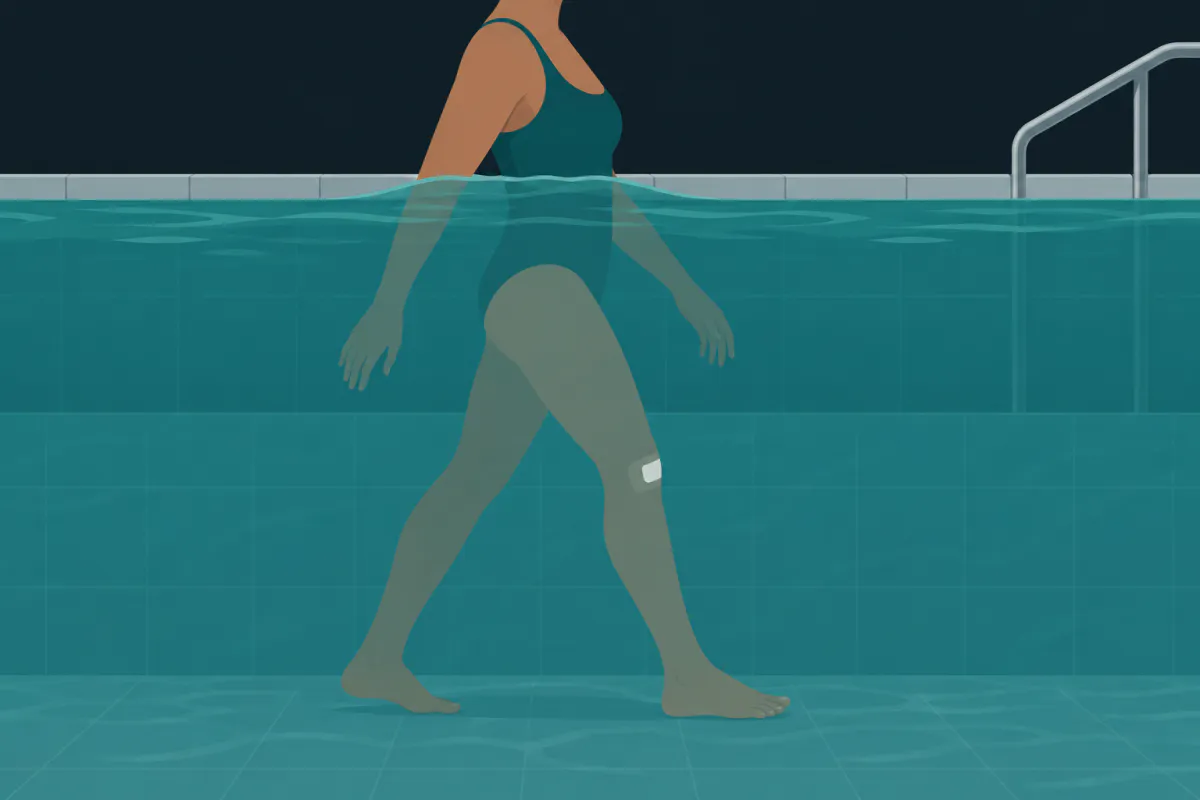
Swimming looks like the ideal exercise for a newly reconstructed knee: no impact, nothing to trip over, and the water carries most of your weight. Much of that is true, and it still is not the first question to settle. Two other things decide when you get in — whether the surgical wound has closed, and which kick you intend to use.
When swimming starts, and with which strokes, is a decision for your surgeon and physiotherapist, and their instructions come first. That is particularly true if a meniscus was repaired or the medial ligament was involved, because both change what the knee is allowed to do in the first months.
The wound decides when you get in
Nothing about the knee itself matters until the skin has closed. A pool, a lake and a hotel hot tub are all standing water against an incision, and an infection near a new graft is a far larger problem than a few weeks of not swimming.
Guidelines are clearer about washing than about swimming. The NICE guideline on surgical site infections advises that patients may shower safely 48 hours after surgery, which reflects evidence that a clean, closed wound tolerates running water earlier than used to be assumed. It does not address immersing that wound in a pool, which is a longer exposure to water other people are also in. Surgical teams generally keep that until the wound is fully healed rather than merely dry, and how long healing takes varies with the person, the graft and the number of arthroscopy portals — so it is a question for the team that closed them, who can look at the knee.
While the wound is still healing, the standard warning signs apply. The NHS recovery guidance lists them: a calf that is hot, red, swollen or painful; a fever with spreading redness or discharge at the incision; new weakness or numbness in the foot; a knee that locks and will not move. Any of those means contacting your surgical team, your GP or an urgent care service the same day. None of them is something to swim off and reassess later.
What the water does for a swollen knee
Water is worth waiting for, because it takes away the thing that makes early rehabilitation awkward — your own weight — while leaving resistance behind. That combination has been tested directly in this population, if only in a small way.
Tovin and colleagues randomly assigned 20 people who had had intra-articular ACL reconstruction to an eight-week programme of comparable exercises either in water or on land. The water group finished with less joint effusion (fluid inside the joint) and higher scores on the Lysholm knee scale; the land group recorded greater peak torque for knee flexion. Two things follow from that, and the second matters as much as the first. Water suits a knee that is still reacting to work, and it is not where strength is built. A pool does not replace the loaded, progressive strength work that the rest of the programme exists to deliver.
It is also worth separating two activities that both happen in a pool. Aquatic rehabilitation — walking, marching, controlled range-of-motion work in chest-deep water, which is what Tovin and colleagues studied — is a physiotherapy session that happens to be wet. Swimming lengths is a sport, with pushing off walls and turning at the end of them. The first tends to arrive well before the second.
The gate for adding either is the one the consensus guideline from van Melick and colleagues applies to loading generally: a correct movement pattern, no pain, no effusion, and no increase in symptoms afterwards. The criterion-based structure described in Noyes’ Knee Disorders works the same way — what the leg can do decides the next step, not the number of weeks on the calendar.
The strokes are not interchangeable
Front crawl and backstroke are driven by a flutter kick that comes mostly from the hip. The knee bends and straightens through a modest arc, roughly in one plane, with no deliberate sideways force. Breaststroke is the outlier, and the difference is not subtle.
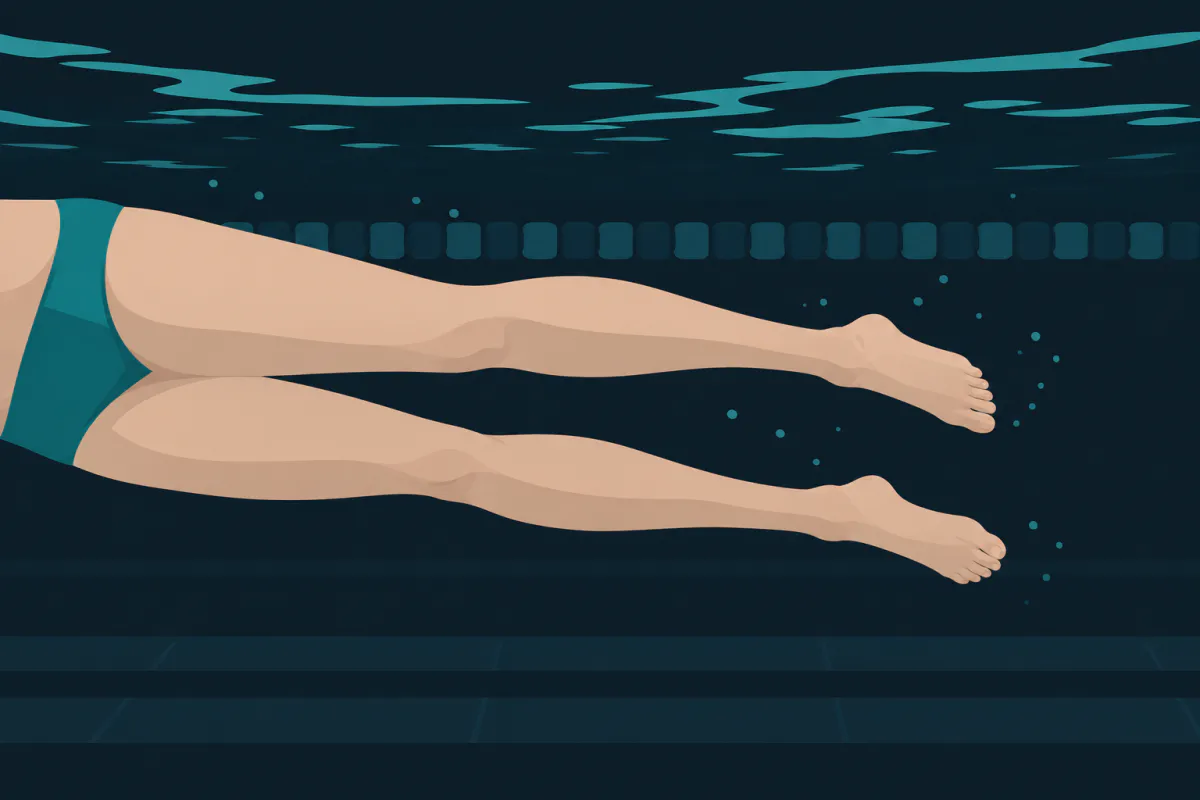
Reviewing injuries in competitive swimmers, Wanivenhaus and colleagues describe the mechanism plainly: the whip kick produces high valgus loads — force pushing the knee inwards — which increase strain on the medial collateral ligament, and repeated loading of that kind can also irritate the pes anserinus tendons on the inner shin. That is the origin of what swimmers call breaststroker’s knee.
It is common enough to have been counted. Vizsolyi and colleagues surveyed 391 competitive swimmers and found knee pain in 73 per cent of breaststroke specialists and 48 per cent of non-breaststrokers. They also found a bimodal pattern in injury rates according to hip abduction angle at the start of the kick, with the rate rising when that angle was below 37 degrees or above 42 degrees — a narrow window, and evidence that technique changes what the medial side of the knee absorbs.
Earlier, Keskinen and colleagues examined breaststroke swimmers with knee pain arthroscopically and found medial synovitis in seven of nine, with no other structural disorder; their filmed analysis in a swimming flume showed the whip kick being performed at high peak angular velocities. The problem looked like a loading problem rather than something torn.
All of that comes from competitive swimmers with their own knees, not from people with reconstructed ones, and we know of no study that has followed breaststroke specifically after ACL reconstruction. So this is reasoning rather than evidence: the early months after reconstruction are the part of rehabilitation most protective of valgus and rotational load, and breaststroke is the stroke that produces both. It is usually the last to return, and later still when the medial ligament or a meniscus was part of the injury. The timing is your surgeon’s to give.
The parts of swimming that are not the stroke
A length is not just kicking. Pushing off the wall is a single-leg press against resistance, at a knee angle you do not choose, and a tumble turn adds a twist to it. Ladders, wet tiled edges and the walk from the changing room are their own hazard on a leg that is not yet confident, and the swim itself hides the leg’s response until afterwards, because buoyancy makes limping impossible to feel.
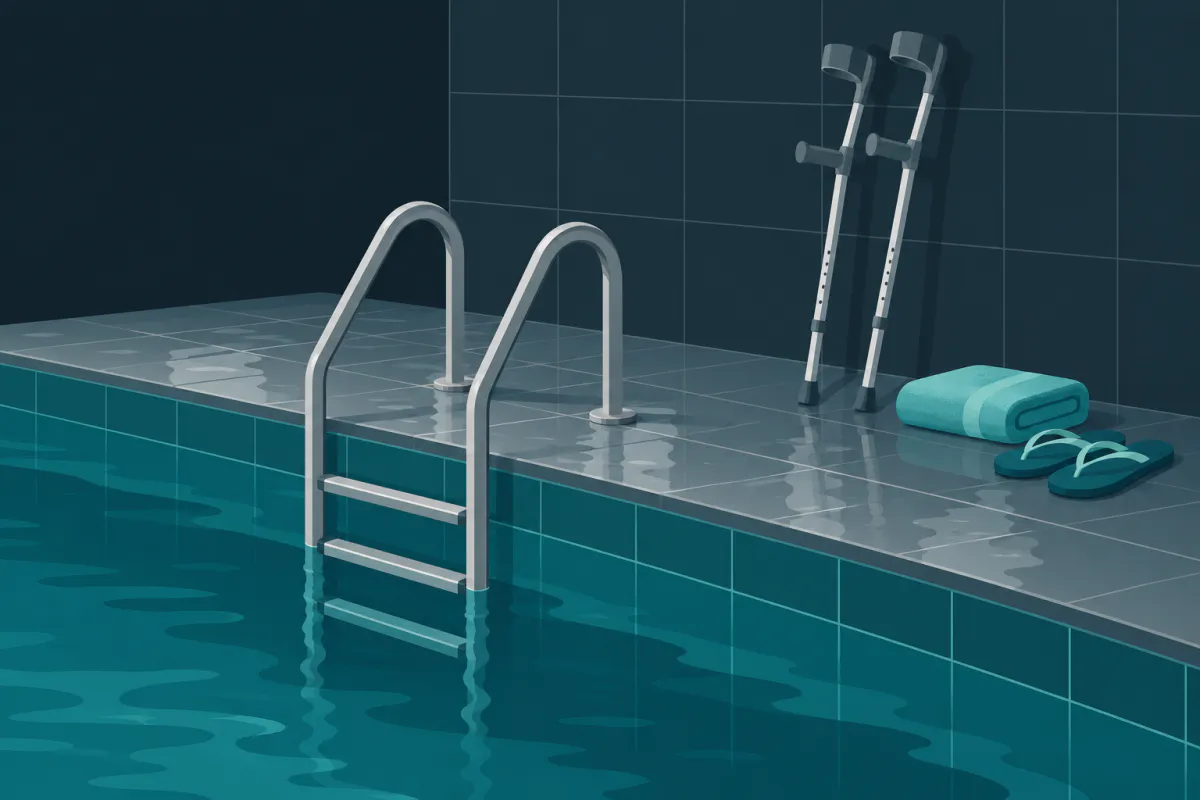
That is one reason pool work often starts as walking in water rather than swimming in it, and why the useful information tends to arrive the following morning — in how the knee looks and how it moves, rather than how the session felt. The same after-the-fact reading applies to the stationary bike and, later, to returning to running.
Where the app fits
Swimming is not one of the programmed exercises in ACL Recovery Tracker — the sessions are the land-based ones your level calls for, and Levels 3 to 5 span roughly weeks 6 to 16 after surgery, where Level 3 asks for full flexion, full extension and no swelling after exercise before it is complete. Our free ACL rehab app for iPhone and Android is the place to record what a swim did rather than the swim itself: the pain diary takes a 0 to 10 score with the location and the moment it occurred, the mobility log stores flexion and extension in degrees, and the week screen shows where an extra session falls among your planned training days and rest days.
Swimming after this operation is less a milestone than a set of separate permissions: one for the wound, one for the water, one for each stroke. They arrive at different times, and the order is rarely the one people expect. Most swimmers get the front crawl back long before they get the kick they actually came for.
The illustrations in this article were generated with AI.
Sources
- National Institute for Health and Care Excellence. Surgical site infections: prevention and treatment. NICE guideline NG125. 2019.
- Tovin BJ, Wolf SL, Greenfield BH, Crouse J, Woodfin BA. Comparison of the effects of exercise in water and on land on the rehabilitation of patients with intra-articular anterior cruciate ligament reconstructions. Phys Ther. 1994;74(8):710-719.
- Wanivenhaus F, Fox AJS, Chaudhury S, Rodeo SA. Epidemiology of injuries and prevention strategies in competitive swimmers. Sports Health. 2012;4(3):246-251.
- Vizsolyi P, Taunton J, Robertson G, et al. Breaststroker's knee. An analysis of epidemiological and biomechanical factors. Am J Sports Med. 1987;15(1):63-71.
- Keskinen K, Eriksson E, Komi P. Breaststroke swimmer's knee. A biomechanical and arthroscopic study. Am J Sports Med. 1980;8(4):228-231.
- van Melick N, et al. Evidence-based clinical practice update: practice guidelines for anterior cruciate ligament rehabilitation based on a systematic review and multidisciplinary consensus. Br J Sports Med. 2016;50:1506-1515.
- Noyes FR, Barber-Westin SD, eds. Noyes' Knee Disorders: Surgery, Rehabilitation, Clinical Outcomes. 2nd ed. Elsevier; 2017.
- NHS. ACL (anterior cruciate ligament) surgery: recovering.