The guide · Exercises, Mobility
Cycling after ACL surgery: the bike and the road
Why the stationary bike appears early in ACL rehab, how much knee bend a full pedal revolution needs, and what raising the saddle changes.
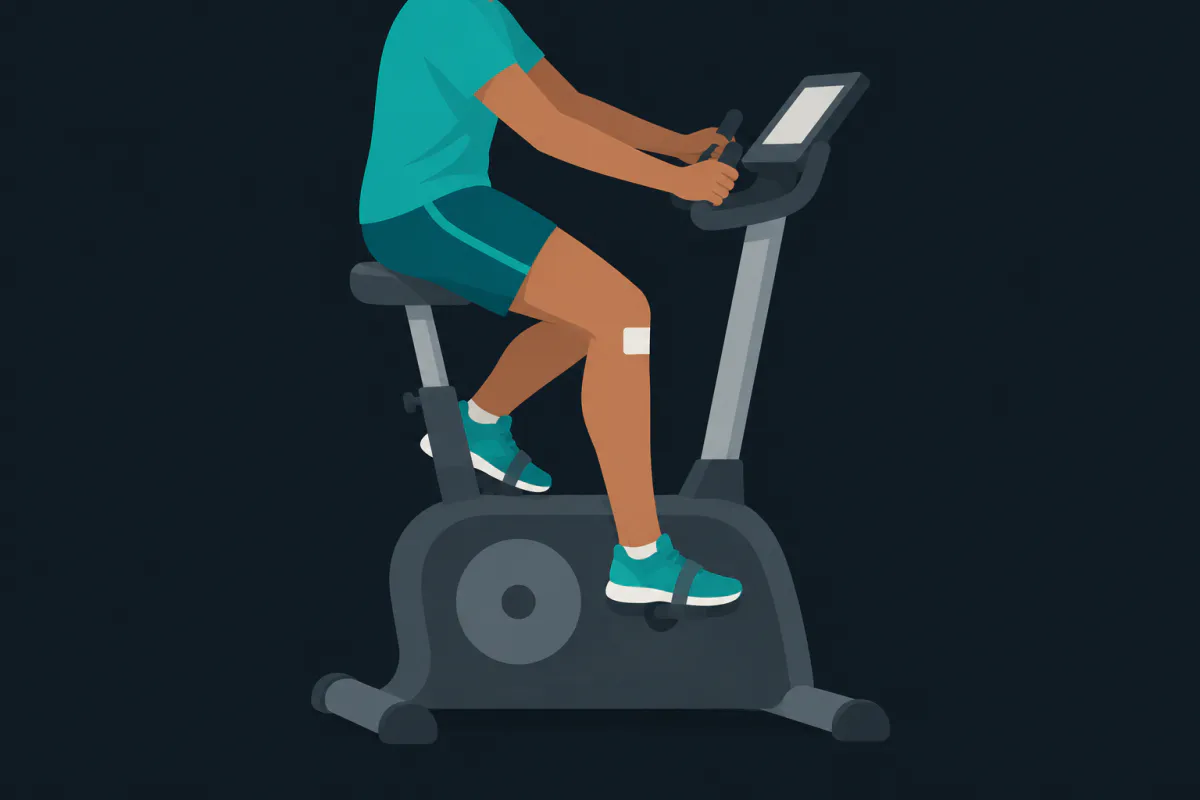
The stationary bike turns up in almost every ACL rehabilitation programme, and it turns up early — often before the knee can do much else. That is not because pedalling is good exercise, although it is. It is because a pedal stroke asks the knee to bend and straighten through a fixed arc, under a load you control with a dial, and that combination is hard to get any other way.
When you get on a bike, how long for and with how much resistance is your physiotherapist’s and surgeon’s call, and their instructions come first — particularly if a meniscus was repaired, or you have a weight-bearing or bending restriction.
Why a bike, and why so early
Two things dominate the first months after reconstruction: getting the knee’s range of motion back, and getting the quadriceps working again. A bike is one of the few pieces of equipment that does something for both at once, and it does it in a repeatable way. Each revolution takes the knee through the same arc, so the exercise is a measurement as much as a workout: on any given morning, either the pedals go round or they do not.
The resistance dial is the other half of the appeal. Rehabilitation after this operation is organised around what the leg can do rather than how many weeks have passed — the criterion-based structure set out in Noyes’ Knee Disorders — and that requires exercises whose difficulty can be turned up in small steps. The consensus guideline from van Melick and colleagues frames the gate for progressing load plainly: a correct movement pattern, no pain, no effusion (fluid inside the joint) and no increase in symptoms afterwards. A bike with the resistance at zero is close to the smallest dose of loaded knee movement there is, and it climbs from there.
A bike is not a substitute for the strength work, though. Pedalling with no resistance asks very little of the quadriceps, and the muscle deficit after this surgery is not fixed by cardio.
How much knee bend a pedal stroke needs
Ericson and colleagues measured the joint motions of six healthy people on an ergometer and found the knee moving through a mean range of 66 degrees, between about 46 and 112 degrees of flexion. Those numbers are for a standard fit on a standard bike, and the top of that range is the sticking point: the crank passes its highest point with the knee at its most bent, and if the knee will not reach that angle, the foot stops.
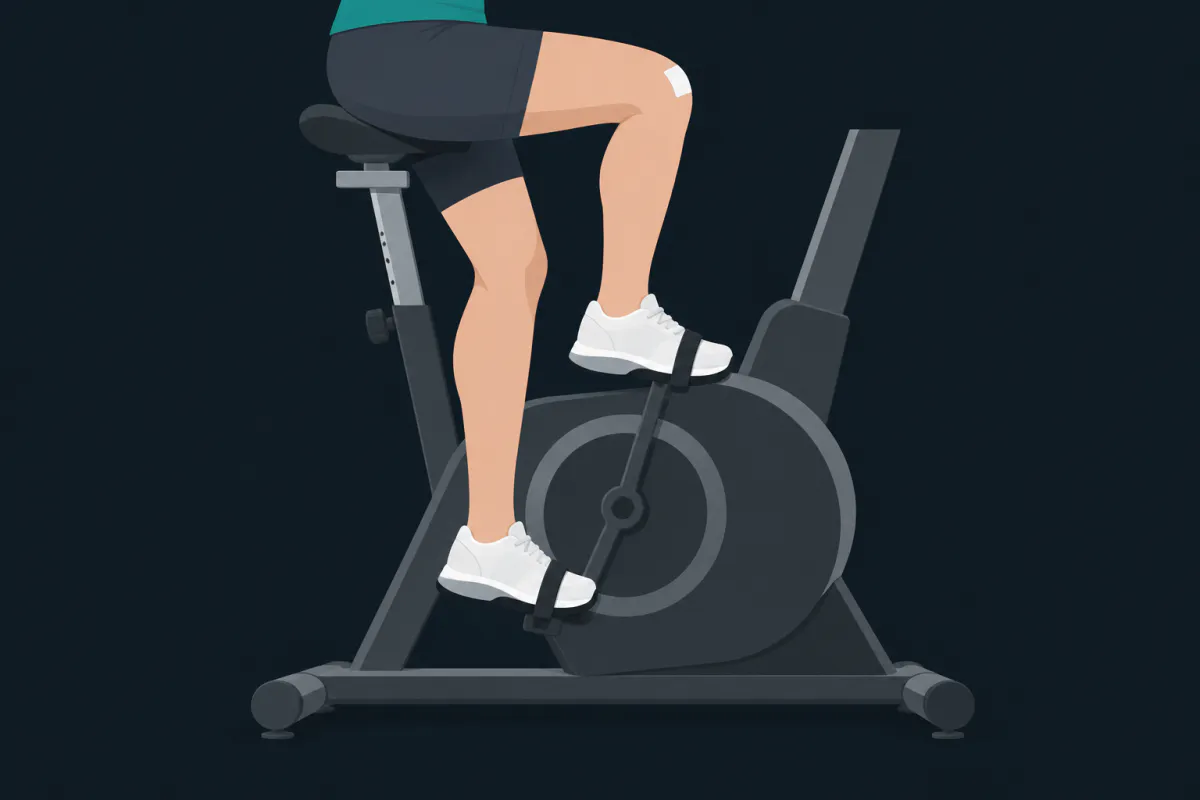
The geometry allows a halfway step, and it is a common one: rocking the pedals back and forth through whatever arc the knee allows, without completing a revolution, and moving to full revolutions once the bend is there. Which stage you are at is a question about degrees, and measuring knee flexion with your phone covers how that number is checked at home.
The requirement is not fixed, though. Ericson and colleagues also found that saddle height and foot position on the pedal changed the hip, knee and ankle motion, and that adjusting the saddle was the most effective way to alter the range used. A higher saddle stretches the leg out, and the knee at the top of the stroke does not have to close as far.
That relationship is direct enough to have been written down as an equation. Gatti and colleagues put 40 healthy adults through eighteen cycling bouts across three vertical and three horizontal saddle positions and two crank arm lengths, and produced equations that predict the saddle height needed for a chosen minimum or maximum knee flexion angle. Their framing is worth borrowing: bicycle fit for knee health is usually about setting the saddle to produce a minimum knee flexion angle of 25 to 40 degrees at the bottom of the stroke — that is, the leg near but not quite straight.
So a saddle set high for a knee that does not yet bend fully is a deliberate compromise rather than a poor fit: it buys a complete revolution at an angle the knee can actually reach, and it comes back down as the bend returns. Research on cycling in rehabilitation, such as the kinematic study by Yum and colleagues, standardises saddle height against leg length for the same reason — it changes what the joints do. Shorter cranks shrink the arc too, if the bike allows them.
What the bike does to the graft
The reassuring part of this topic has been measured directly. Fleming and colleagues implanted a strain transducer on the ACL of eight people undergoing arthroscopic surgery under local anaesthetic and recorded ligament strain while they pedalled at three power levels and two cadences. Mean peak strain was 1.7 per cent, ranging from 1.2 to 2.1 per cent across conditions, which the authors described as low compared with the other rehabilitation activities tested the same way. Neither turning the power up nor slowing the cadence down produced significantly more strain.
Two caveats belong with that. The measurements were taken on intact ligaments, not reconstructed grafts, and a healing graft is a different tissue. And low strain is not zero strain.
The wider picture from Escamilla and colleagues fits it, though. Reviewing ACL strain and tensile force across rehabilitation exercises, they found the ligament is loaded most between roughly 10 and 50 degrees of knee flexion, peaking between 10 and 30 degrees, and less between 50 and 100 degrees. Set that against the 46 to 112 degrees Ericson and colleagues measured, and a pedal stroke spends most of its arc above the band where the ligament is loaded hardest — part of why the bike is regarded as a gentle way to make a knee move.
Cycling outdoors is a different question
A road or a towpath adds everything the stationary bike deliberately leaves out: balance, uneven surfaces, traffic, stopping, standing on the pedals at a hill, and the possibility of falling onto the knee. Clipping in and out is its own skill on a leg that does not yet trust itself.
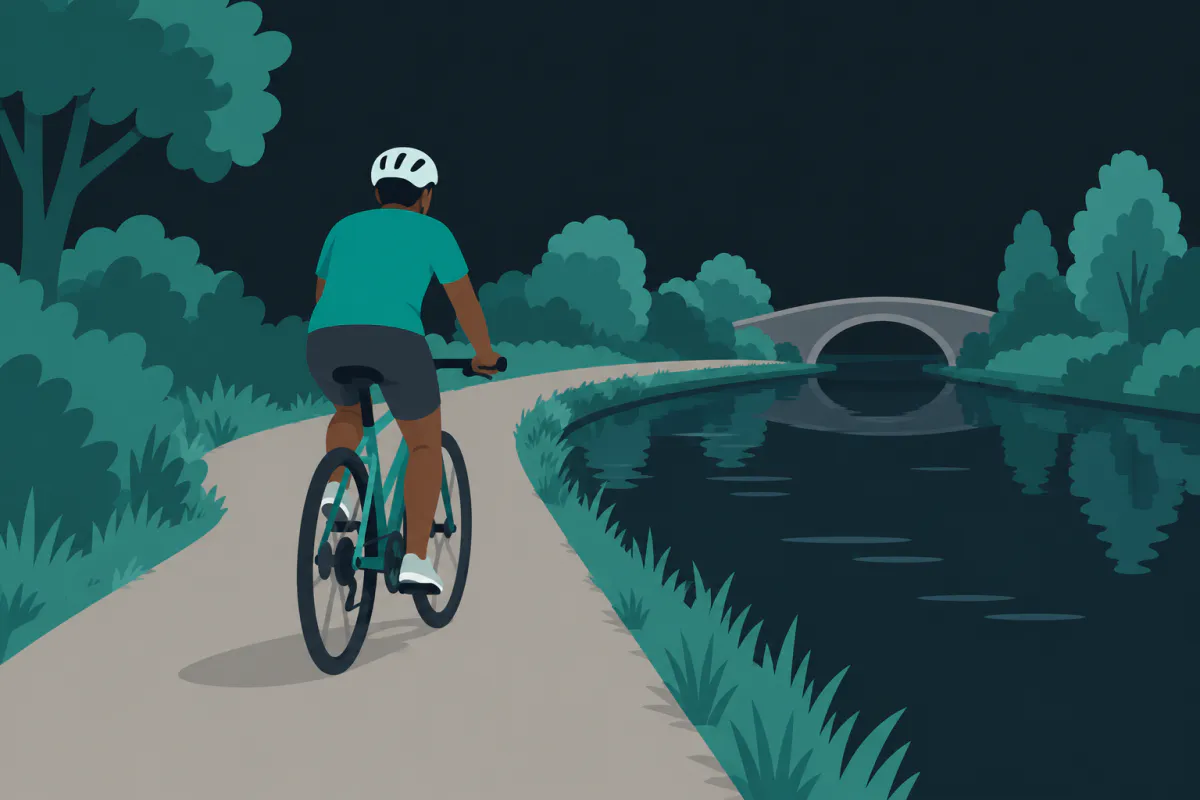
There is far less research on when riding outside is reasonable than on the stationary version, and the answer depends on the graft, what else was repaired and how the leg is behaving — so it is a conversation with your physiotherapist rather than something to read off a chart. Commuting by bike is closer to a return-to-activity decision than to an exercise, in the way returning to running is.
Separately, some things are not cycling problems and should not be pedalled through. The NHS recovery guidance lists the standard warning signs after this surgery: a calf that is hot, red, swollen or painful; a fever with spreading redness or discharge at the incision; new weakness or numbness in the foot; a knee that locks and will not move. Any of those means contacting your surgical team, your GP or an urgent care service the same day.
Where the bike sits in your rehab
In our free ACL rehab app, the Stationary Bike is a programmed exercise in the Level 4 to 6 gym sessions, where it runs for ten minutes as part of the session rather than as a warm-up you improvise. Before that — through Levels 2 and 3, where the criteria are 125 degrees of flexion and then full flexion with no swelling after exercise — the bike is usually something your physiotherapist adds, and the part worth recording is the bend it needs: the mobility log stores flexion and extension in degrees, entered by hand or measured with the phone’s gyroscope, so the week the pedals first went round is a date rather than a memory. The app is a free ACL recovery app for iPhone and Android, and you can use it to keep those angles, the sessions and the pain scores in one place between appointments.
A bike is an honest instrument. It will not let you cheat the range, and on a bad week it tells you so within half a revolution. That bluntness is most of its value, and it is why the machine that feels least like rehabilitation ends up being one of the more useful things in the room.
The illustrations in this article were generated with AI.
Sources
- Ericson MO, Nisell R, Nemeth G. Joint motions of the lower limb during ergometer cycling. J Orthop Sports Phys Ther. 1988;9(8):273-278.
- Gatti AA, Keir PJ, Noseworthy MD, Beauchamp MK, Maly MR. Equations to prescribe bicycle saddle height based on desired joint kinematics and bicycle geometry. Eur J Sport Sci. 2022;22(3):344-353.
- Yum H, Kim H, Lee T, Park MS, Lee SY. Cycling kinematics in healthy adults for musculoskeletal rehabilitation guidance. BMC Musculoskelet Disord. 2021;22(1):1044.
- Fleming BC, Beynnon BD, Renstrom PA, Peura GD, Nichols CE, Johnson RJ. The strain behavior of the anterior cruciate ligament during bicycling: an in vivo study. Am J Sports Med. 1998;26(1):109-118.
- Escamilla RF, Macleod TD, Wilk KE, Paulos L, Andrews JR. Anterior cruciate ligament strain and tensile forces for weight-bearing and non-weight-bearing exercises: a guide to exercise selection. J Orthop Sports Phys Ther. 2012;42(3):208-220.
- van Melick N, et al. Evidence-based clinical practice update: practice guidelines for anterior cruciate ligament rehabilitation based on a systematic review and multidisciplinary consensus. Br J Sports Med. 2016;50:1506-1515.
- Noyes FR, Barber-Westin SD, eds. Noyes' Knee Disorders: Surgery, Rehabilitation, Clinical Outcomes. 2nd ed. Elsevier; 2017.
- NHS. ACL (anterior cruciate ligament) surgery: recovering.