The guide · Using the app, Measuring progress
Sharing your ACL rehab log with your physio
What to show a physio after ACL surgery: how the knee reacted after sessions, range-of-motion trends against the other knee, what you trained, and questions.
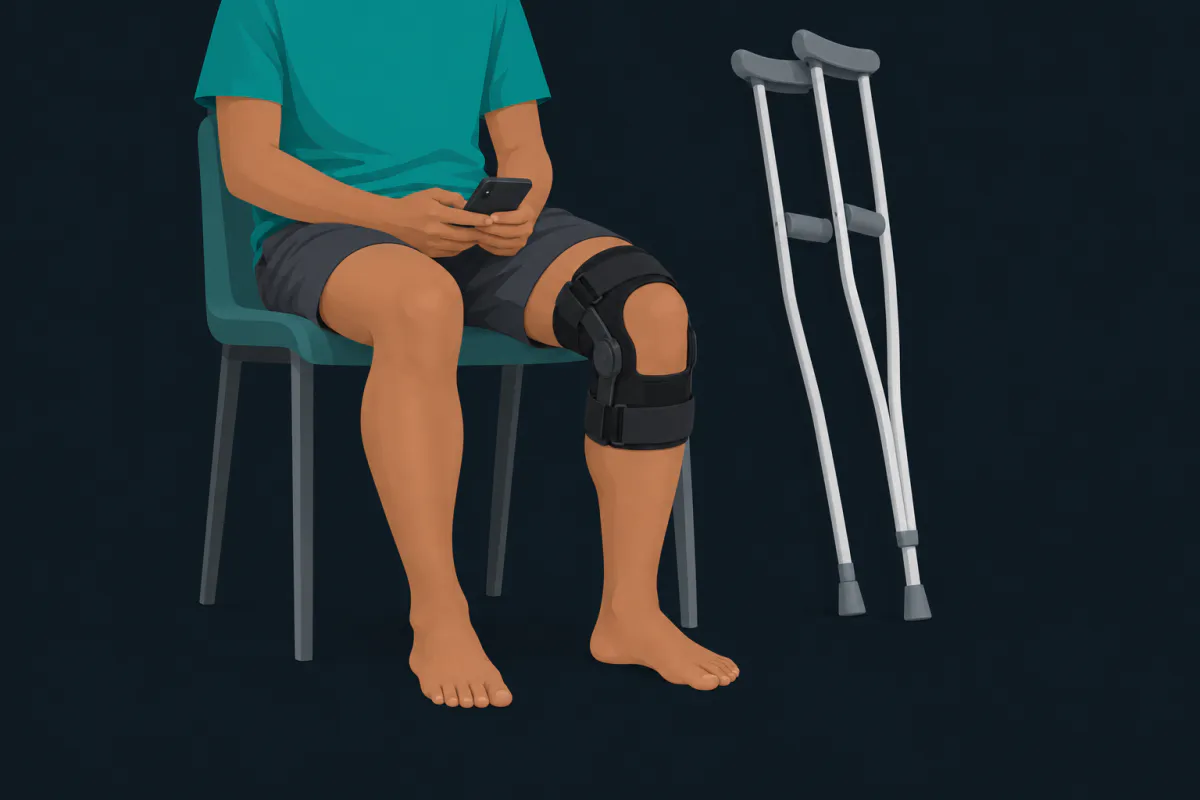
The short answer: the most useful things to bring are the ones your physiotherapist cannot see in the clinic. How the knee answered your sessions, that evening and the next morning. How its bend and its straightening have moved over the weeks, next to the other knee. What you actually trained, and anything you changed or skipped. And the two or three questions you want answered. A few lines of that are worth more than pages of numbers. Your surgeon’s and physiotherapist’s instructions come first: they decide what the record means and what happens next; it is there to inform their judgement, not to make the decision for them.
Why the days between visits matter
Most of a rehabilitation after ACL reconstruction happens away from the clinic. An appointment shows your physiotherapist the knee as it is that day: they can grade the swelling, measure the range of motion and watch you move. What they cannot see is how the knee behaved on the days in between, and that is often what decides whether the programme moves on.
The consensus guideline from van Melick and colleagues describes progression by criteria rather than by date, and states the rule most protocols use for adding load: the exercise is done correctly and there is no pain, no effusion (fluid inside the joint) and no increase in symptoms afterwards. “Afterwards” is the part you hold. The criterion-based progression from the University of Delaware, published by Adams and colleagues, reproduces soreness rules that work the same way: what the knee did after the last session, and during the warm-up of the next, decides whether the load goes up, stays or comes down.
Memory is a poor substitute for a note. Broderick and colleagues compared what 83 patients of a rheumatology practice recalled about their pain with ratings they had given several times a day on an electronic diary. Recalled ratings ran consistently higher than the averages of the ratings given at the time, and a recall of the last day matched far better than a recall of the last week or month. Those were not ACL patients, but the point carries: by the end of a fortnight, “it’s been sore” can mean one bad evening or ten.
What is worth bringing
A short list your physiotherapist can read in a minute does more than a long one. These are the things most clinics ask about.
- The knee’s answer to your sessions. Pain that evening and the next morning, and whether the knee looked or felt more swollen the day after. Note the session that came before any jump in pain or swelling.
- Range of motion as a trend. Flexion (how far the knee bends) and extension (how close it gets to straight), measured the same way each time, with the dates. A handful of readings over two weeks shows a direction; one reading shows a day.
- The other knee’s numbers. The target for range of motion is your other knee, not a textbook figure, so those readings belong next to the operated knee’s.
- What you trained. Which sessions you did, which you skipped and why, and anything you changed: a weight, a number of sets, an exercise left out because it hurt.
- Anything new. The knee catching or giving way, or a pain in a place that did not hurt before.
- Your questions, written down before you go in. It is easy to leave without asking the one you came with.
Swelling and range of motion, read the way a physio reads them
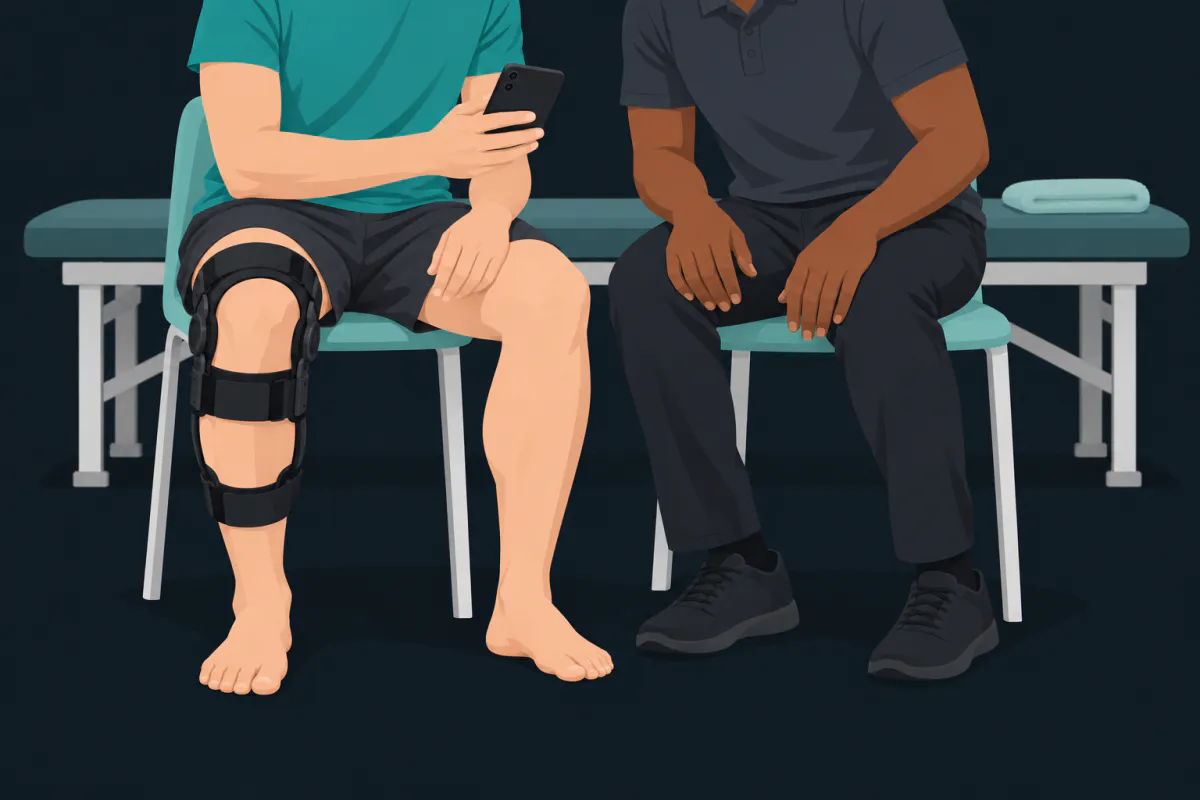
Physiotherapists do not judge swelling by eye alone. They grade it with a stroke test, sweeping fluid up the inner side of the knee and watching how it returns. Sturgill and colleagues tested a five-point version of that scale in an outpatient clinic and found that pairs of therapists agreed on the exact grade 73 per cent of the time, with a kappa of 0.75. In the Delaware progression, a grade of trace or less is among the conditions to meet before running starts. Your own rating at home is cruder than that, and it does not need to compete with it. Its job is to show change: whether the knee was fuller the morning after a harder session, and whether that settled in a day or lingered.
Range of motion is read against the other knee. Shelbourne and Gray, following patients for at least ten years after reconstruction, defined normal motion as extension within two degrees of the other knee, hyperextension included, and flexion within five. That is why a reading of the operated knee alone says less than it seems to: a knee that stops at flat may be short of its target if the other one straightens a few degrees past it. If you measure at home, say how you measured, with a phone, by eye or with the heel propped, so the numbers can be read for what they are. The phone method is written up in measuring knee flexion with your phone.
What a log is not
A record of your own is a description, not a test. It does not replace the physiotherapist’s examination, and it does not decide when you move on. Strength, hop and movement tests are measured in the clinic, and the van Melick guideline treats them as the criteria for the later stages. A tidy run of numbers at home is a reason to ask whether you are ready, not an answer.
It also does not need to be complete. A gap of a few days says nothing bad about you; a note that you stopped logging because the knee was worse says a great deal. And a log does not wait for the appointment when something is wrong. Contact your surgical team or seek urgent care the same day if you have:
- a calf that is hot, red, swollen or painful;
- a fever, or spreading redness or discharge at the incision;
- new weakness or numbness in your foot;
- a knee that locks.
When ordinary soreness turns into something to report is covered in pain vs a setback in ACL rehab.
Where the app fits
ACL Recovery Tracker is a free ACL tracker for iOS and Android, and it keeps the record this article describes on your phone, with no account. The pain diary takes pain from 0 to 10, where it hurts and when, with a swelling rating and an optional tape measurement; the post-workout log asks for pain, swelling and mobility after each session. Mobility History holds your flexion and extension readings, typed in or measured with the phone, beside the healthy-leg baseline of the other knee. Workout History lists each session’s sets, and the Analytics tab draws the trends over time. You can use it by opening those screens at the appointment and going through the last few weeks with your physiotherapist: the app shows what you logged and draws no conclusions from it.
The appointments are short and the weeks between them are long. A plain record of those weeks, in your own words and numbers, lets the person who knows your knee best spend the appointment on what has changed.
The illustrations in this article were generated with AI.
Sources
- van Melick N, et al. Evidence-based clinical practice update: practice guidelines for anterior cruciate ligament rehabilitation based on a systematic review and multidisciplinary consensus. Br J Sports Med. 2016;50:1506-1515.
- Adams D, Logerstedt DS, Hunter-Giordano A, Axe MJ, Snyder-Mackler L. Current concepts for anterior cruciate ligament reconstruction: a criterion-based rehabilitation progression. J Orthop Sports Phys Ther. 2012;42(7):601-614.
- Broderick JE, Schwartz JE, Vikingstad G, Pribbernow M, Grossman S, Stone AA. The accuracy of pain and fatigue items across different reporting periods. Pain. 2008;139(1):146-157.
- Sturgill LP, Snyder-Mackler L, Manal TJ, Axe MJ. Interrater reliability of a clinical scale to assess knee joint effusion. J Orthop Sports Phys Ther. 2009;39(12):845-849.
- Shelbourne KD, Gray T. Minimum 10-year results after anterior cruciate ligament reconstruction: how the loss of normal knee motion compounds other factors related to the development of osteoarthritis after surgery. Am J Sports Med. 2009;37(3):471-480.