The guide · Using the app, Daily life
Reminders for ACL rehab exercises that fit your plan
Reminders help with forgetting. In one trial, people sent automated texts reported a little more home exercise. They fit best when tied to your plan.
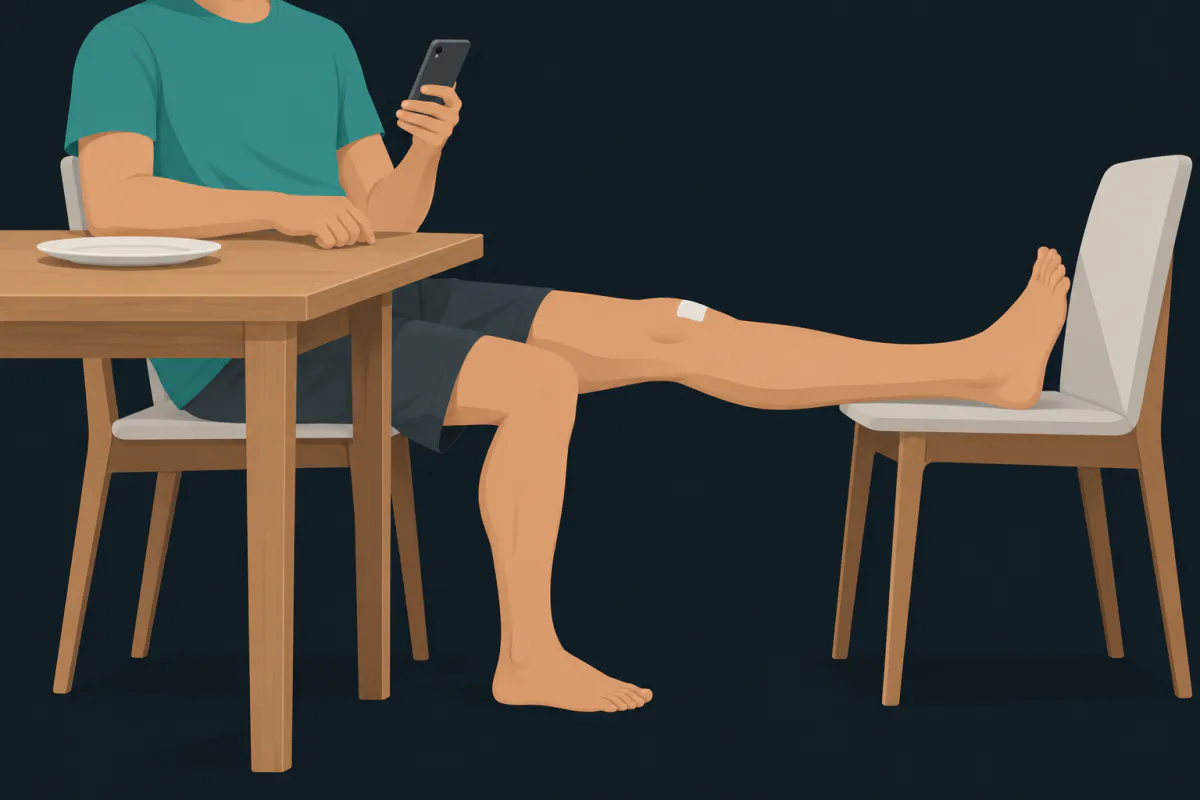
The short answer: reminders help with one particular reason sessions get missed, which is forgetting, and they help most when they match the plan you are actually following: the days you train, the number of times a day an exercise is done, and the care tasks in between. In an Australian trial of home exercise for knee osteoarthritis, automated text messages went with a modest rise in how often people reported exercising; the people were not ACL patients and the effect was small. A reminder that fires on a rest day, or after the session is already done, is easy to start ignoring, and then the useful ones get ignored with it. Your surgeon and physiotherapist decide what you do and when; reminders only help you keep to their plan.
Why sessions get missed
Most of an ACL rehabilitation happens at home, between appointments, and nobody is watching the clock for you. A scoping review by Walker and colleagues gathered 71 studies on how people take part in ACL rehabilitation and stick to it. Among the barriers patients named most often were organisation and lack of time, alongside fear of reinjury and their own motivation.
The early weeks make organisation harder than it sounds. The first exercises are usually little and often, several times a day, and the NHS recovery guidance suggests an ice pack wrapped in a towel for 15 to 20 minutes every two to three hours. That is a lot of small appointments with yourself to keep in a day that also holds painkillers, crutches and sleep. Why the early programme is dosed this way, and how it changes later, is in should you do ACL rehab exercises every day.
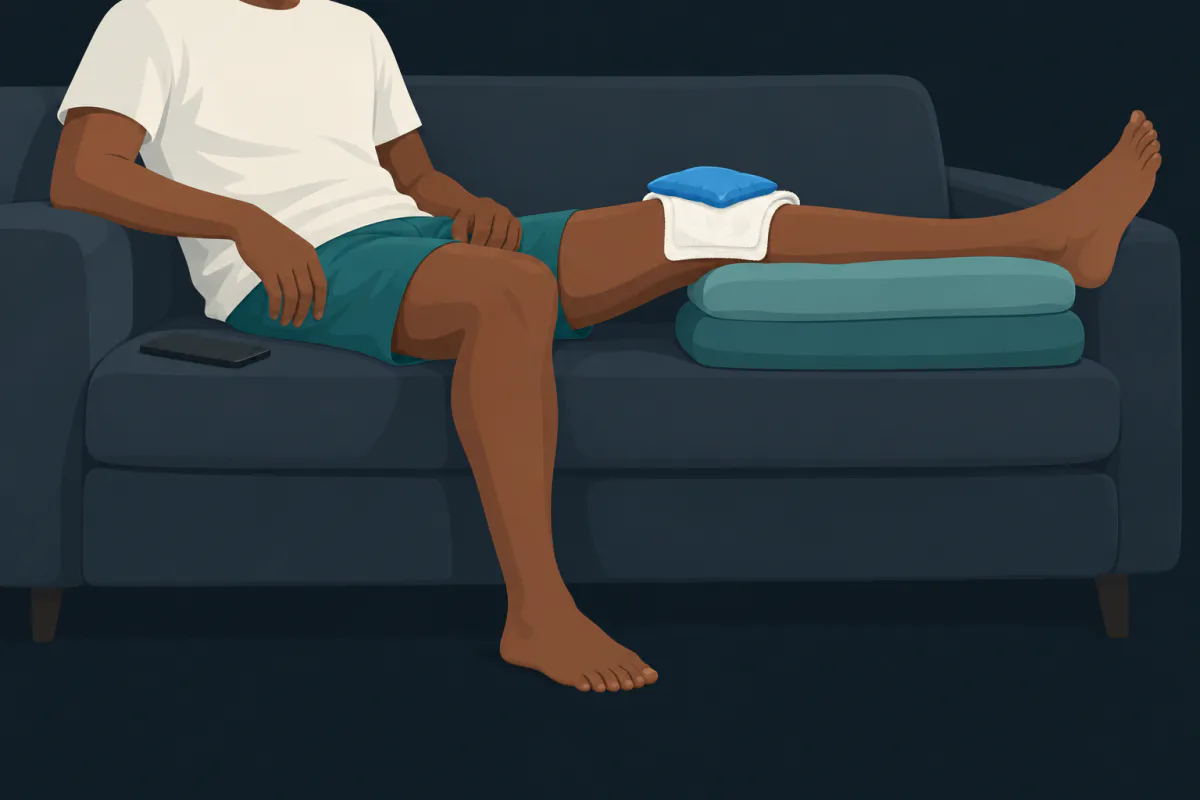
Ordinary days get in the way too. Brewer and colleagues asked 91 people to keep a daily diary for the first six weeks after reconstruction. Adherence to the home exercises was high overall, but on days with more stress or a worse mood, fewer exercises were done. A reminder cannot fix a bad day. It can make sure a busy one does not swallow the session by accident.
What the trials of reminders found
The closest trials we found were not in ACL patients. They tested automated text messages in people doing home exercise for knee osteoarthritis, run by the same Australian group.
Bennell and colleagues took 110 people who had just finished a 12-week supervised exercise programme and randomised them to six months of behaviour-change text messages or no messages, with both groups continuing their exercises at home. At 24 weeks the text group scored higher on an exercise adherence scale and reported exercising on more days: 1.8 days in the past week, out of a possible three, against 1.3. Pain, function and quality of life were no different between the groups.
Nelligan and colleagues tested a self-directed web programme of strengthening exercises supported by automated texts in 206 people, against an information website alone. After 24 weeks the programme group had less knee pain and better function. Because the texts came as part of a wider programme, the trial cannot say how much of that was the messages.
So the evidence supports something modest: reminders can nudge people to do a few more of the sessions they meant to do. The adherence result rests on what people reported, and neither trial was about recovery after surgery.
From a reminder to a habit
A reminder is a prompt from outside. Over weeks, the aim is for the session to be prompted by the day itself. Gardner, Lally and Wardle describe a habit as an action set off automatically by a cue it has been linked to by repetition, such as fastening a seatbelt after getting into a car. In the study from their group, people repeated a chosen health behaviour after a single daily cue, and it took an average of 66 days for it to feel automatic, with wide variation between people and behaviours. Missing one opportunity did not seriously set the process back.
Two things follow for rehab. A session tied to something that already happens every day, after breakfast or before the evening meal, has a cue that a reminder can lean on and eventually stop being needed for. And a missed session is not the end of a routine; the next one counts as much.
The cue changes as the programme does. Early on it is several times a day; months later strength sessions usually run a few days a week, with days off between them that are part of the plan. The reasons are in rest days in ACL rehab. A reminder that still fires every morning in month five no longer matches the plan, and is easy to start dismissing.
Reminders that fit the plan
What makes a reminder useful is how closely it follows the programme your physiotherapist set. A few features matter more than the rest.
- The days you train, not every day. A reminder on a rest day asks for a session the plan does not.
- One per round. When an exercise is prescribed several times a day, each time needs its own prompt at a sensible hour.
- Silence once it is done. A prompt for a session you finished an hour ago says nothing new.
- Care tasks apart from training. Icing and raising the leg run on their own rhythm, and they fall away as the swelling settles.
- Moves when the plan moves. If a session shifts to another day, the reminder should shift with it rather than nag on the old day.
None of this replaces the plan itself. How often you train, and when a session can be moved or dropped, is for your physiotherapist to decide.
Where the app fits
ACL Recovery Tracker, a free ACL rehab app for iOS and Android, schedules its reminders from your plan rather than from a fixed alarm. You can use it to make the reminders follow your training days: each session has day chips and its own time, a session done several times a day can have up to five rounds, each reminded at its own hour and silenced once you finish it, and moving a workout to another day moves its reminder. Care routines, such as icing, get one reminder per time slot, and ticking a slot off silences it for the rest of the day. An evening nudge fires only while something is still due, and pauses while a session runs more than one round a day; the daily pain check-in is skipped if you have already logged pain or swelling that day. The reminders are scheduled on the phone itself, with no account, and never show your health data.
Reminders are a small tool for a long rehabilitation. Their job is to get you to the sessions your programme asks for on the days it asks for them, and, given a couple of months of repetition, to become something you no longer need.
The illustrations in this article were generated with AI.
Sources
- Bennell K, Nelligan RK, Schwartz S, Kasza J, Kimp A, Crofts SJC, Hinman RS. Behavior change text messages for home exercise adherence in knee osteoarthritis: randomized trial. J Med Internet Res. 2020;22(9):e21749.
- Nelligan RK, Hinman RS, Kasza J, Crofts SJC, Bennell KL. Effects of a self-directed web-based strengthening exercise and physical activity program supported by automated text messages for people with knee osteoarthritis: a randomized clinical trial. JAMA Intern Med. 2021;181(6):776-785.
- Gardner B, Lally P, Wardle J. Making health habitual: the psychology of 'habit-formation' and general practice. Br J Gen Pract. 2012;62(605):664-666.
- Walker A, Hing W, Lorimer A. The influence, barriers to and facilitators of anterior cruciate ligament rehabilitation adherence and participation: a scoping review. Sports Med Open. 2020;6(1):32.
- Brewer BW, Cornelius AE, Van Raalte JL, Tennen H, Armeli S. Predictors of adherence to home rehabilitation exercises following anterior cruciate ligament reconstruction. Rehabil Psychol. 2013;58(1):64-72.
- NHS. ACL (anterior cruciate ligament) surgery: recovering.