The guide · Return to sport, Exercises
Cutting and change of direction after ACL surgery
Cutting usually comes last in ACL rehab, after running and landing, as it is where many tears happen. Drills go from planned and slow to sharp and unplanned.
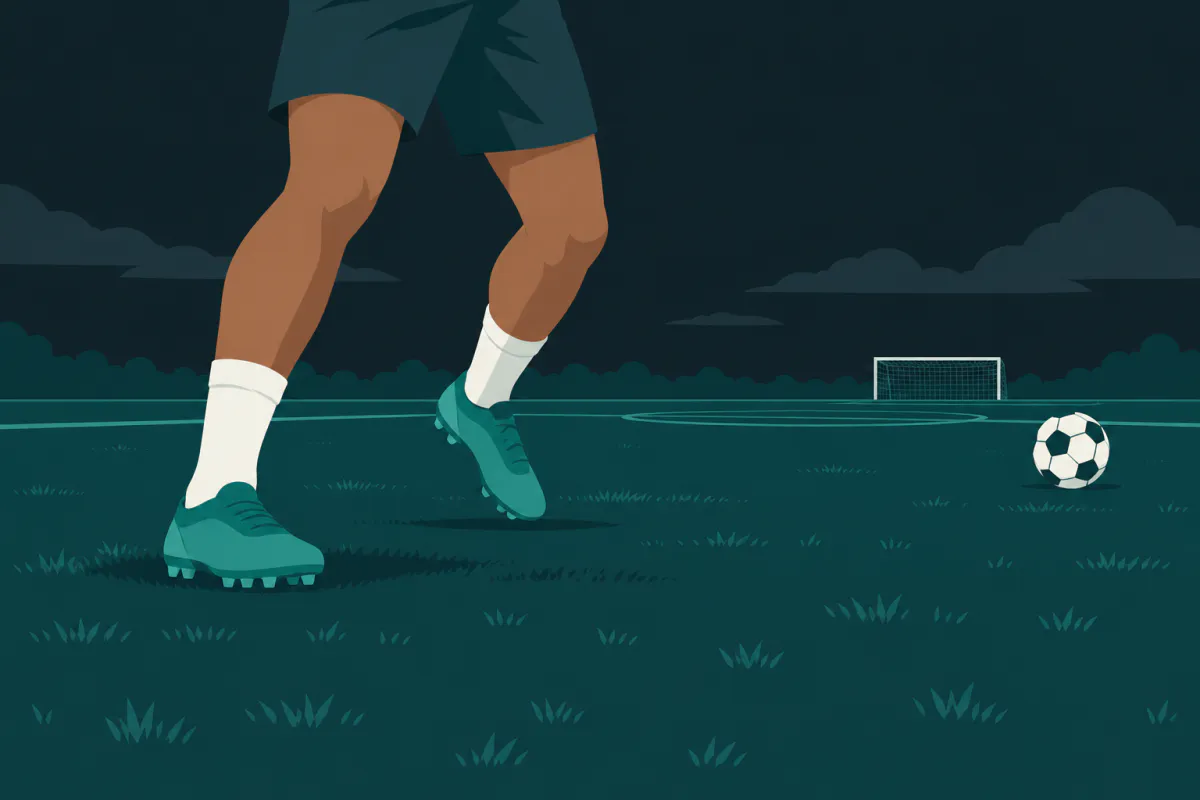
The short answer: cutting, the sharp sidestep or turn that sports such as football, basketball and netball are full of, is usually the last thing an ACL programme adds, after running and single-leg landing are well established and close to the return to sport itself. It comes last because sudden stops and changes of direction are among the commonest moments of ACL injury, and because a cut made on the spot loads the knee harder than a planned one. The drills are built up in steps: slow and planned at first, then sharper and faster, and finally in reaction to something you could not predict. When you start, and how quickly you move through the steps, is for your surgeon and physiotherapist to decide; this article explains why the order is what it is.
Why change of direction comes last
Noyes’ Knee Disorders, a standard textbook of knee surgery and rehabilitation, describes the established structure of ACL rehabilitation as a series of phases that ends with running, jumping and cutting before sport. The reason cutting sits at the very end is that it is close to how many ACL tears happen.
Della Villa and colleagues studied video of 134 ACL injuries in ten seasons of professional Italian football. 88 per cent happened without a direct blow to the knee: 44 per cent with no contact at all, and another 44 per cent where the player was pushed or bumped elsewhere on the body. The most common situation was pressing and tackling an opponent, and in 81 per cent of the injuries whose movement could be analysed, the knee was collapsing inwards (valgus) at the moment of injury. Pressing involves much of what a cut does: planting one foot, braking hard and pushing off in a new direction, often while someone else is moving close by.
How much of this stage a programme includes depends on what you are going back to: someone returning to cycling or hiking has different demands from a footballer. But for pivoting sports, cutting is the last demand to be rebuilt, which is why programmes hold it back until the foundations are in place.
Planned and unplanned cuts load the knee differently
A cut you have planned is not the same as one you have to make on the spot. Besier and colleagues measured the loads on the knee in 11 healthy men as they ran and cut, either knowing in advance which way they would go or reacting to a light that told them at the last moment. The moments that bend the knee inwards or outwards and twist it were up to twice as large in the unplanned cuts. The authors put it down to the time it takes to position the foot and body before the turn, and they suggested that training for sport should include drills with unanticipated changes of direction.
That is the logic behind progressing from controlled to unpredictable. Taberner, Allen and Cohen, writing from more than a decade of rehabilitation in English Premier League football, describe a “control-chaos continuum”: work starts with a high level of structure, where every movement is known in advance, and moves towards the random, reactive situations of a real match. Among the things they progress is the angle of the turn, from 45 degrees to a full 180, and the speed of braking and acceleration. They are clear that progression along the continuum is based on criteria, not on the time that has passed.
What the drills are training
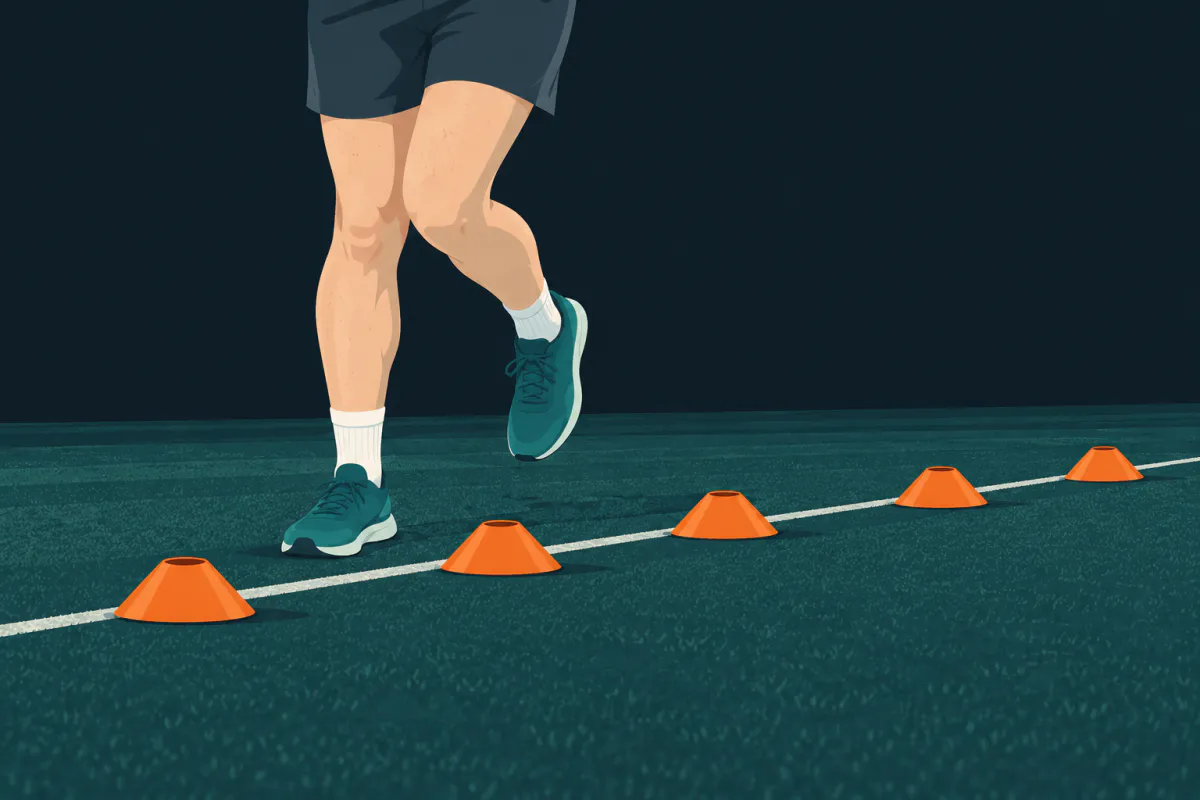
Change-of-direction drills look simple, but they train several things at once.
- Deceleration. Every cut begins by braking on one leg, so programmes usually practise stopping before they practise turning.
- Angle and speed. Curved runs and wide turns come before sharp ones, and slow before fast.
- Reaction. Drills where a coach, a partner or a signal decides the direction at the last moment bring in the unplanned element.
- The sport itself. Late on, drills borrow the sport’s own movements, such as receiving a ball or marking an opponent.
- Fatigue and volume. Buckthorpe, in a review of the late stage of ACL rehabilitation, lists fatigue among the factors that matter at this stage, and names a lack of sport-specific training, with too little build-up of the sport’s training load, as one of the gaps before return.
How many drills, at what intensity and for how long varies widely between programmes. No guideline we found sets a single schedule, and the drills themselves are best learned with a physiotherapist watching.
A fast time is not the same as good movement
A stopwatch can make a knee look more ready than it is. King and colleagues tested 156 male athletes nine months after ACL reconstruction on planned and unplanned 90-degree cuts in a motion-capture laboratory. There was no difference between the legs in how long the cut took. But the operated knee still moved differently: it bent less and did less of the work than the knee on the other side. In other words, the athletes were as fast on both sides while doing the job in different ways.
This is one reason the Aspetar clinical practice guideline, from Kotsifaki and colleagues, looks at how a cut is done as well as how fast. Its minimum criteria for a professional athlete to leave the clinic and start training with the club include more than 90 per cent symmetry of knee biomechanics during high-speed running and change of direction, and the completion of a sport-specific training programme. The same guideline found that adding plyometric and agility training in the advanced phase may improve how patients rate their own knee and how well they perform functional tasks, without more laxity or pain. Few clinics have a motion-capture laboratory, and how the quality of a cut is judged varies; it is read alongside strength and hop test results rather than on its own.
Where cutting sits in the timeline
Cutting at full intensity is usually part of the last weeks or months before a return to pivoting sport. In the Delaware-Oslo cohort, Grindem and colleagues found that each month return to these sports was delayed, up to nine months after surgery, was associated with a 51 per cent lower reinjury rate, and that more symmetrical quadriceps strength before return was also linked to fewer reinjuries. That is why the earlier milestones matter: the return to running and the landing work come months before, and cutting builds on them rather than replacing them. The decision about playing again is covered in return to sport after ACL reconstruction.
A knee that swells or is sorer the morning after a session of drills, gives way, or feels unstable when you push off is worth telling your physiotherapist about before the next one, since these are the signs they use to adjust the load.
Where the app fits
Cutting drills are Level 10, “Cutting & Sport”, in our free ACL recovery app, ACL Recovery Tracker for iOS and Android. The level’s drills come in three stages, beginner, intermediate and advanced, and the level’s workout holds the drills of the stage you are on. After two weeks in a stage it offers to move you to the next, and you can go back a stage at any time if the knee reacts. Level 10’s checklist includes hop tests of at least 90 per cent of the other leg, full knee motion, no swelling, at least nine months since surgery and clearance from your ACL rehabilitation clinician; you tick it yourself, and the app does not test the knee or decide that you are ready. You can use it to log each drill session and the pain diary the morning after, so your physiotherapist can see how the knee responded as the drills became harder.
Cutting is where the knee is asked to do what it could not do on the day it was injured. Taking it slowly, from planned to unplanned, is not caution for its own sake; it is how the stage is meant to be built.
The illustrations in this article were generated with AI.
Sources
- Della Villa F, Buckthorpe M, Grassi A, et al. Systematic video analysis of ACL injuries in professional male football (soccer): injury mechanisms, situational patterns and biomechanics study on 134 consecutive cases. Br J Sports Med. 2020;54(23):1423-1432.
- Besier TF, Lloyd DG, Ackland TR, Cochrane JL. Anticipatory effects on knee joint loading during running and cutting maneuvers. Med Sci Sports Exerc. 2001;33(7):1176-1181.
- King E, Richter C, Franklyn-Miller A, et al. Biomechanical but not timed performance asymmetries persist between limbs 9 months after ACL reconstruction during planned and unplanned change of direction. J Biomech. 2018;81:93-103.
- Taberner M, Allen T, Cohen DD. Progressing rehabilitation after injury: consider the 'control-chaos continuum'. Br J Sports Med. 2019;53(18):1132-1136.
- Kotsifaki R, Korakakis V, King E, et al. Aspetar clinical practice guideline on rehabilitation after anterior cruciate ligament reconstruction. Br J Sports Med. 2023;57(9):500-514.
- Buckthorpe M. Optimising the late-stage rehabilitation and return-to-sport training and testing process after ACL reconstruction. Sports Med. 2019;49(7):1043-1058.
- Grindem H, Snyder-Mackler L, Moksnes H, Engebretsen L, Risberg MA. Simple decision rules can reduce reinjury risk by 84% after ACL reconstruction: the Delaware-Oslo ACL cohort study. Br J Sports Med. 2016;50(13):804-808.
- Noyes FR, Barber-Westin SD, eds. Noyes' Knee Disorders: Surgery, Rehabilitation, Clinical Outcomes. 2nd ed. Elsevier; 2017.