Questions · Daily life, Exercises
Can you swim with a torn ACL?
Usually yes, once the first swelling settles: front crawl and backstroke suit a knee without an ACL. Breaststroke, push-offs and wet floors are the risks.
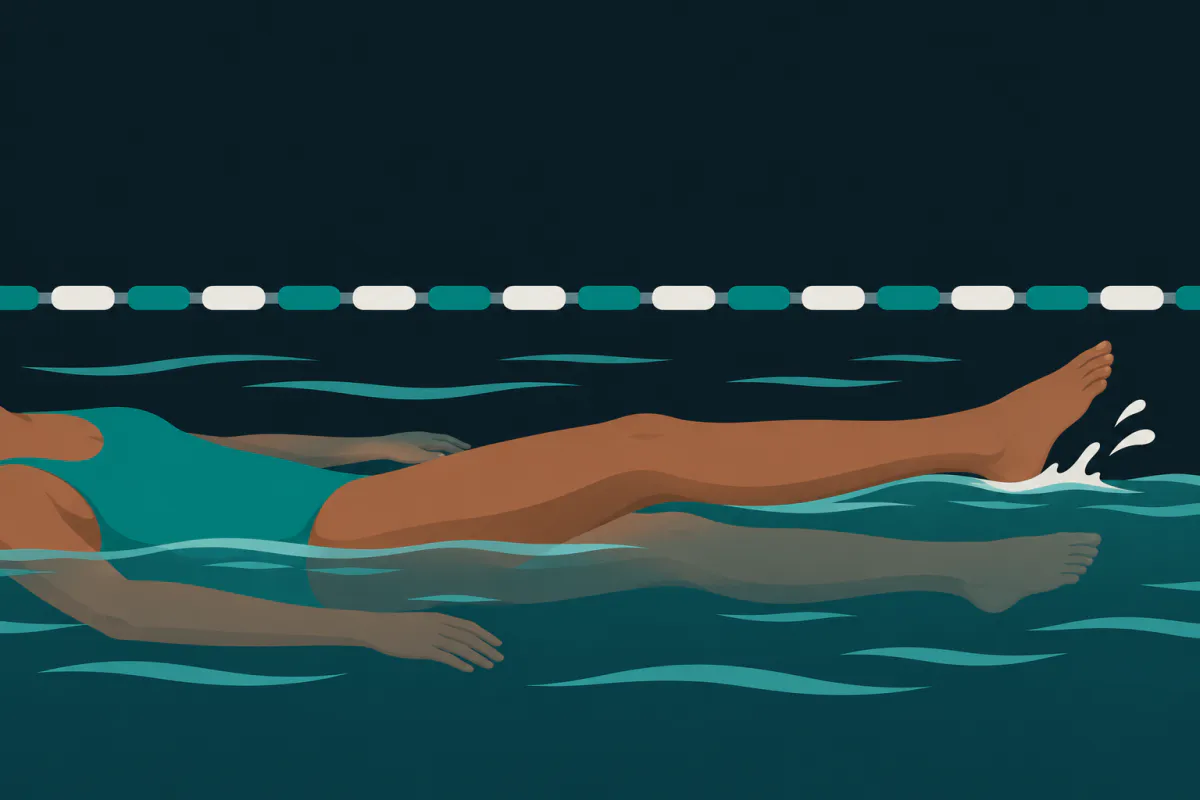
The short answer: usually yes. The strokes have none of the landing, sudden stopping and pivoting that make a knee without an ACL give way. Front crawl and backstroke usually suit it once the first swelling has settled. The breaststroke kick, pushing off the wall and wet floors are the risks, and a torn meniscus as well changes things.
Your doctor or physiotherapist knows what else was injured in your knee. If they have told you to wait or to avoid a stroke, follow that, not this article.
Can you swim with a torn ACL?
Most people can. The ACL stops your shin sliding forward and twisting under your thigh. You need it most when you land, stop quickly or turn on a planted foot. Sports like football and basketball are full of those moves. Staying out of sports with a lot of pivoting and cutting lowers the risk of hurting the knee again.
In the water your weight is carried and your foot is never planted. Front crawl and backstroke use a flutter kick that comes mostly from the hip. Your knee bends and straightens a little, with no twist.
Plenty of people live and stay active without a reconstructed ACL. In one trial, 59 young, active adults were offered rehabilitation first, with surgery later only if they needed it. Two years on, 36 of them had not had surgery. The whole group of 59 scored as well on a knee questionnaire as the people operated on early.
When after the injury?
Usually once the first swelling and pain have settled. A freshly injured knee is often swollen, stiff and sore for the first weeks, and your physiotherapist decides when the pool joins in.
Rehabilitation starts in those weeks, on land. Evidence-based recommendations are to start it as soon as possible after the diagnosis. The first aims are no fluid in the joint (effusion), a knee that fully straightens and bends, and a straight-leg raise without the knee sagging. Before an operation, the aim adds a thigh nearly as strong as the other one. A knee surgery textbook describes the same groundwork before surgery.
Swimming can sit alongside that work. It does not replace it, because floating does not build the thigh strength the knee needs. Ask your physiotherapist where a swim fits in your week.
Which strokes, and what to avoid
Front crawl and backstroke usually come first. Walking in chest-deep water is another gentle way to start.
The breaststroke kick is the one to ask about. It pushes the knee inwards and turns the shin outwards. Even in swimmers with healthy ligaments, it strains the inner side of the knee. A twisting load is exactly what a knee without an ACL controls worst. We know of no study of breaststroke with a torn ACL, so this part is reasoning, not evidence.
These parts of a swim also load the knee:
- Pushing off the wall is a hard press through a bent knee.
- Tumble turns add a twist to the push-off.
- Jumping or diving in ends in a landing, on the pool floor or on the edge.
- Wet tiles, steps and ladders are where a knee that gives way is most likely to slip.
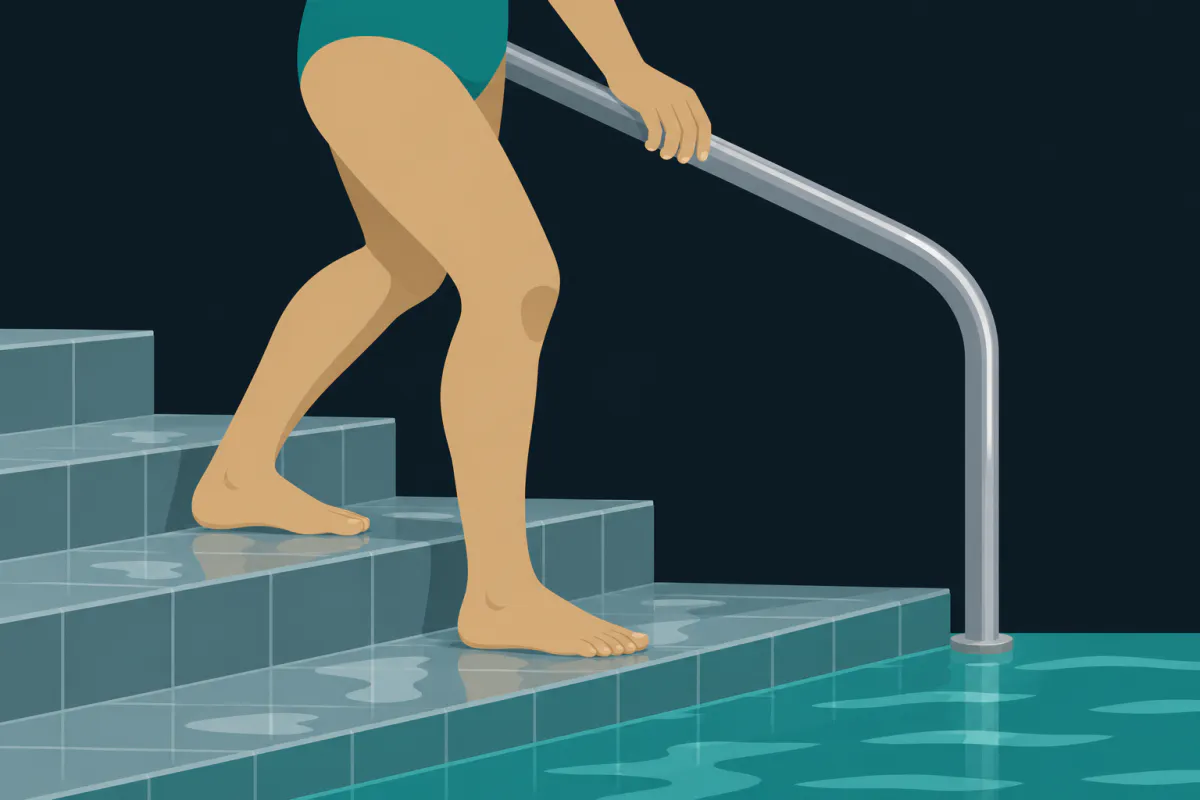
Fins make the kick heavier. No study says when they are safe with a torn ACL, so ask your physiotherapist first.
Can swimming make a torn ACL worse?
The ligament is already torn, and swimming does not tear it further. What can make the knee worse is giving way. When the knee buckles, the shin shifts under the thigh. Repeated episodes can damage the meniscus and the joint surface.
A review of 12 studies with 3,042 patients looked at the wait before surgery. Tears of the inner meniscus were more common when the reconstruction came more than 3 months after the injury. The studies cannot say why. A knee that kept giving way during the wait is one possible reason.
So the question for swimming is the same as for any activity: does it make your knee give way? A gentle front crawl has none of the moves that usually cause it. If your knee gives way, in the pool or out of it, see your doctor or physiotherapist within a week or so. Repeated giving way is one of the reasons guidelines give for going back to the doctor.
If your meniscus is torn too
A meniscus tear comes with about 4 in 10 ACL tears. Ask your doctor whether yours changes what you can do in the pool. Breaststroke combines a deep knee bend with a twist of the shin, so it is the stroke to ask about first.
When to get help
Some signs need a doctor the same day, whether or not you have been swimming. Contact your doctor, your GP or an urgent care service the same day if:
- your knee locks and will not straighten;
- you cannot put weight on the leg;
- your knee swells up within a day, or turns hot and red, or you have a fever;
- your calf is hot, red, swollen or painful.
Call an ambulance if you suddenly get short of breath or have chest pain, or if your foot turns cold, pale or numb.
Can you tear your ACL swimming?
It is very unlikely from the stroke itself. A review of injuries in competitive swimmers describes overuse problems of the shoulder, knee and back, from repeating the same movement. It does not list torn ligaments from swimming. An ACL usually tears when you land, stop or turn on a planted foot, and in the water your foot is not planted.
Around the pool is another matter. A slip on wet tiles or a jump onto the edge can twist a knee like any fall.
If you have had your reconstruction, the rules change: the wound has to heal first, and each stroke returns in its own time. When you can swim after ACL surgery covers that.
Where the app fits
ACL Recovery Tracker has a program for the time before surgery, or while you decide whether to have it. This free ACL rehab app for iPhone and Android gives you two levels. Level 1 calms the knee, and Level 2 builds strength and balance. It also shows the warning signs and what to do if your knee gives way.
Swimming is not one of its workouts. You can use the pain diary to note how your knee feels the morning after a swim: a score from 0 to 10 and where it hurts. Over a few weeks, it shows whether the pool suits your knee.
A torn ACL does not have to keep you out of the water. The strokes that keep the knee steady usually come first, and the morning after shows how a swim went.
The illustrations in this article were generated with AI.
Sources
- Filbay SR, Grindem H. Evidence-based recommendations for the management of anterior cruciate ligament (ACL) rupture. Best Pract Res Clin Rheumatol. 2019;33(1):33-47.
- Frobell RB, Roos EM, Roos HP, Ranstam J, Lohmander LS. A randomized trial of treatment for acute anterior cruciate ligament tears. N Engl J Med. 2010;363(4):331-342.
- Prodromidis AD, Drosatou C, Thivaios GC, Zreik N, Charalambous CP. Timing of anterior cruciate ligament reconstruction and relationship with meniscal tears: a systematic review and meta-analysis. Am J Sports Med. 2021;49(9):2551-2562.
- Wanivenhaus F, Fox AJS, Chaudhury S, Rodeo SA. Epidemiology of injuries and prevention strategies in competitive swimmers. Sports Health. 2012;4(3):246-251.
- Noyes FR, Barber-Westin SD, eds. Noyes' Knee Disorders: Surgery, Rehabilitation, Clinical Outcomes. 2nd ed. Elsevier; 2017.