The guide · Strength, Early recovery
Electrical stimulation for the quad after ACL surgery
What NMES is, what the trials and the Aspetar guideline found it does for quadriceps strength after ACL reconstruction, and when it is used.
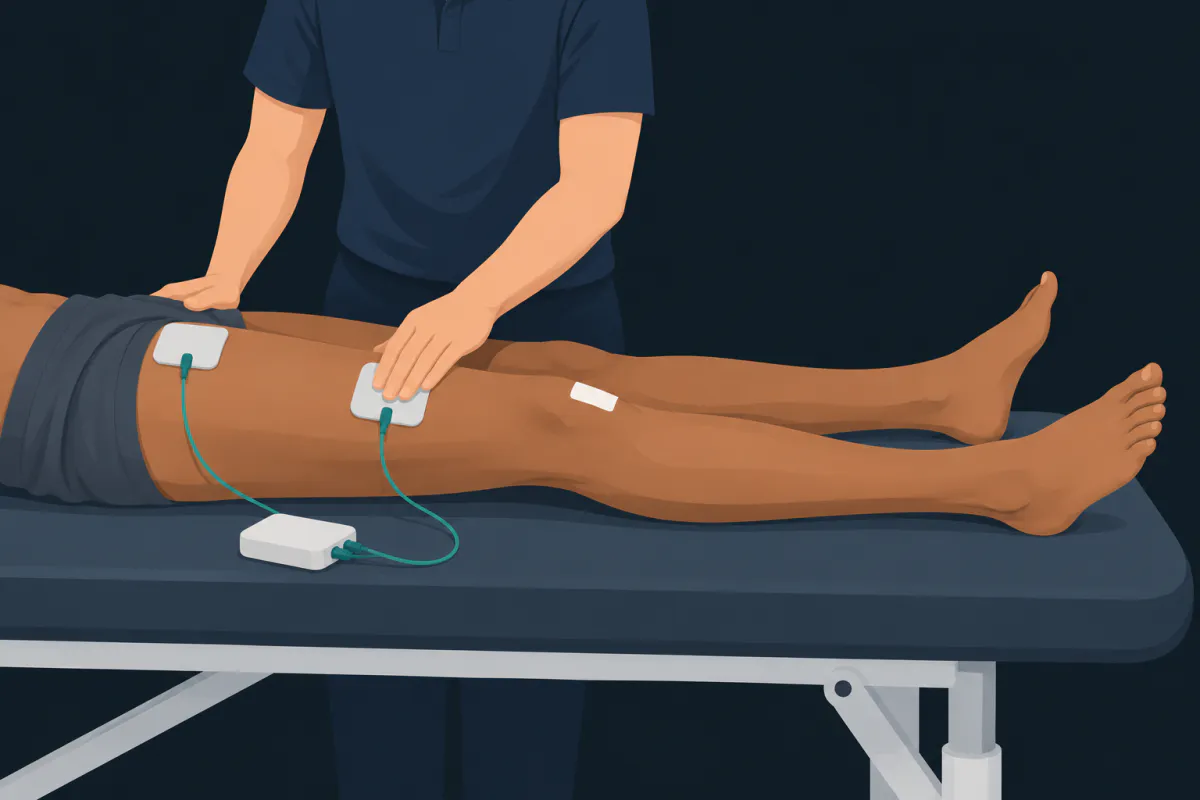
Electrical stimulation is the piece of kit in ACL rehabilitation that patients hear about and then struggle to find anything solid on. Someone puts pads on your thigh, the muscle contracts without you asking it to, and the explanation stops there — leaving the obvious questions open: is it doing anything, and should you buy one of the units sold online?
Whether stimulation belongs in your own programme is a decision for your physiotherapist and surgeon: they can see how the quadriceps is responding, they know what was done to the knee, and their plan comes first. What follows is what the trials and guidelines report across groups of patients, not a recommendation for a particular knee.
What electrical stimulation is, and what it is not
Neuromuscular electrical stimulation, usually shortened to NMES, sends current through electrodes stuck to the front of the thigh to make the quadriceps contract whether or not you can produce the contraction yourself. That last part is the point. In the weeks after a reconstruction the quadriceps often refuses to fire properly even though the nerve and the muscle are intact — a reflex inhibition driven by swelling and pain, described at more length in quad activation after ACL surgery. Stimulation goes around that rather than through it: the current recruits the muscle directly, so a contraction happens on a day when your own effort produces very little.
It is not the same device as a TENS unit sold for pain relief, even though both work through sticky pads and a battery. TENS is dosed to be felt; NMES is dosed to produce a visible contraction, which is a different and considerably less comfortable setting. The distinction shows up in the outcomes: a 2026 network meta-analysis in BMC Musculoskeletal Disorders by Li and colleagues, pooling eleven randomised trials and 629 patients, found NMES better than transcutaneous electrical nerve stimulation for range of motion after reconstruction.
What the trials and the guideline found
For quadriceps strength the evidence has pointed the same way for fifteen years, through three separate reviews.
Kim and colleagues reviewed eight randomised trials in 2010 and concluded that NMES combined with exercise may be more effective for quadriceps strength than exercise alone, while its effect on functional performance and patient-reported outcomes was inconclusive; they also noted that the stimulation settings varied considerably from trial to trial. Hauger and colleagues took the question up again in 2018: eleven studies met their criteria, six were pooled, and the short-term effect on strength in the first four to twelve weeks after surgery was significant, with a standardised mean difference of 0.73 (95% confidence interval 0.29 to 1.16). Physical function improved more in the stimulation groups too. The 2025 meta-analysis by Li and colleagues pooled nine trials for strength and found a smaller but still significant effect, 0.55 (95% confidence interval 0.33 to 0.76), holding at both under and over six weeks of follow-up.
The 2023 Aspetar clinical practice guideline, which built 26 recommendations out of 140 randomised trials covering 5,231 patients, reads the same literature and is usefully specific about where the benefit stops. Adding NMES to usual rehabilitation produced a moderate improvement in quadriceps strength and no effect on hamstring strength, plus a large reduction in knee joint swelling in the early phase after surgery and a moderate reduction later. It found no significant change in range of motion, laxity, subjective function or the time taken to return to sport — the last of which is worth holding on to, being the outcome most people care about. On range of motion the guideline and the 2026 network meta-analysis disagree, a reasonable reminder of how small this literature still is.
One thing is consistent across all of it: in every trial, stimulation was added to an exercise programme. None of them replaced the exercise with it.
Why the intensity matters more than the machine
The oldest and most quoted trial here is also the one that explains why results differ so much between clinics. Snyder-Mackler and colleagues randomised patients after ACL reconstruction to high-intensity electrical stimulation, low-intensity stimulation, the two combined, or high-level volitional exercise, with the stimulation set at the highest intensity each patient could tolerate. In that trial the groups trained at high intensity finished with stronger quadriceps than the low-intensity and exercise-only groups.
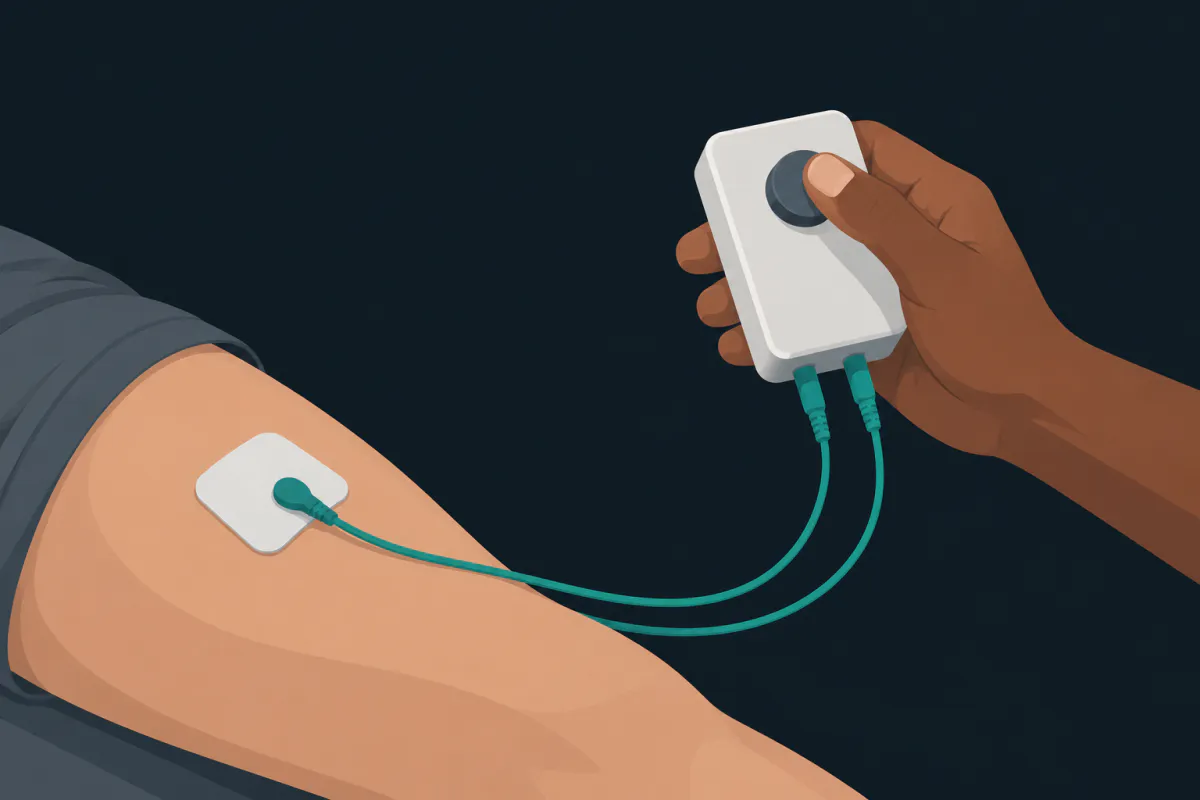
That finding has an uncomfortable implication, and a 2024 clinical commentary in the Journal of Orthopaedic and Sports Physical Therapy by Arhos and colleagues says it out loud: the evidence supporting NMES for quadriceps strength is strong, clinical uptake is low, and where it is used it is often dosed at too low an intensity to restore muscle recruitment. Their recommendations set out the practical side — contractions of roughly ten seconds separated by around a minute of rest, the current ramped up rather than switched on, the intensity progressed as the patient tolerates more.
The number on the dial, in other words, not the presence of the machine, is the active ingredient. A full NMES contraction is uncomfortable, and that discomfort is among the barriers Arhos and colleagues identify to using it properly. It also bears on the question of the units sold online: what the trials delivered was an intensity somebody set, checked and pushed up over several weeks, which is not something a device supplies by itself. If your quadriceps is slow to come back, whether stimulation is worth adding is a fair thing to raise with your physiotherapist.
When it is used, and for how long
Rehabilitation after this operation is organised into phases with criteria for moving between them, the structure set out at length in Noyes’ Knee Disorders, and stimulation belongs almost entirely to the first of them. The consensus guideline from van Melick and colleagues rates electrical stimulation as useful for re-educating voluntary contraction of the quadriceps in the first weeks after surgery. Aspetar recommends it in the very early phase to stimulate muscle activation or to limit the disuse atrophy expected at that stage, and allows that in the early phase it might be used during functional activities rather than lying still.
The trials start it early. Toth and colleagues ran a sham-controlled, blinded trial in 25 people having an ACL reconstruction, with stimulation or placebo for three weeks before surgery and three weeks after it, beginning 72 hours post-operatively, an hour a day, five days a week. The stimulated legs showed less atrophy of the fast-twitch muscle fibres and better preserved contractility in the slow-twitch ones. That is a small study of muscle tissue rather than of how people walk or jump, so take it as evidence about mechanism, not as a dose to copy.
Stimulation changes nothing about what the knee has to prove to progress: swelling, extension, quadriceps strength and movement quality are still the gates. And the standard warning signs still mean a same-day call to your surgical team, your GP or an urgent care service: a calf that is hot, red, swollen or painful; a fever, or redness or discharge at the incision; new weakness or numbness in the foot; a knee that locks.
Where the app fits
If your clinic adds stimulation sessions, they sit alongside the exercises rather than replacing any of them, and that is the part worth keeping a record of. ACL Recovery Tracker is a free ACL rehab app for iOS and Android, and because you can add a custom exercise when a physiotherapist prescribes something outside the library, a stimulation session can be added to the day’s workout with its own timer and logged like the rest — with the pain diary and the extension and flexion readings beside it, so a fortnight when the quadriceps was slow to wake up is recorded rather than remembered.
The honest summary is narrower than the enthusiasm around these devices. Stimulation, added to exercise and turned up high enough to produce a real contraction, helps the quadriceps get stronger in the early weeks and appears to help with swelling; it has not been shown to get anyone back to sport sooner. If you have access to it, it is a useful few weeks of help with the hardest part of the early programme. If you do not, the exercises are still what does the work, as the evidence on how much physiotherapy you need keeps finding.
The illustrations in this article were generated with AI.
Sources
- Kim KM, Croy T, Hertel J, Saliba S. Effects of neuromuscular electrical stimulation after anterior cruciate ligament reconstruction on quadriceps strength, function, and patient-oriented outcomes: a systematic review. J Orthop Sports Phys Ther. 2010;40(7):383-391.
- Hauger AV, Reiman MP, Bjordal JM, et al. Neuromuscular electrical stimulation is effective in strengthening the quadriceps muscle after anterior cruciate ligament surgery. Knee Surg Sports Traumatol Arthrosc. 2018;26(2):399-410.
- Li Z, et al. Effects of neuromuscular electrical stimulation on quadriceps femoris muscle strength and knee joint function in patients after ACL surgery: a systematic review and meta-analysis of randomized controlled trials. Orthop J Sports Med. 2025.
- Li Z, Jin L, Chen Z, et al. Effects of electrical stimulation on lower limb function after anterior cruciate ligament reconstruction: a systematic review and network meta-analysis. BMC Musculoskelet Disord. 2026.
- Snyder-Mackler L, Delitto A, Bailey SL, Stralka SW. Strength of the quadriceps femoris muscle and functional recovery after reconstruction of the anterior cruciate ligament. A prospective, randomized clinical trial of electrical stimulation. J Bone Joint Surg Am. 1995;77(8):1166-1173.
- Arhos EK, Ito N, Hunter-Giordano A, Nolan TP, Snyder-Mackler L, Silbernagel KG. Who's afraid of electrical stimulation? Let's revisit the application of NMES at the knee. J Orthop Sports Phys Ther. 2024;54(2):101-106.
- Toth MJ, Tourville TW, Voigt TB, et al. Utility of neuromuscular electrical stimulation to preserve quadriceps muscle fiber size and contractility after anterior cruciate ligament injuries and reconstruction: a randomized, sham-controlled, blinded trial. Am J Sports Med. 2020.
- Kotsifaki R, Korakakis V, King E, et al. Aspetar clinical practice guideline on rehabilitation after anterior cruciate ligament reconstruction. Br J Sports Med. 2023;57:500-514.
- van Melick N, et al. Evidence-based clinical practice update: practice guidelines for anterior cruciate ligament rehabilitation based on a systematic review and multidisciplinary consensus. Br J Sports Med. 2016;50:1506-1515.
- Noyes FR, Barber-Westin SD, eds. Noyes' Knee Disorders: Surgery, Rehabilitation, Clinical Outcomes. 2nd ed. Elsevier; 2017.
- NHS. ACL (anterior cruciate ligament) surgery: recovering.