Questions · Progression, Timeline, Return to running
ACL rehab weeks 24 to 28: starting to run
In many programmes, weeks 24 to 28 after ACL surgery bring the first runs: short, easy and in straight lines. How they usually build up and what is tested next.
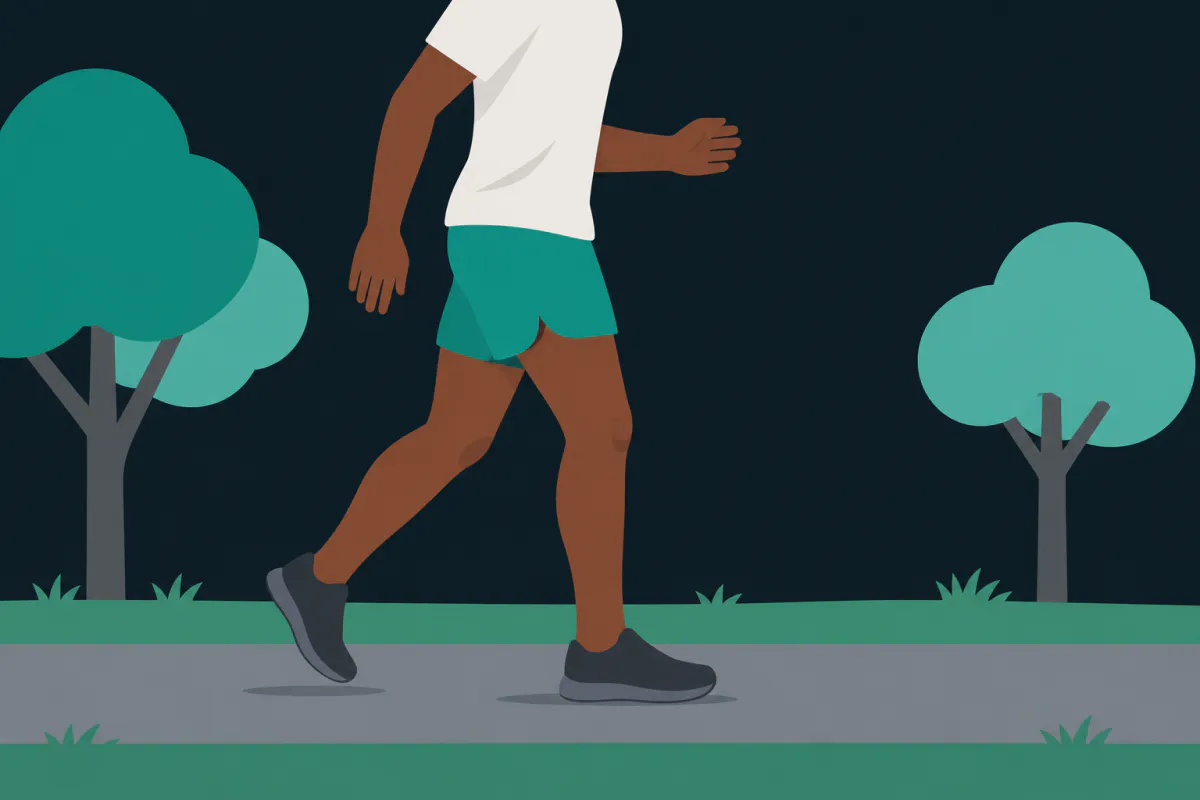
The short answer: in many programmes, weeks 24 to 28 after an ACL reconstruction are when running starts. The first runs are short, easy and in straight lines, and they grow by a few minutes at a time. Your care team usually checks your knee before the first run. After that, how your knee reacts the next morning decides each step up, not the date.
Your surgeon’s and physiotherapist’s instructions come first, and their timing can differ from this with your graft, any other repair or your sport.
When running usually starts
The weeks vary a lot between programmes. A review of 201 studies found that running was allowed at a median of 12 weeks after surgery. The range was 5 to 39 weeks. Some programmes put running later, after months of gym strength work and jump training.
A standard rehab textbook sets out this structure: you move on to the next phase by meeting criteria, not by counting weeks. So the weeks in this article are a typical range, not a target. When can you run after ACL reconstruction explains why the calendar alone is a weak test.
What is usually checked before the first run
Research has not settled which tests should come before running. One clinical guideline still proposes a set of criteria, agreed by its expert panel:
- Movement: full extension, and bending (flexion) at least 95 per cent of the other knee;
- Swelling: none, or only a trace of fluid in the joint (effusion);
- Strength: the thigh muscles (quadriceps) above 80 per cent of the other leg;
- Jumping: in a two-footed jump from standing (countermovement jump), the operated leg absorbing over 80 per cent of what the other leg does;
- Hopping: repeated small hops on one leg (pogos) without pain;
- Unloaded running: pain-free running in water or on an anti-gravity treadmill.
The guideline says these criteria come from expert opinion, not from trials. They describe running that is hard enough to build your fitness, not a few easy steps. Your physiotherapist may use some of them, others, or a different set.
How the first runs usually build up
How to build up running is the least studied part. A review of 64 studies found that most described little more than when running started. Only 1 in 4 gave three or more of the ten details the reviewers looked for. So your physiotherapist’s plan is the one that counts.
Most plans share a few habits:
- you start with a few minutes of easy jogging, often mixed with walking;
- you run on flat ground and in straight lines, because turns and sudden stops come later;
- you add time before speed, a little each week;
- you keep up your strength work, because running rests on it.
The knee’s reaction guides each step. A knee that is more swollen or sore the next morning usually means the last run was too much. Most plans then hold the distance or step back, rather than pushing on. Pain versus a setback explains how ordinary soreness usually differs from a sign worth reporting.
Why the way you run still matters
After an ACL reconstruction, the operated knee often bends less when your foot is on the ground during running. A review of 25 studies found this from 3 months to 5 years after surgery. The knee also took less of the load than the other one.
These changes did not seem to fade with time. They went with weaker quadriceps and hamstrings on the operated side. So time alone may not even out your running. That is one reason programmes keep up strength and landing work through this phase, and why a physiotherapist may want to watch you run.
What is tested before the next phase
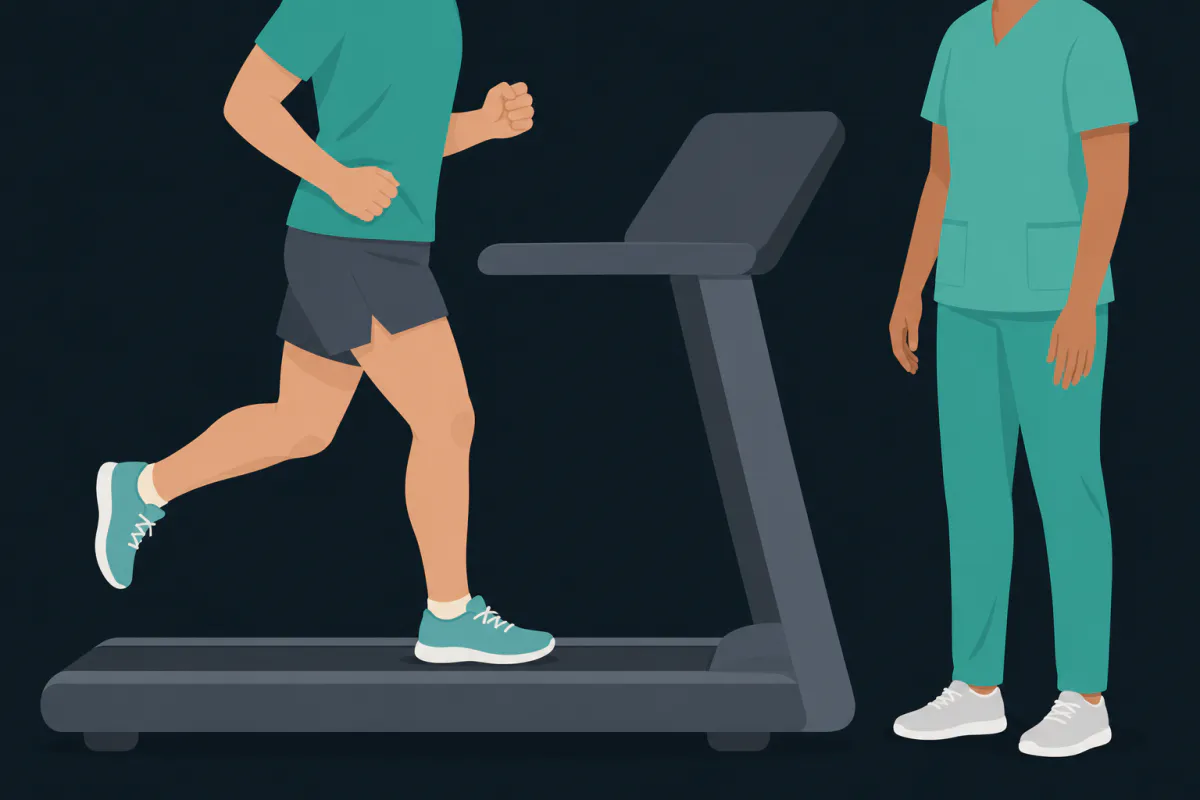
After running, programmes usually move on to harder jumps, turns and cutting. Before that, many check strength and hopping again, with higher targets than before the first run.
For return to sport, the evidence is stronger. A study of 106 people who played pivoting sports followed them for two years after their reconstruction. Those who passed all tests, including strength and hops above 90 per cent of the other leg, had far fewer new knee injuries.
For each month they waited before going back to sport, up to 9 months after surgery, the rate of reinjury fell by about half.
That study was about returning to sport, not about running. It is one reason programmes test you along the way, so the gaps show while there is still time to close them. Hop tests after ACL surgery explains how the hop percentages are measured.
Some signs need prompt contact with your care team, whatever the week:
- a calf that is hot, red, swollen or painful;
- a fever, or spreading redness or discharge at the incision;
- new weakness or numbness in your foot;
- a locked knee.
Where the app fits
In our free ACL rehab app, ACL Recovery Tracker for iOS and Android, running starts at Level 7, “Back to running”, which typically runs from week 20 to week 26. Weeks 24 to 28 fall at the end of Level 7 and the start of Level 8, “Power and speed”. That is later than the 12-week median above, because the app puts running after the gym and landing levels.
Without a physiotherapist, the app’s rules say to move into Level 7 no earlier than week 20 with its own thigh strength test, or week 24 with no strength measure.
The level has two sessions, each planned twice a week:
- “Run”: a 15-minute warm-up, high knee walks and walking lunges, then the walk-jog plan;
- “Strength and hops”, on days you don’t run: single-leg hops and landings, then heavy strength work such as front squats and the single-leg leg press.
The running plan starts with short jogs between walks and builds to about 5 km without stopping. In your first two weeks of running, you leave two rest days between runs, and you move up at most two steps a week. If you are sore after a run, you stay on the same step. If you get sore during it, you take a day off and go one step down.
The checklist for moving on asks for:
- the running plan’s last step done, with no soreness the next day;
- 10 single-leg hops forward on each leg, each landing held 2 seconds on one foot, with no wobble and the knee over the foot;
- a single-leg leg press of 1.5 times your body weight, 8 times on the operated leg;
- no swelling after running days;
- thigh strength and hop tests at least 80 per cent of the other leg, measured by a physio.
Those figures are the programme’s own, not numbers from the studies above. You tick them yourself: the app does not test your leg. You can use the app to log each run and any pain the next morning. Then you and your physiotherapist can see how your knee copes as the running plan’s steps grow.
After revision surgery, Level 7 starts no earlier than week 27, and Level 8 no earlier than week 30. The first runs are usually slow and short. What counts is that your knee stays calm the next morning, again and again.
The illustrations in this article were generated with AI.
Sources
- Kotsifaki R, Korakakis V, King E, Barbosa O, Maree D, Pantouveris M, Bjerregaard A, Luomajoki J, Wilhelmsen J, Whiteley R. Aspetar clinical practice guideline on rehabilitation after anterior cruciate ligament reconstruction. Br J Sports Med. 2023;57(9):500-514.
- Rambaud AJM, Ardern CL, Thoreux P, Regnaux JP, Edouard P. Criteria for return to running after anterior cruciate ligament reconstruction: a scoping review. Br J Sports Med. 2018;52(22):1437-1444.
- Van Cant J, Pairot de Fontenay B, Douaihy C, Rambaud A. Characteristics of return to running programs following an anterior cruciate ligament reconstruction: a scoping review of 64 studies with clinical perspectives. Phys Ther Sport. 2022;57:61-70.
- Pairot-de-Fontenay B, Willy RW, Elias ARC, Mizner RL, Dubé MO, Roy JS. Running biomechanics in individuals with anterior cruciate ligament reconstruction: a systematic review. Sports Med. 2019;49(9):1411-1424.
- Grindem H, Snyder-Mackler L, Moksnes H, Engebretsen L, Risberg MA. Simple decision rules can reduce reinjury risk by 84% after ACL reconstruction: the Delaware-Oslo ACL cohort study. Br J Sports Med. 2016;50(13):804-808.
- Noyes FR, Barber-Westin SD, eds. Noyes' Knee Disorders: Surgery, Rehabilitation, Clinical Outcomes. 2nd ed. Elsevier; 2017.