The guide · Early recovery, Timeline
Meniscus repair with ACL reconstruction: what changes
A stitched meniscus usually means weeks of limited weight and bending on top of the ACL protocol. How long varies by repair and surgeon.
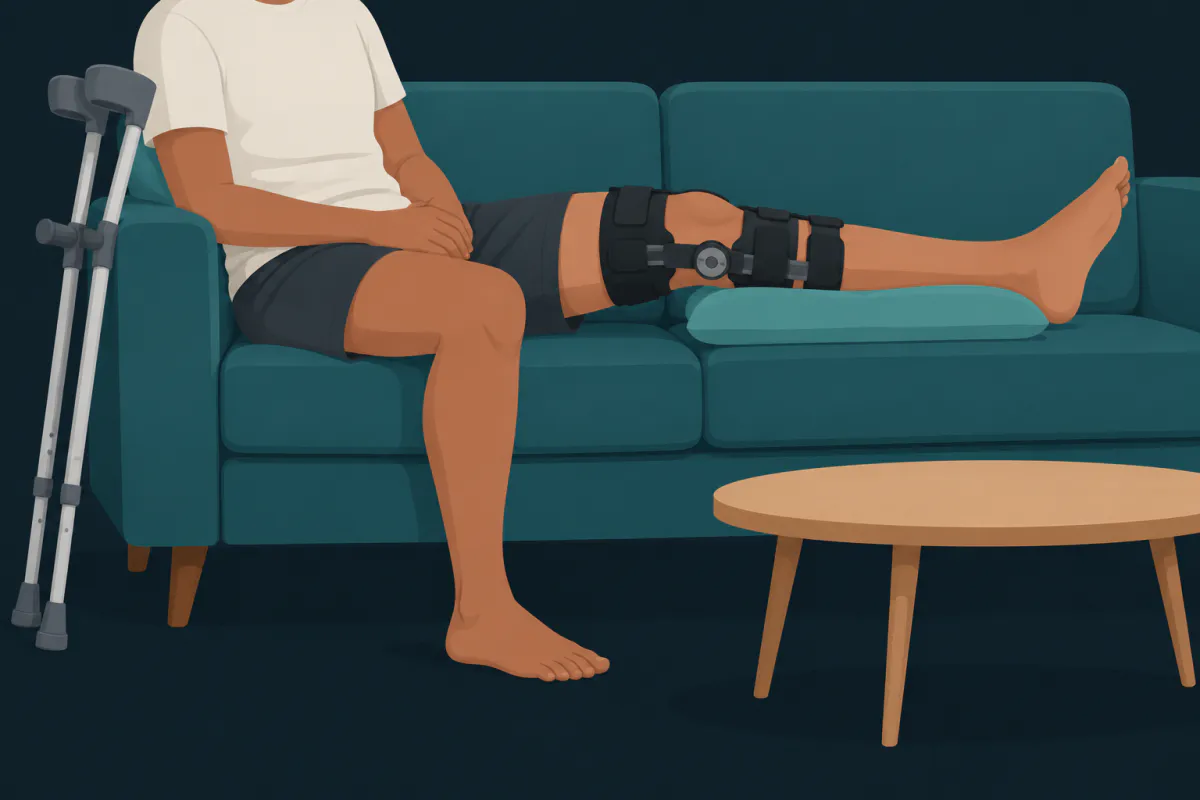
The short answer: when a torn meniscus is stitched during an ACL reconstruction, the first weeks are usually more cautious than for the ligament alone. Many protocols limit weight on the leg and how far the knee bends for about four to six weeks, and keep deep, loaded bending for later, while others allow full weight from the start; the published studies report similar results with both. After that early stretch, most of the rehabilitation is the same as for an ACL alone. A meniscus that was trimmed rather than stitched usually changes little.
The limits for your knee are set by your surgeon, who saw the tear and the repair, and their instructions and your physiotherapist’s come first. This article explains why the limits exist and what the research says about them.
Why a stitched meniscus changes the early weeks
Each knee has two menisci, C-shaped pads of cartilage between the thigh bone and the shin bone that spread the load across the joint. A torn meniscus is either trimmed, with the loose piece removed, or repaired, with the torn edges stitched back together so they can heal. A trimmed meniscus has nothing left to heal, which is why it rarely changes the rehabilitation. A repair is a wound in tissue with a modest blood supply, and it needs time.
Noyes, Heckmann and Barber-Westin, whose group has published many studies of meniscus repair, put the early goal plainly in their review: avoid excessive weight through the knee, because high compressive and shearing forces can pull a healing repair apart. In the same programme, knee motion and muscle strengthening start the day after surgery. So the meniscus does not stop rehabilitation. It changes how much load the knee takes and at what angle.
There is some good news in the combination. Cannon and Vittori found that meniscal repairs done together with an ACL reconstruction healed in 93 per cent of their cases, against 50 per cent for isolated repairs in knees with an intact ligament. It was a small, older study, and later work has not always shown so large a gap, but it is one reason surgeons are willing to stitch a meniscus at the same operation.
What the restrictions usually are
There is no single protocol. When VanderHave and colleagues reviewed the studies on weight-bearing after meniscus repair, the programmes ranged from one extreme to the other:
- no weight on the leg, with bending limited to 60 degrees for two weeks and then to 90, and full weight from six weeks;
- no weight for four weeks with bending limited to 90 degrees, and no return to sport for at least four months;
- full weight and full movement allowed straight away.
Several of those studies included patients who had an ACL reconstruction at the same time. With restricted weight-bearing, 70 to 94 per cent of patients had a successful result; with the accelerated programmes, 64 to 96 per cent had good results. The authors could not say which approach was better, because the repair techniques and the measures of success differed too much between studies. Their conclusion was that the choice should rest on what the surgeon found during the operation, how secure they judged the repair, and the patient.
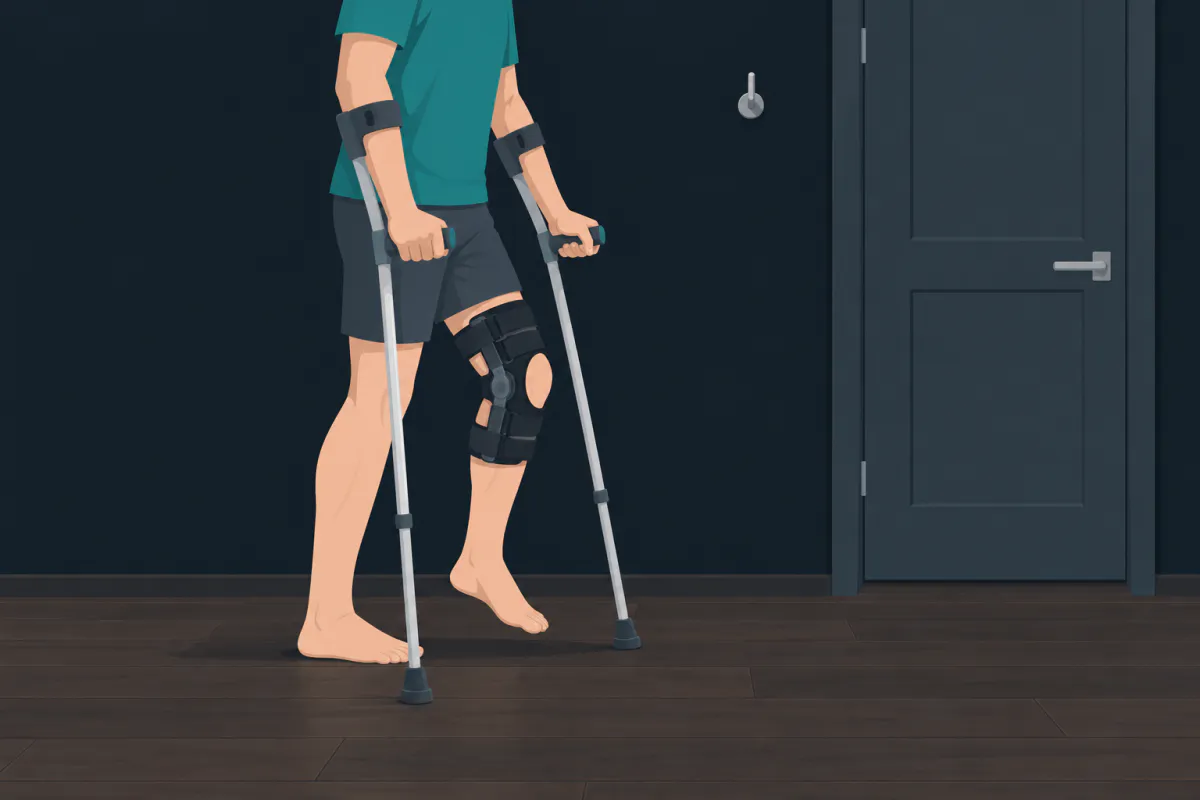
O’Donnell and colleagues reached the same place in a systematic review of 15 studies of isolated meniscal repairs, without an ACL reconstruction. Accelerated, motion-restricted, weight-restricted and doubly restricted programmes had similar clinical success, and early motion and weight-bearing showed no effect on outcome. They also found no consensus on the ideal limits. Because their review left out combined operations, it supports the general point rather than any specific number for your knee.
In practice, the limits most often concern the same few things:
- Weight on the leg, from none to partial to full, often with crutches for longer than after an ACL reconstruction alone; the article on crutches after ACL surgery covers how they come away.
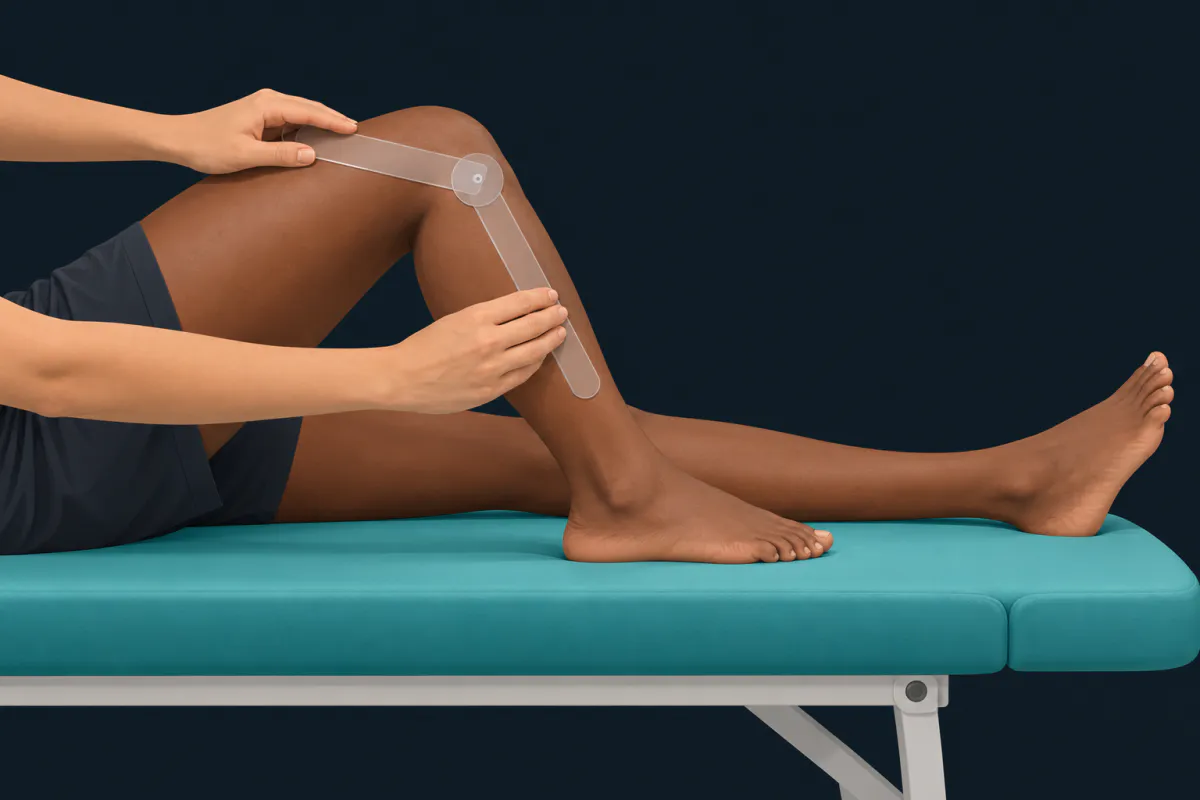
- How far the knee bends, commonly capped around 90 degrees in the first weeks, sometimes set on a hinged brace.
- Deep bending under load, such as squats, lunges and leg presses past a right angle, which is usually reintroduced later than the rest of the programme.
Root and complex repairs
Not every repair is the same. Noyes and colleagues noted that repairs at the outer edge of the meniscus, where the blood supply is better, heal quickly, while complex tears that reach into its inner part heal more slowly and need more caution. A tear of the meniscus root, where it attaches to the shin bone, is a further step: Mueller and colleagues wrote a separate, criteria-based rehabilitation programme for root repairs, and pointed out how little had been published on the subject. If your operation note mentions a root repair or a complex tear, expect your surgeon’s limits to be stricter and to last longer than the ranges above.
How often a repair holds
The MOON group, a network of surgeons in the United States that follows reconstruction patients over many years, looked at 286 people who had a meniscus repaired at the same time as their ACL. Of the 235 followed for six years, 14 per cent had a repair that failed, meaning the meniscus needed another operation. Medial repairs, on the inner side of the knee, failed earlier on average than lateral ones, at about two years against nearly four. The improvement in the patients’ own outcome scores was sustained at six years.
Nepple, Dunn and Wright pooled 13 studies that followed meniscal repairs for at least five years and found a failure rate of 23 per cent, similar whether the ACL was intact or reconstructed. They also set out why surgeons repair rather than trim when they can: losing meniscus tissue is linked to cartilage wearing down later. The early weeks of restriction are the price of keeping that tissue.
Most failures in these studies were found months or years later, not in the first weeks. A knee that keeps catching or giving way is worth raising with your physiotherapist or surgeon. Some signs are more urgent, and the NHS recovery guidance lists them for this operation: a calf that is hot, red, swollen or painful, or new shortness of breath or chest pain, which can indicate a blood clot; spreading redness at the incision, discharge from the wound or a fever; new weakness or numbness in the foot; and a knee that locks and cannot be moved. Any of those means contacting your surgical team, your GP or an urgent care service the same day.
Where the app fits
In ACL Recovery Tracker, our free ACL rehab app for iOS and Android, a meniscus repair is one of the surgery details you can add, as a stitched repair or as a root or complex repair. The app then adds the notes that published protocols usually give for it: exercises done standing marked as not recommended until week 4, exercises where you stand on the operated leg alone until week 6, a note to keep bending to 90 degrees in the first six weeks, and loaded squats, presses and lunges kept to 90 degrees until about week 18. A root or complex repair brings stricter notes: no weight on the leg until week 6, and Level 2 not before week 9. These are notes, not a plan that overrides yours: each answer has a switch for following your surgeon’s own protocol instead. You can use the mobility log to record the bend you reach within your limit and the pain diary to note how the knee reacts as weight comes back.
A meniscus repair adds a slower first chapter to an ACL reconstruction, and the details of that chapter differ more between surgeons than almost anything else in the programme. The evidence does not point to one right answer, which is why the limits you were given, by the person who did the repair, are the ones that count.
The illustrations in this article were generated with AI.
Sources
- VanderHave KL, Perkins C, Le M. Weightbearing versus nonweightbearing after meniscus repair. Sports Health. 2015;7(5):399-402.
- O'Donnell K, Freedman KB, Tjoumakaris FP. Rehabilitation protocols after isolated meniscal repair: a systematic review. Am J Sports Med. 2017;45(7):1687-1697.
- Noyes FR, Heckmann TP, Barber-Westin SD. Meniscus repair and transplantation: a comprehensive update. J Orthop Sports Phys Ther. 2012;42(3):274-290.
- Westermann RW, Wright RW, Spindler KP, Huston LJ; MOON Knee Group; Wolf BR. Meniscal repair with concurrent anterior cruciate ligament reconstruction: operative success and patient outcomes at 6-year follow-up. Am J Sports Med. 2014;42(9):2184-2192.
- Nepple JJ, Dunn WR, Wright RW. Meniscal repair outcomes at greater than five years: a systematic literature review and meta-analysis. J Bone Joint Surg Am. 2012;94(24):2222-2227.
- Cannon WD Jr, Vittori JM. The incidence of healing in arthroscopic meniscal repairs in anterior cruciate ligament-reconstructed knees versus stable knees. Am J Sports Med. 1992;20(2):176-181.
- NHS. ACL (anterior cruciate ligament) surgery: recovering.
- Mueller BT, Moulton SG, O'Brien L, LaPrade RF. Rehabilitation following meniscal root repair: a clinical commentary. J Orthop Sports Phys Ther. 2016;46(2):104-113.