The guide · Strength, Exercises
Blood flow restriction training after ACL surgery
What blood flow restriction training is, what the trials after ACL reconstruction found, where guidelines place it, and why the cuff pressure is measured.
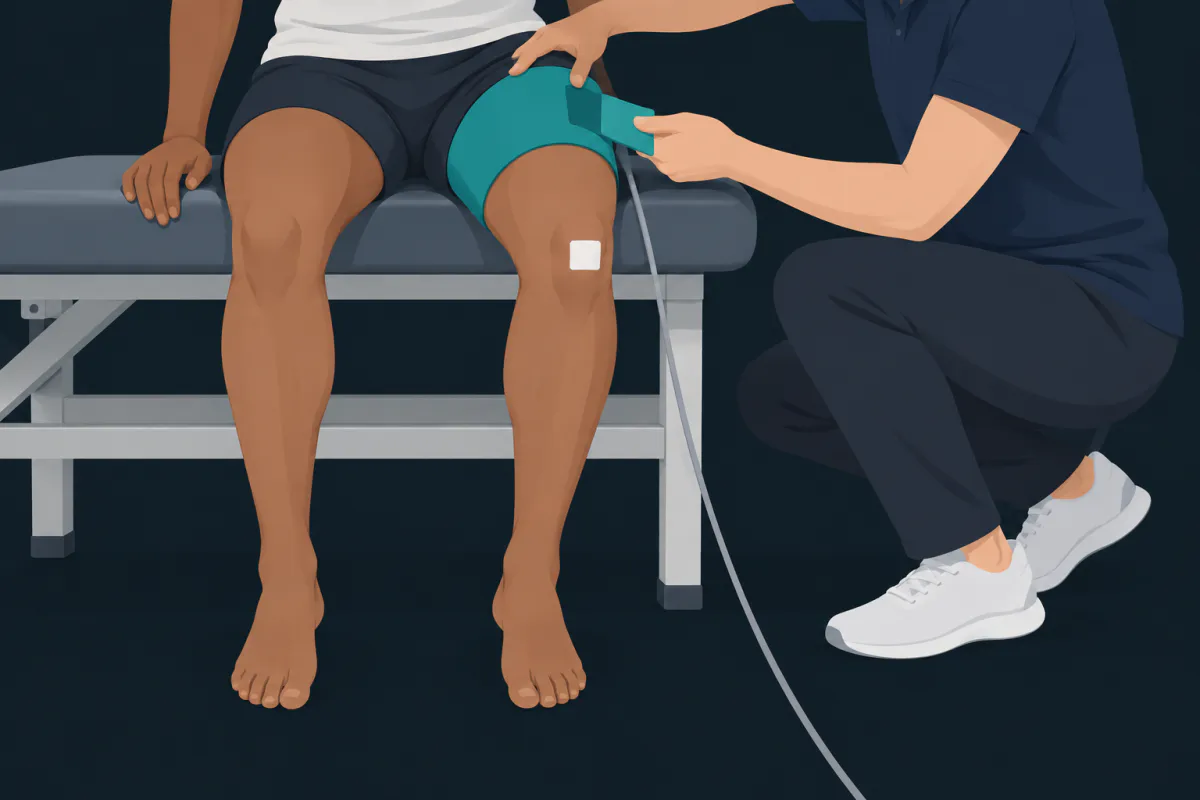
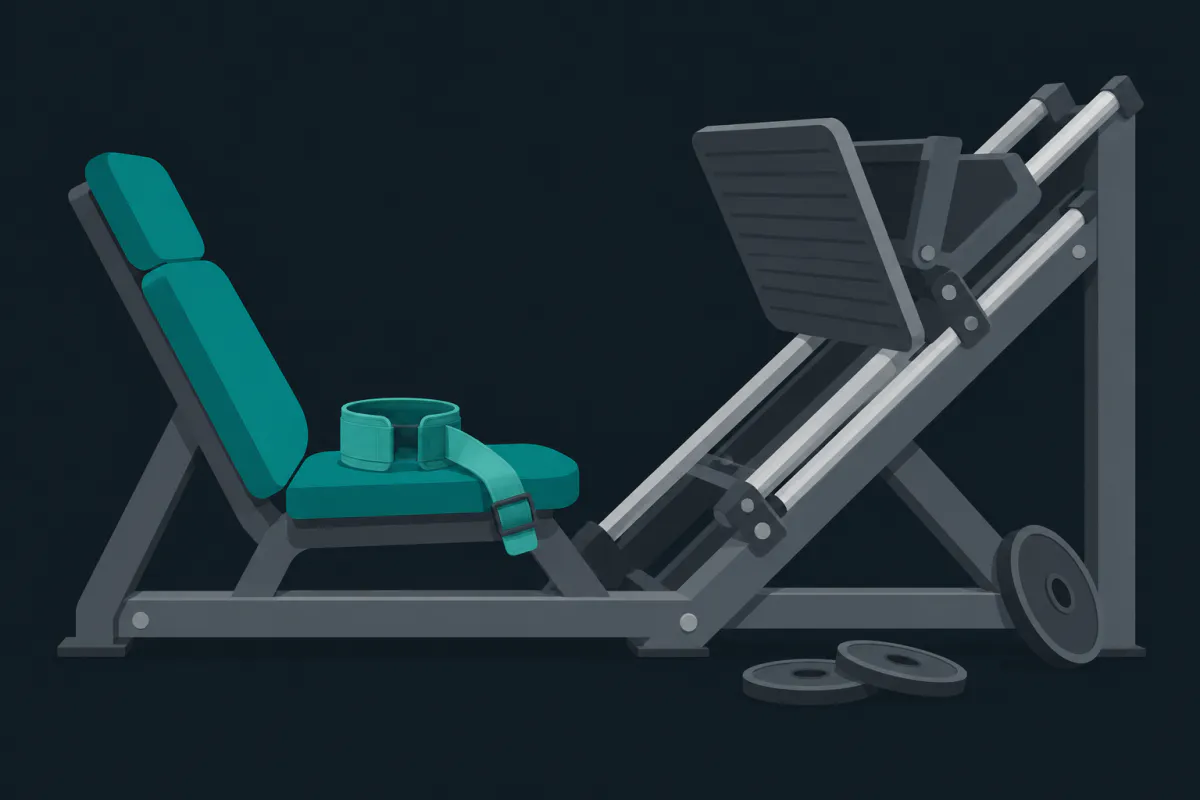
Spend any time reading about ACL rehabilitation and you will meet photographs of people doing leg presses with a wide cuff strapped around the top of the thigh. Blood flow restriction training is one of the few genuinely new ideas in this field in the last decade, and unusually for a new idea, there are randomised trials behind it in exactly this population. It is also a prescription rather than something to take up on your own.
Whether it belongs in your programme is a decision for your surgeon and physiotherapist. They can see the knee, they know what was done to it, and setting the cuff is their job rather than yours. What follows is what the method is, what the trials found and where guidelines place it — general information, not a plan for a particular knee.
What it is, and why the loads are so light
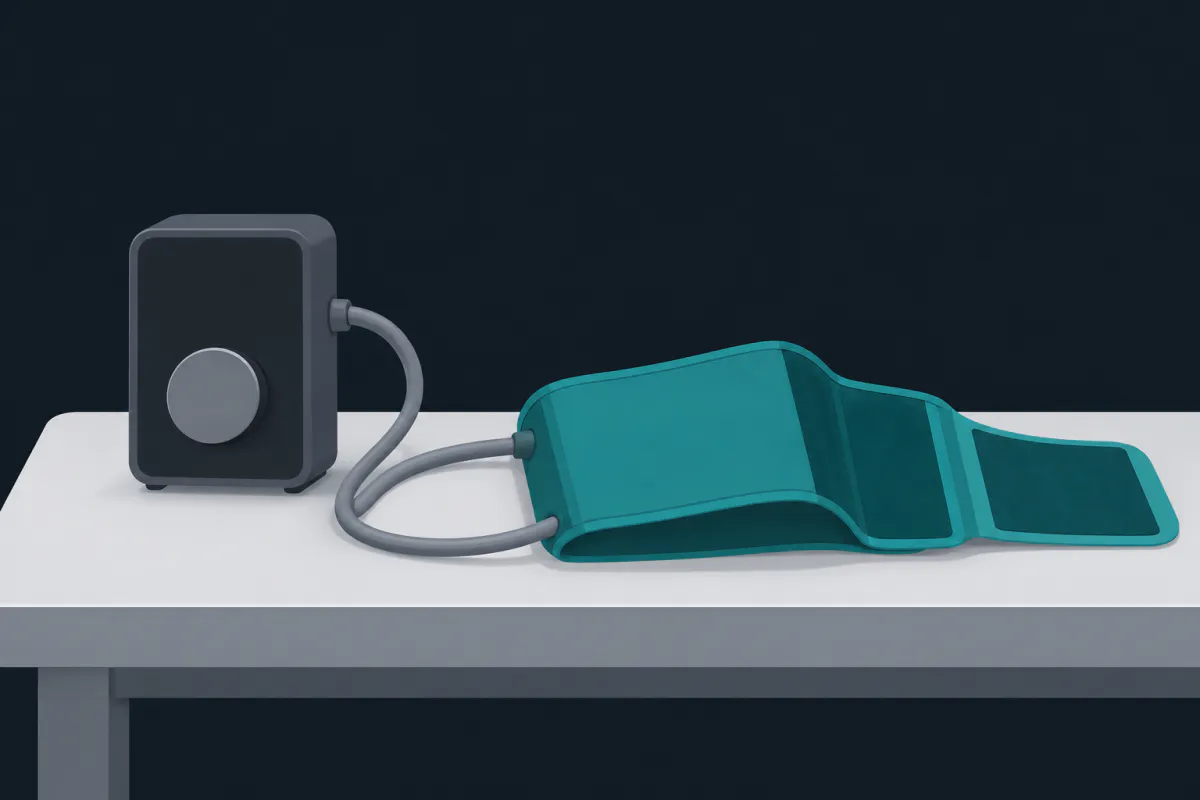
A cuff goes around the top of the thigh and is inflated to a measured fraction of the pressure that would stop arterial blood entering the limb — the limb occlusion pressure. Inflow is reduced rather than stopped, and the veins are squeezed harder than the arteries, so blood is slower to leave the working muscle than to enter it. The person then exercises with weights far lighter than a strength session would normally use. The position stand on the method, written by Patterson and colleagues, sets out how the pressure, the loads and the sets are chosen and what the practitioner has to measure first.
The reason anyone bothers is the problem the early weeks after a reconstruction present. Building strength normally takes heavy loads, and a knee a few weeks past surgery often cannot take them: the joint is swollen, the loads it is allowed are built up gradually, and the quadriceps is partly switched off by the joint itself, which is a separate problem with its own explanation and its own exercises. Blood flow restriction is an attempt to get some of the signal of heavy training out of light training. In the UK trial described below, the restricted group lifted 30 per cent of the most they could manage once, with the cuff pressure set from a measurement taken on their own limb.
What the trials after ACL reconstruction found
The best-known trial is Hughes and colleagues’ work in the UK National Health Service, published in Sports Medicine in 2019. Twenty-eight patients having a hamstring-graft reconstruction were randomly assigned to eight weeks of twice-weekly leg press training either at a heavy load, 70 per cent of their one-repetition maximum, or at the light load with the cuff — sixteen sessions in each group, on top of the hospital’s standard rehabilitation. Muscle size and strength improved to a similar extent in both groups. The restricted group had the greater reduction in knee pain and in effusion, the fluid inside the joint, and the greater improvement in physical function overall. No adverse events were reported.
Twenty-eight patients is a small trial, so the pooled evidence matters more. A 2026 systematic review and meta-analysis by Hu and colleagues in Orthopaedic Journal of Sports Medicine gathered six randomised trials and 284 patients and found that restricted training significantly improved quadriceps peak torque compared with the control programmes, rating the certainty of that finding moderate. Their conclusion was appropriately narrow: it may help early recovery of quadriceps strength and some aspects of knee function, under low loads.
The Aspetar clinical practice guideline, published in the British Journal of Sports Medicine in 2023 by Kotsifaki and colleagues, reviewed five studies of low-load restricted training added to usual rehabilitation after surgery, plus two of it used before surgery. Its reading was that the method might improve quadriceps and hamstring strength and prevent the muscle wasting of disuse in the early phase, with a large effect on swelling and on pain reported during training.
Note what the evidence does not cover. These are early-phase outcomes — strength, muscle size, pain, swelling, function in the first months. There is no evidence here that the method shortens a recovery, changes the graft’s fate or lowers the risk of a second injury, and the trials are small.
Where guidelines place it
Consistently, as an addition. The Aspetar guideline’s clinical application is that low-load restricted training might be used alongside standard care in the early phase, and it names the situation it suits: a patient whose knee is painful, or who cannot tolerate high loads through the joint. That is the honest case for it. It is not a shortcut, and it does not replace the programme.
The shape of that programme is unchanged by it. Across the standard references, including Noyes’ Knee Disorders, which is the textbook account of how ACL rehabilitation is structured, the early phase is built around restoring extension, getting the quadriceps firing and loading the knee in a controlled, graded way, with movement from the first days as the consensus guideline from van Melick and colleagues describes. Progression between phases is decided by criteria the knee has to meet, not by the calendar and not by what equipment was used. A cuff on the thigh changes how a set of leg presses is loaded; it does not change what the knee has to be able to do before the next phase starts.
Safety, and the part that is easy to get wrong
The method has been studied for safety in a way most rehabilitation techniques have not. A literature review in Military Medicine by Anderson and colleagues pulled together case reports, surveys, questionnaires and trials covering 25,813 people and found 1,672 who reported an adverse event, around 6.5 per cent. Most of what was reported was minor and local: numbness, dizziness, bruising under the cuff. The review also collected case reports of rhabdomyolysis, a breakdown of muscle tissue, and isolated serious events in people who had other conditions alongside; those cases are the reason screening comes before the first inflation. The risk sits with the individual and their history rather than with the technique in the abstract. It is worth knowing that clots after knee surgery are uncommon but not unheard of, with their own signs to recognise, and that screening for a clotting history is one of the things a practitioner does before inflating anything.
The other finding worth carrying away is less comfortable. Korakakis and colleagues surveyed physiotherapists using the method in 2025 and found wide variation in the devices used, in how limb occlusion pressure was worked out, in the pressures applied and in how the sets were arranged; two-thirds had learnt it on a short course, and half of those did not think the course had been evidence-based. The authors concluded that practice is largely not aligned with the evidence. The trials that produced the results above measured each patient’s own occlusion pressure and worked from it. An elastic band pulled tight by feel is not the same intervention, and that is the difference between what was studied and what is sometimes done.
Where the app fits
If your physiotherapist does add restricted leg presses or knee extensions, they will not be in the exercise library, because they belong to a clinician’s prescription rather than a general programme. You can add them to the relevant session as a custom exercise in our free ACL rehab app for iOS and Android, log the reps and the weight you used, and record in the pain diary how the knee felt afterwards — which is the information your physiotherapist will want at the next appointment.
The fair summary of blood flow restriction after an ACL reconstruction is that it is a real tool with real trials behind it, aimed at one specific window: the weeks when the quadriceps needs a stimulus the knee cannot yet tolerate. Whether it is offered to you depends on your knee, your history and, frankly, on whether your clinic owns the equipment and knows how to use it. If it is not offered, you are not missing the thing that decides your recovery; the strength work you do without it is still the thing that does.
The illustrations in this article were generated with AI.
Sources
- Patterson SD, Hughes L, Warmington S, et al. Blood flow restriction exercise: considerations of methodology, application, and safety. Front Physiol. 2019;10:533.
- Hughes L, Rosenblatt B, Haddad F, et al. Comparing the effectiveness of blood flow restriction and traditional heavy load resistance training in the post-surgery rehabilitation of anterior cruciate ligament reconstruction patients: a UK National Health Service randomised controlled trial. Sports Med. 2019;49(11):1787-1805.
- Hu Y, Guo L, Zeng X, Yuan R. Blood flow restriction training after anterior cruciate ligament reconstruction: a systematic review and meta-analysis of randomized controlled trials. Orthop J Sports Med. 2026.
- Kotsifaki R, Korakakis V, King E, et al. Aspetar clinical practice guideline on rehabilitation after anterior cruciate ligament reconstruction. Br J Sports Med. 2023;57:500-514.
- Anderson KD, Rask DMG, Bates TJ, Nuelle JAV. Overall safety and risks associated with blood flow restriction therapy: a literature review. Mil Med. 2022;187(9-10):1059-1064.
- Korakakis V, Korakaki A, Korakaki T, Karanasios S, Kotsifaki R. Trends and practices on blood flow restriction training are not largely aligned with the contemporary evidence. Cureus. 2025;17(4):e81766.
- van Melick N, et al. Evidence-based clinical practice update: practice guidelines for anterior cruciate ligament rehabilitation based on a systematic review and multidisciplinary consensus. Br J Sports Med. 2016;50:1506-1515.
- Noyes FR, Barber-Westin SD, eds. Noyes' Knee Disorders: Surgery, Rehabilitation, Clinical Outcomes. 2nd ed. Elsevier; 2017.