The guide · Progression, Timeline, Strength
ACL rehab weeks 12 to 16: gym strength
Around weeks 12 to 16 after ACL surgery, gym work usually gets heavier and moves to one leg at a time. Why, and what usually decides the next step.
The short answer: around weeks 12 to 16 after an ACL reconstruction, gym work usually gets heavier, and more of it is done on one leg. That way the operated leg cannot lean on the other one. In one trial, the heaviest training began at week 14. How your knee responds, and often a strength test, decides when you move on, not the date. Your surgeon’s and physiotherapist’s instructions come first, and they can differ from this with your graft or any other repair.
What changes around week 12
By now you have usually been lifting weights on machines for some weeks. The change is in how hard and how: heavier loads, fewer repetitions, and more exercises on one leg. Moving through phases by meeting criteria, rather than by counting weeks, is the structure set out in Noyes’ Knee Disorders.
The most direct evidence for these weeks comes from one trial of 50 people (Bieler and colleagues). One group trained with light weights from week 8 to week 20. The other built up to heavy weights, which began at week 14. With the heavier training, the leg’s pushing power (leg extensor power) came back faster:
- at week 14, it reached 84 per cent of the other leg, against 73 per cent;
- at week 20, it reached 98 per cent, against 83 per cent.
The knee did not get looser (laxity) in either group, and no other result differed.
The Aspetar clinical practice guideline reads this with caution. It says there is little evidence on how much or how hard to train after ACL surgery (Kotsifaki and colleagues). So the trial suggests that heavier loads, built up slowly, did not harm the knee. It does not give you a target weight.
Why one leg at a time
When you use both legs together, the stronger leg can quietly do more of the work. A small study measured eight people doing squats within a year of surgery (Salem and colleagues). Both feet pushed down equally hard. But the other knee worked about a quarter harder than the operated knee. The operated leg used its hip more to make up for it.
The same pattern can last for years. A study looked at 26 people, on average five years after surgery (Ishida and colleagues). Some still had a weaker thigh muscle (quadriceps) on the operated side. In a squat on both legs, only this group used the operated knee less than the other knee.
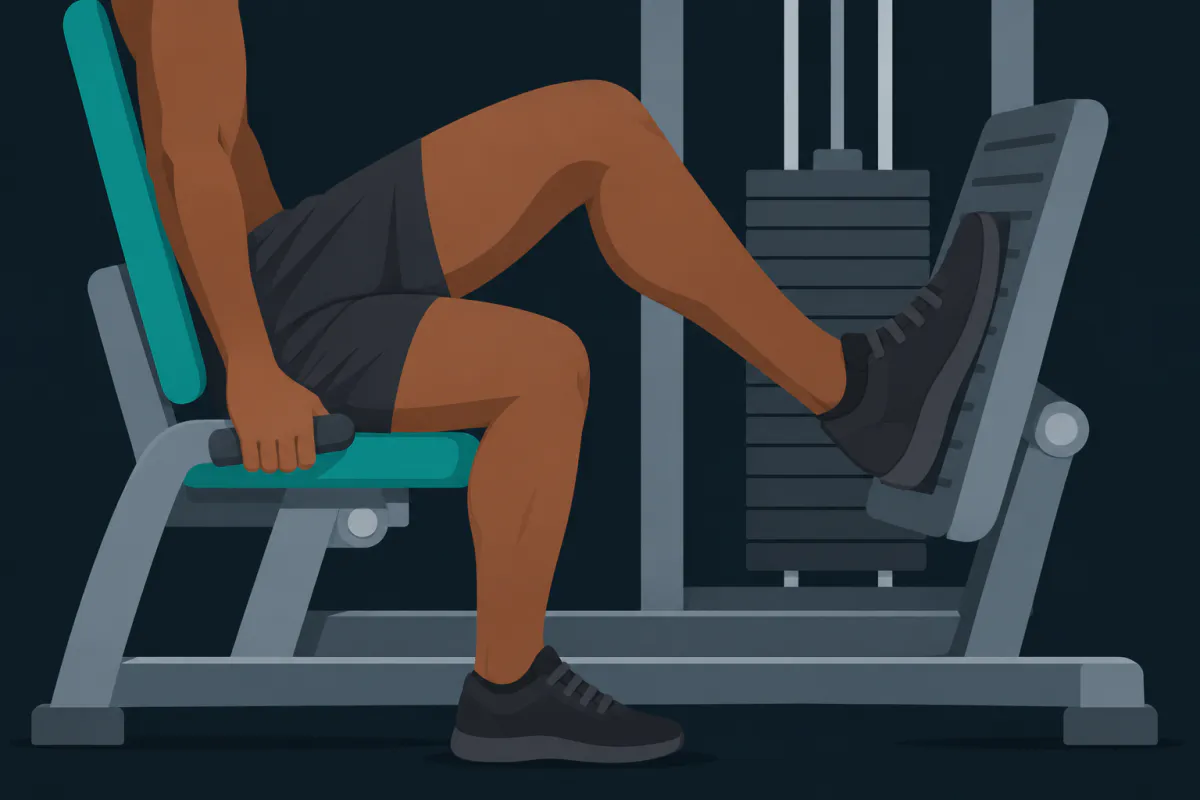
Training one leg at a time takes that option away. Programmes still keep some work on both legs. A clinical commentary on quadriceps strength recommends seated and standing exercises, for both legs, moving from single-muscle exercises to whole movements (Buckthorpe and colleagues). That paper is expert opinion, not a trial.
Why the back of the thigh matters too
The place your graft came from usually leaves its own gap in strength. A review of 14 studies found that a patellar tendon graft left the quadriceps weaker, and a hamstring graft left the hamstrings weaker (Xergia and colleagues). Those gaps were still there up to two years after surgery.
That is one reason many programmes split the week between the front of the thigh and the back of the thigh and buttocks. The muscles on both sides of the knee then get their share. Your graft can also decide when heavier hamstring work starts, and that date belongs to your surgeon.
What usually decides the next step
There is no single agreed test for leaving this stage. The Aspetar guideline found no evidence on which progression criteria to use. Clinicians generally look at:
- Swelling after the harder sessions;
- Pain during sessions and the next day;
- Range of movement compared with the other knee;
- Control, whether the movements stay steady on one leg;
- Strength, measured in many clinics as a percentage of the other leg.
Strength matters for later on. In a study of 106 people in pivoting sports, more equal quadriceps strength before going back to sport meant fewer new knee injuries (Grindem and colleagues).
The comparison with the other leg can flatter you, though, because that leg often loses strength during rehab too. A study tested 70 athletes six months after surgery, on quadriceps strength and four hop tests (Wellsandt and colleagues). Measured against the other leg, 57 per cent scored at least 90 per cent on all of them. Measured against what the other leg could do before surgery, only 29 per cent did. The limb symmetry index after ACL surgery explains how that number is worked out.
Heavier sessions can bring on a flare. Pain versus a setback explains how ordinary soreness usually differs from a sign worth reporting. Some signs need prompt contact with your care team, whatever the week:
- a calf that is hot, red, swollen or painful;
- a fever, or spreading redness or discharge at the incision;
- new weakness or numbness in your foot;
- a locked knee.
Where the app fits
In our free ACL rehab app for iOS and Android, this stage is Level 5, “Gym Strength”, typically weeks 12 to 16. It has two sessions:
- Anterior Chain, recommended once or twice a week, for the front of the thigh. It has the stationary bike, single-leg leg press, single-leg knee extension, goblet squats to a bench, resistance band crab walks and the wall knee drive (load and go).
- Posterior Chain, recommended twice a week, for the back of the thigh and the buttocks. It has the stationary bike, stiff-leg RDLs, single-leg glute bridges, feet-elevated hamstring bridges, single-leg hip thrusts and single-leg calf raises with the front of the foot raised.
The checklist for moving on asks for:
- single-leg leg press: 1.25 times your body weight for 10 reps;
- single-leg knee extension and single-leg hamstring curl: half your body weight for 5 reps each;
- single-leg calf raise on a Smith machine: 1.1 times your body weight for 10 reps;
- side plank: 90 seconds on each side;
- single-leg sit to stand: 25 reps.
Those figures are the programme’s own, not numbers from the studies above. You tick them yourself: the app does not test your leg. You can use it to log the weight and reps of each set. It suggests the next load, and holds or lowers it when you log more pain, but your physiotherapist’s numbers come first.
With a meniscus root or complex repair, Level 5 starts no earlier than week 16, and after revision surgery no earlier than week 18.
These weeks can feel slow, because the weights go up in small steps and one leg at a time shows the gap plainly. A gap is usual at three to four months. Your log shows it closing, and your physiotherapist checks how the knee copes with each step up. The harder single-leg work that usually comes next is in ACL rehab weeks 16 to 20.
The illustrations in this article were generated with AI.
Sources
- Bieler T, Sobol NA, Andersen LL, et al. The effects of high-intensity versus low-intensity resistance training on leg extensor power and recovery of knee function after ACL-reconstruction. Biomed Res Int. 2014;2014:278512.
- Kotsifaki R, Korakakis V, King E, et al. Aspetar clinical practice guideline on rehabilitation after anterior cruciate ligament reconstruction. Br J Sports Med. 2023;57(9):500-514.
- Salem GJ, Salinas R, Harding FV. Bilateral kinematic and kinetic analysis of the squat exercise after anterior cruciate ligament reconstruction. Arch Phys Med Rehabil. 2003;84(8):1211-1216.
- Ishida T, Samukawa M, Koshino Y, et al. Interlimb asymmetry in knee extension moment during double-leg squatting is associated with persistent quadriceps weakness after ACL reconstruction. Orthop J Sports Med. 2023;11(6):23259671231182105.
- Buckthorpe M, La Rosa G, Villa FD. Restoring knee extensor strength after anterior cruciate ligament reconstruction: a clinical commentary. Int J Sports Phys Ther. 2019;14(1):159-172.
- Xergia SA, McClelland JA, Kvist J, Vasiliadis HS, Georgoulis AD. The influence of graft choice on isokinetic muscle strength 4-24 months after anterior cruciate ligament reconstruction. Knee Surg Sports Traumatol Arthrosc. 2011;19(5):768-780.
- Grindem H, Snyder-Mackler L, Moksnes H, Engebretsen L, Risberg MA. Simple decision rules can reduce reinjury risk by 84% after ACL reconstruction: the Delaware-Oslo ACL cohort study. Br J Sports Med. 2016;50(13):804-808.
- Wellsandt E, Failla MJ, Snyder-Mackler L. Limb symmetry indexes can overestimate knee function after anterior cruciate ligament injury. J Orthop Sports Phys Ther. 2017;47(5):334-338.
- Noyes FR, Barber-Westin SD, eds. Noyes' Knee Disorders: Surgery, Rehabilitation, Clinical Outcomes. 2nd ed. Elsevier; 2017.