The guide · Progression, Timeline, Strength
ACL rehab weeks 16 to 20: advanced strength
Around weeks 16 to 20 after ACL surgery, strength work usually moves to harder single-leg exercises. Why, and what usually decides the move to jumping.
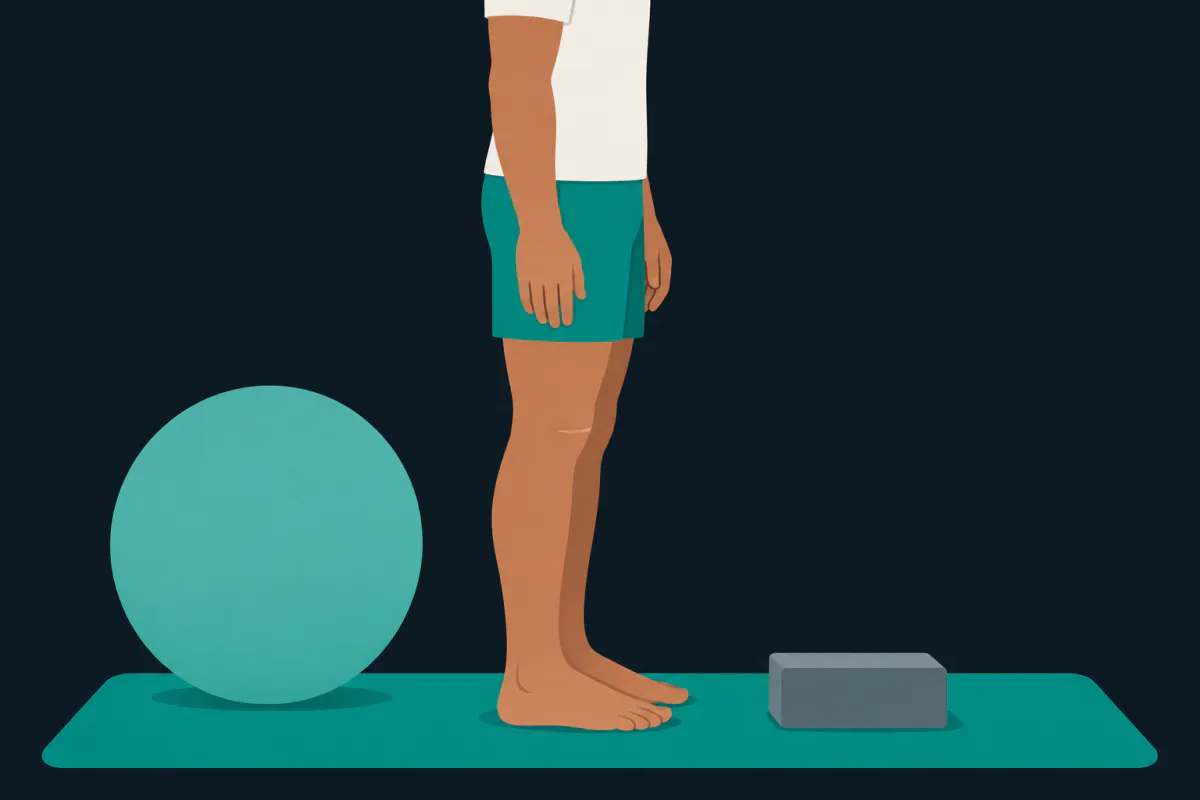
The short answer: around weeks 16 to 20 after an ACL reconstruction, strength work usually moves to harder exercises on one leg. Typical ones are split squats, lunges to the side and single-leg deadlifts. The aim is a leg that stays steady under more force, because jumping and landing come next. Your strength and control decide when you move on, not the date.
Your surgeon’s and physiotherapist’s instructions come first, and they can differ from this with your graft or any other repair.
What changes around week 16
By now you have usually trained on gym machines for some weeks, much of it on one leg. Now you hold that leg steady in harder positions. You might have one foot behind you on a bench, step wide to the side, or stand on one leg and tip forward from the hip. Moving through phases by meeting criteria, rather than by counting weeks, is the structure set out in Noyes’ Knee Disorders.
There is little research on how hard or how often to train at this stage. The Aspetar clinical practice guideline makes exercise the core of rehab after ACL surgery. But it finds little evidence on how much or how hard to train, and very low certainty for most parts of rehab (Kotsifaki and colleagues). So programmes differ, and the exercises below are typical, not fixed.
Why harder exercises on one leg
When you use both legs, the operated knee can quietly hand its work elsewhere. A small early study measured eight people doing squats about seven months after surgery (Salem and colleagues). Both feet pushed down equally hard. But the other knee worked about a quarter harder than the operated knee. The operated leg used its hip more to make up for it.
On one leg, the operated knee has to do its own share. In a split squat or a side lunge, you also keep the knee steady while your body moves over it.
Standing exercises like squats and lunges usually strain the ACL less than exercises where the foot moves freely, such as a seated knee extension. A review of studies that measured ACL strain found this (Escamilla and colleagues). The strain was highest early in the bend, up to about 50 degrees. The review also says nobody yet knows the ideal amount of strain for a healing graft.
Why the back of the thigh gets more work
The muscles at the back of your thigh (hamstrings) often stay weak after the early weeks. That weakness has been linked to a higher risk of a new injury after you go back to sport. One review recommends building hamstring strength step by step, including explosive work and work in more than one direction (Buckthorpe and colleagues). That paper is expert opinion, not a trial. It names a hamstring graft as a special concern.
One study followed 158 male professional athletes after they went back to sport (Kyritsis and colleagues). About 1 in 6 tore the graft again. The risk was higher in those whose hamstrings were weak compared with the front of the thigh (quadriceps). This was a link in elite male players, not proof that weak hamstrings cause a new tear.
Different exercises work different parts of the hamstrings. A study in 24 healthy men found that hip exercises, where you tip forward and come back up, worked the long hamstrings more. Knee-bending exercises, such as curls, worked the inner hamstrings relatively more (Bourne and colleagues). Programmes at this stage often include both kinds.
What usually decides the next step
There is no single agreed test for leaving this stage. The Aspetar guideline found no evidence on which progression criteria to use. Clinicians generally look at:
- Swelling after the harder sessions;
- Pain during sessions and the next day;
- Control, whether your knee stays in line over your foot on one leg;
- Strength, often measured as a percentage of the other leg.
One group of experts gives a detailed example for jump training (Buckthorpe and Della Villa). Their weeks are only a guide:
- Second stage, typically weeks 15 to 18: a well-controlled single-leg squat, and leg strength above 1.25 times body weight on an exercise such as the leg press.
- Third stage, typically weeks 19 to 22: good control when landing on one leg, and 1.5 times body weight.
They also say progress should wait while pain or swelling increases.
A gap in strength is usual at this point. One study tested 173 people five to seven months after surgery (Walaszek and colleagues). Most of them, 85 per cent, had not yet reached common targets for quadriceps strength or for matching the other leg. The limb symmetry index after ACL surgery explains how those percentages are worked out.
Harder sessions can bring on a flare. Pain versus a setback explains how ordinary soreness usually differs from a sign worth reporting. Some signs need prompt contact with your care team, whatever the week:
- a calf that is hot, red, swollen or painful;
- a fever, or spreading redness or discharge at the incision;
- new weakness or numbness in your foot;
- a locked knee.
Where the app fits
In ACL Recovery Tracker, a free ACL rehab app for iOS and Android, this stage is Level 6, “Advanced Strength”, typically weeks 16 to 20. It has one session, recommended twice a week:
- stationary bike, 10 minutes;
- split squat (Bulgarian), 3 sets of 10 on each leg;
- single leg RDL, 3 sets of 8 on each leg;
- hamstring lift offs, 3 sets of 8 on each leg, kneeling and lifting the foot over a yoga block;
- lateral lunge, 3 sets of 10 on each leg;
- Swiss ball hamstring curl, 3 sets of 10.

The checklist for moving on asks for:
- hamstring lift offs: 5 controlled reps;
- lateral lunge, single-leg RDL and single-leg Swiss ball roll outs: 3 sets of 12 each;
- split lunge: 2 sets of 12.
The lunges and roll outs must be done with good form. Those figures are the programme’s own, not numbers from the studies above. You tick them yourself: the app does not test your leg.
You can use the app to log each set and the weight you hold. For the split squat, the single-leg RDL and the lateral lunge, it stops suggesting more weight past a set share of your body weight. After revision surgery, Level 6 starts no earlier than week 18. Your physiotherapist’s numbers come first.
These weeks are usually the last block of gym work before jumping starts. The jumping stages build on a leg that stays steady on its own, and your physiotherapist decides when yours is ready.
The illustrations in this article were generated with AI.
Sources
- Kotsifaki R, Korakakis V, King E, et al. Aspetar clinical practice guideline on rehabilitation after anterior cruciate ligament reconstruction. Br J Sports Med. 2023;57(9):500-514.
- Salem GJ, Salinas R, Harding FV. Bilateral kinematic and kinetic analysis of the squat exercise after anterior cruciate ligament reconstruction. Arch Phys Med Rehabil. 2003;84(8):1211-1216.
- Escamilla RF, Macleod TD, Wilk KE, Paulos L, Andrews JR. Anterior cruciate ligament strain and tensile forces for weight-bearing and non-weight-bearing exercises: a guide to exercise selection. J Orthop Sports Phys Ther. 2012;42(3):208-220.
- Buckthorpe M, Danelon F, La Rosa G, Nanni G, Stride M, Della Villa F. Recommendations for hamstring function recovery after ACL reconstruction. Sports Med. 2021;51(4):607-624.
- Bourne MN, Williams MD, Opar DA, et al. Impact of exercise selection on hamstring muscle activation. Br J Sports Med. 2017;51(13):1021-1028.
- Kyritsis P, Bahr R, Landreau P, Miladi R, Witvrouw E. Likelihood of ACL graft rupture: not meeting six clinical discharge criteria before return to sport is associated with a four times greater risk of rupture. Br J Sports Med. 2016;50(15):946-951.
- Buckthorpe M, Della Villa F. Recommendations for plyometric training after ACL reconstruction - a clinical commentary. Int J Sports Phys Ther. 2021;16(3):879-895.
- Walaszek MC, Grindstaff TL, Hart JM, et al. Quadriceps strength and knee-related symptom state 6 months after anterior cruciate ligament reconstruction. J Athl Train. 2023;58(6):536-541.
- Noyes FR, Barber-Westin SD, eds. Noyes' Knee Disorders: Surgery, Rehabilitation, Clinical Outcomes. 2nd ed. Elsevier; 2017.