The guide · Progression, Timeline
ACL rehab weeks 8 to 12: gym strength training
Around weeks 8 to 12 after ACL surgery, many programmes add gym machines and steadily rising loads. How the knee responds, not the date, sets the pace.
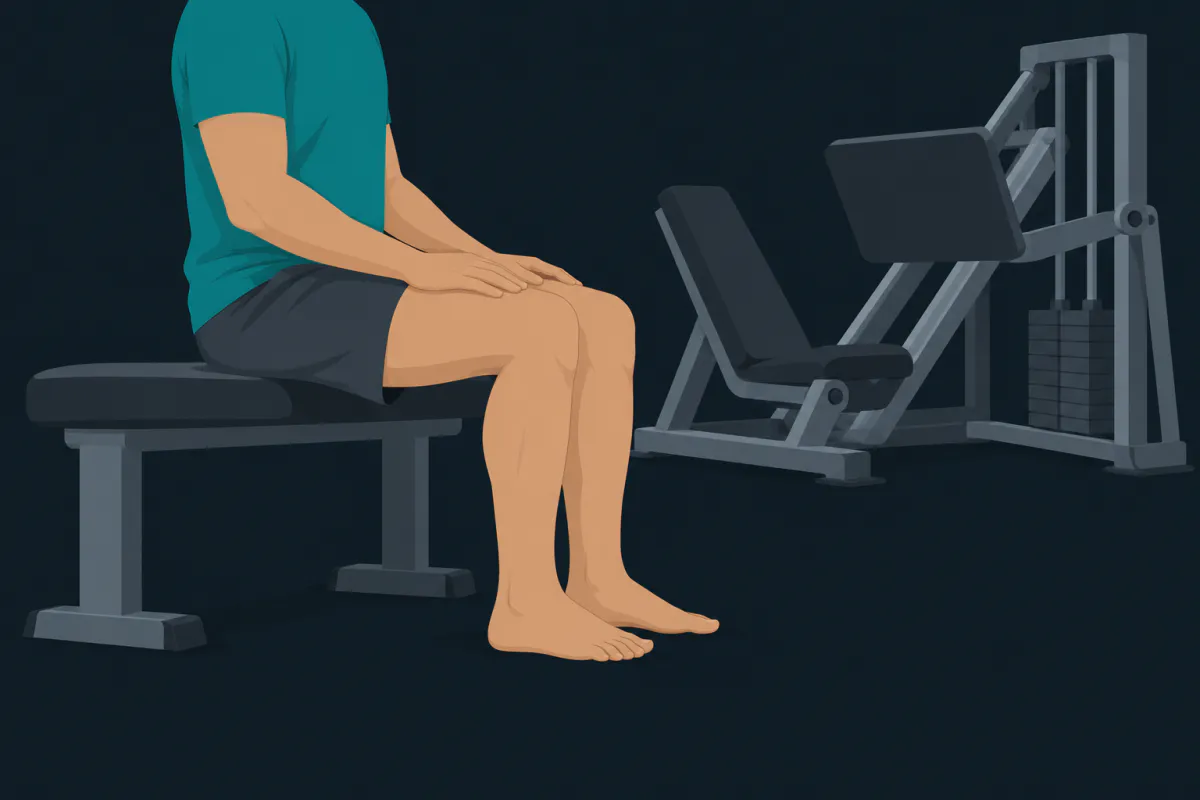
The short answer: around weeks 8 to 12 after an ACL reconstruction, many programmes add gym machines and start tracking the weight lifted. The usual exercises are the leg press, the knee extension and the hamstring curl, built up gradually over sets and weeks. There is no agreed best weight or start date, and one trial began at week 8 with loads reaching high intensity at week 14. How the knee responds sets the pace, usually judged by pain, swelling and next-day soreness. Your surgeon’s and physiotherapist’s instructions come first, and they can differ from this with your graft or any other repair.
What changes around week 8
The main change is that load becomes something you can measure and raise. Moving through phases by meeting criteria, rather than by the date, is the structure set out in Noyes’ Knee Disorders, and the gym is one more step in it.
Programmes differ on what earns that step. In the University of Delaware progression described by Adams and colleagues, a patient whose quadriceps strength measures at least 80 per cent of the other side may carry on with a gym strengthening programme, if no other problems remain. A patient below that keeps working on the quadriceps directly, including with electrical stimulation. The Aspetar clinical practice guideline, from Kotsifaki and colleagues, says there is no evidence on which progression criteria should be used, so a clinic that decides differently is not necessarily wrong.
The reason for the extra load is that the quadriceps recovers slowly. Buckthorpe and colleagues note that most studies find its strength has not fully returned by return to sport. Their commentary, expert opinion rather than a trial, describes a planned programme of weight-bearing and seated exercises for both legs.
How heavy, and how soon
The most direct evidence for these weeks is one randomised trial. Bieler and colleagues assigned 50 people to high- or low-intensity weight training from week 8 to week 20, on top of supervised group sessions. The high-intensity group moved from sets of 20 towards sets of 8 with the heaviest load they could manage, and the low-intensity group stayed at 30 to 20 repetitions. True high-intensity work began only at week 14.
Leg extensor power, a measure of how forcefully the leg pushes, came back faster with the heavier training. It reached 84 per cent of the other leg at week 14 against 73 per cent, and 98 per cent at week 20 against 83 per cent. Knee laxity (looseness) did not worsen in either group, and no other outcome differed between them. Twelve of the 50 dropped out, none because of the training, and the two programmes were not identical: only the heavier group did seated knee extensions.
The Aspetar guideline reads this cautiously. Despite the power result, it says there is insufficient evidence to favour high or low intensity, given the lack of differences in strength, reported function and laxity. So one trial suggests heavier loads, approached slowly, did not harm knee stability. It does not set a target weight for you.
What the sessions usually contain
Lists vary, but three machines come up again and again.
- Leg press. The foot stays on a platform, so this is weight-bearing strength work. In the Bieler trial the knee moved between 90 degrees of bend and straight.
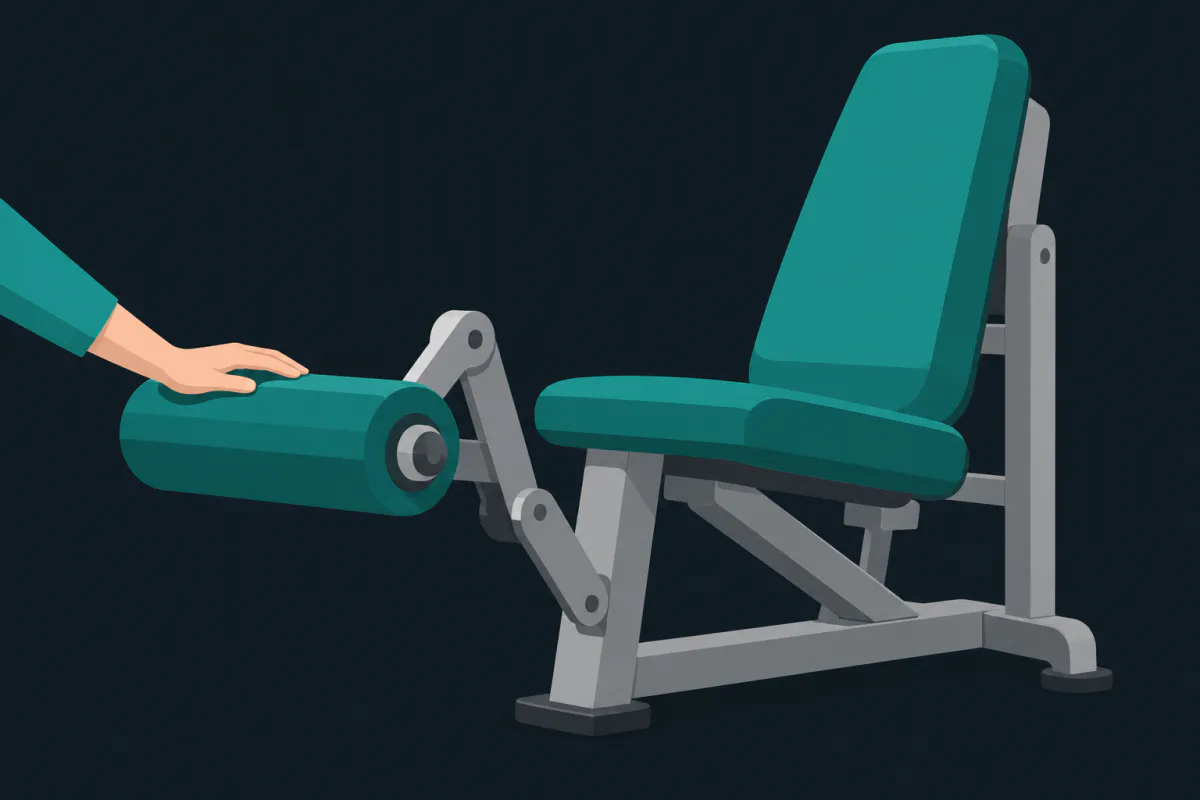
- Knee extension. This seated exercise divides opinion because of concern about strain on the graft, and here it gains added weight. Perry and colleagues randomised 49 people to seated or weight-bearing knee extensor training between weeks 8 and 14, and found no difference in knee laxity or leg function. The Aspetar guideline asks clinicians and patients to watch for pain at the front of the knee and adjust the load.
- Hamstring curl. This loads the backs of the thighs, and your graft may decide when it starts (see below).
The range and set-up of a knee extension matter. Aspetar’s limit of 90 to 45 degrees of knee bend applies to starting at week 4, and the trials it cites moved on at different speeds. One, with no added resistance, reached a straight knee by week 6; another held the limit until week 12. In their review of the biomechanics, Escamilla and colleagues report that ACL force falls when the pad sits higher on the shin, away from the ankle. They add that the best amount of stress for a healing graft is still not known.
How the load usually goes up
Bieler’s rule was simple: the weight went up when a person could do more repetitions than the programme set, and every repetition was slow and controlled. Pain was allowed, but above 5 on a pain scale the range or the load was reduced.
Adams and colleagues pace lifting with soreness rules:
- Soreness in the warm-up that goes away: stay at the same step of the programme.
- Soreness in the warm-up that continues, or that goes away and comes back during the session: two days off and down one step.
- Soreness the day after lifting that is not muscle soreness: one day off and no step up.
- No soreness: up one step a week, or as your clinician says.
Those rules are one centre’s method, and your physiotherapist may use others. If harder sessions bring on a flare, pain versus a setback explains how ordinary soreness usually differs from a sign worth reporting.
Where your graft changes the plan
If the graft came from your hamstrings, Adams and colleagues start resisted hamstring strengthening after 12 weeks, to allow the soft tissue to heal and to limit irritation at the donor site. Other surgeons set other dates. With a patellar tendon graft, the same authors warn of possible irritation at the front of the knee during resisted exercises, and treat any such pain if it arises. Meniscus repairs and other added procedures can move this stage too, and those limits belong to your surgeon.
What usually decides the next step
There is no single agreed test. Clinicians generally look at swelling after harder sessions, pain, range of movement compared with the other knee, and whether the movements stay steady. Some clinics measure strength, which is where limb symmetry percentages come in. Adams and colleagues keep the emphasis on training one leg at a time from here.
Some signs need prompt contact with your care team, whatever the week:
- a calf that is hot, red, swollen or painful;
- a fever, or spreading redness or discharge at the incision;
- new weakness or numbness in your foot;
- a locked knee.
Where the app fits
In ACL Recovery Tracker, a free ACL rehab app for iOS and Android, this stage is Level 4, “Gym Strength Training”, typically weeks 8 to 12. It has two sessions. 4a Gym, recommended once or twice a week, has the stationary bike, leg press, knee extension, hamstring curls, hip thrusts and weighted calf raises. 4b Home Accessory, recommended twice a week, has single-leg calf raises, assisted step-ups, single-leg hamstring bridges, stiff-leg RDLs, side planks and single-leg balance. The checklist for moving on asks for half your body weight for 15 reps on each of the three machines, with both legs together, 20 hamstring bridges and 25 single-leg calf raises. Those figures are the programme’s own, not numbers from the trials above, and you tick them yourself: the app does not test your knee.
You can use it to log the weight and reps of each set, and it suggests the next load, holding or lowering it when you log more pain, but your physiotherapist’s numbers come first. The knee extension’s steps go all the way to straight with the roller at the ankles, so any range or pad position you have been given applies instead. With a hamstring graft, the app notes hamstring loading as not recommended until week 8, four weeks earlier than the Delaware timing above, and your surgeon’s date comes first. With a meniscus root repair, Level 4 starts no earlier than week 9, and its hamstring targets wait until week 16.
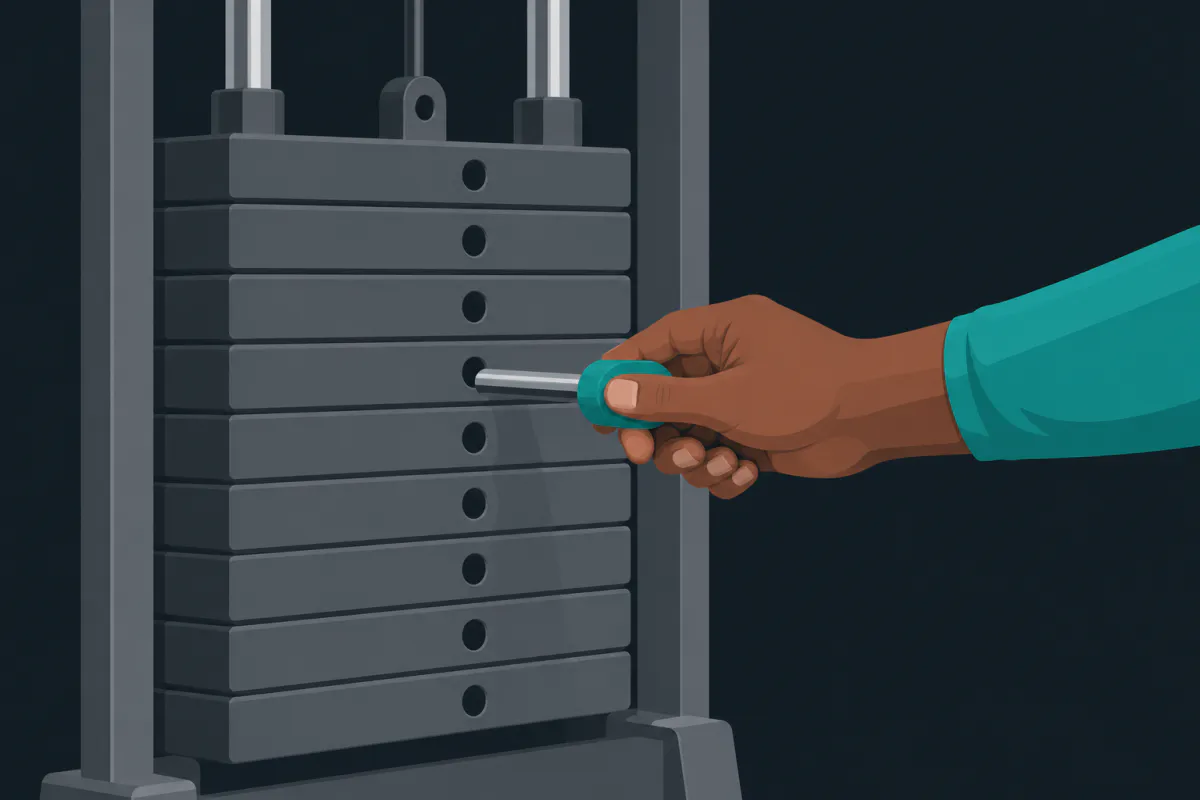
The weights in these weeks can look small next to what you once lifted. The muscle has months of work ahead, and the number on the stack matters less than how the knee felt the next morning.
The illustrations in this article were generated with AI.
Sources
- Bieler T, Sobol NA, Andersen LL, et al. The effects of high-intensity versus low-intensity resistance training on leg extensor power and recovery of knee function after ACL-reconstruction. Biomed Res Int. 2014;2014:278512.
- Perry MC, Morrissey MC, King JB, Morrissey D, Earnshaw P. Effects of closed versus open kinetic chain knee extensor resistance training on knee laxity and leg function in patients during the 8- to 14-week post-operative period after anterior cruciate ligament reconstruction. Knee Surg Sports Traumatol Arthrosc. 2005;13(5):357-369.
- Adams D, Logerstedt DS, Hunter-Giordano A, Axe MJ, Snyder-Mackler L. Current concepts for anterior cruciate ligament reconstruction: a criterion-based rehabilitation progression. J Orthop Sports Phys Ther. 2012;42(7):601-614.
- Kotsifaki R, Korakakis V, King E, et al. Aspetar clinical practice guideline on rehabilitation after anterior cruciate ligament reconstruction. Br J Sports Med. 2023;57(9):500-514.
- Escamilla RF, Macleod TD, Wilk KE, Paulos L, Andrews JR. Anterior cruciate ligament strain and tensile forces for weight-bearing and non-weight-bearing exercises: a guide to exercise selection. J Orthop Sports Phys Ther. 2012;42(3):208-220.
- Buckthorpe M, La Rosa G, Villa FD. Restoring knee extensor strength after anterior cruciate ligament reconstruction: a clinical commentary. Int J Sports Phys Ther. 2019;14(1):159-172.
- Noyes FR, Barber-Westin SD, eds. Noyes' Knee Disorders: Surgery, Rehabilitation, Clinical Outcomes. 2nd ed. Elsevier; 2017.