The guide · Progression, Timeline
ACL rehab weeks 6 to 8: advanced strengthening
Around weeks 6 to 8 after ACL surgery, rehab usually asks more of the operated leg while full movement returns. Criteria, not dates, decide the move to the gym.
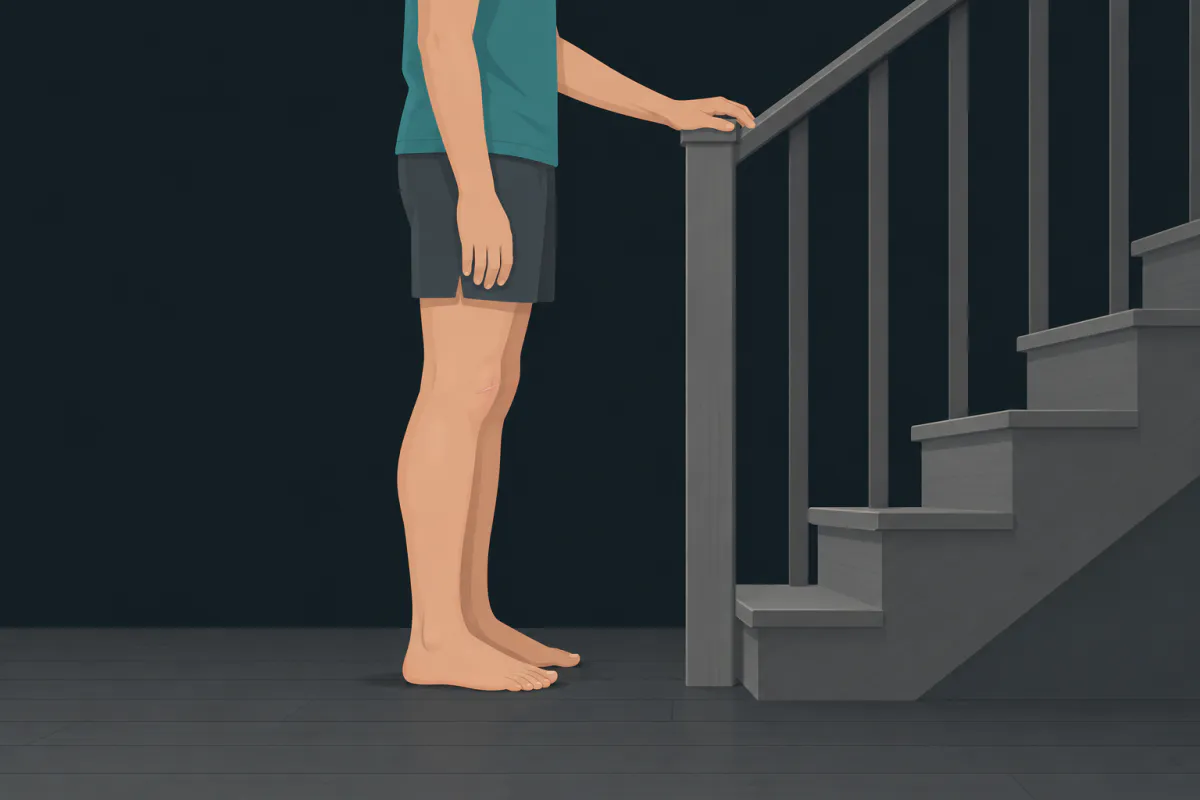
The short answer: around weeks 6 to 8 after an ACL reconstruction, rehabilitation usually asks more of the operated leg. Work on two legs gives way to step-ups and single-leg exercises, the last of the knee’s movement is expected back, and strength sessions often drop to a few days a week. What decides the next step, usually the move to gym machines, is how the knee is doing: pain, swelling, range of movement and, in some clinics, a measured strength comparison. Your surgeon’s and physiotherapist’s instructions come first, and they can differ from this with your graft or any other repair.
What changes around week 6
By now the early problems are often settling, and programmes turn towards load on one leg. The weeks are approximate. Moving through phases by meeting criteria rather than by the date is the structure set out in Noyes’ Knee Disorders, and the University of Delaware progression described by Adams and colleagues works the same way.
Programmes do not agree on what those criteria should be. The Aspetar clinical practice guideline, from Kotsifaki and colleagues, says plainly that there is no evidence on which progression or discharge criteria should be used. It also notes how little is known about how much exercise, and how hard, gives the best results. So two sensible programmes can look different at week 7.
Full movement is the expected finish
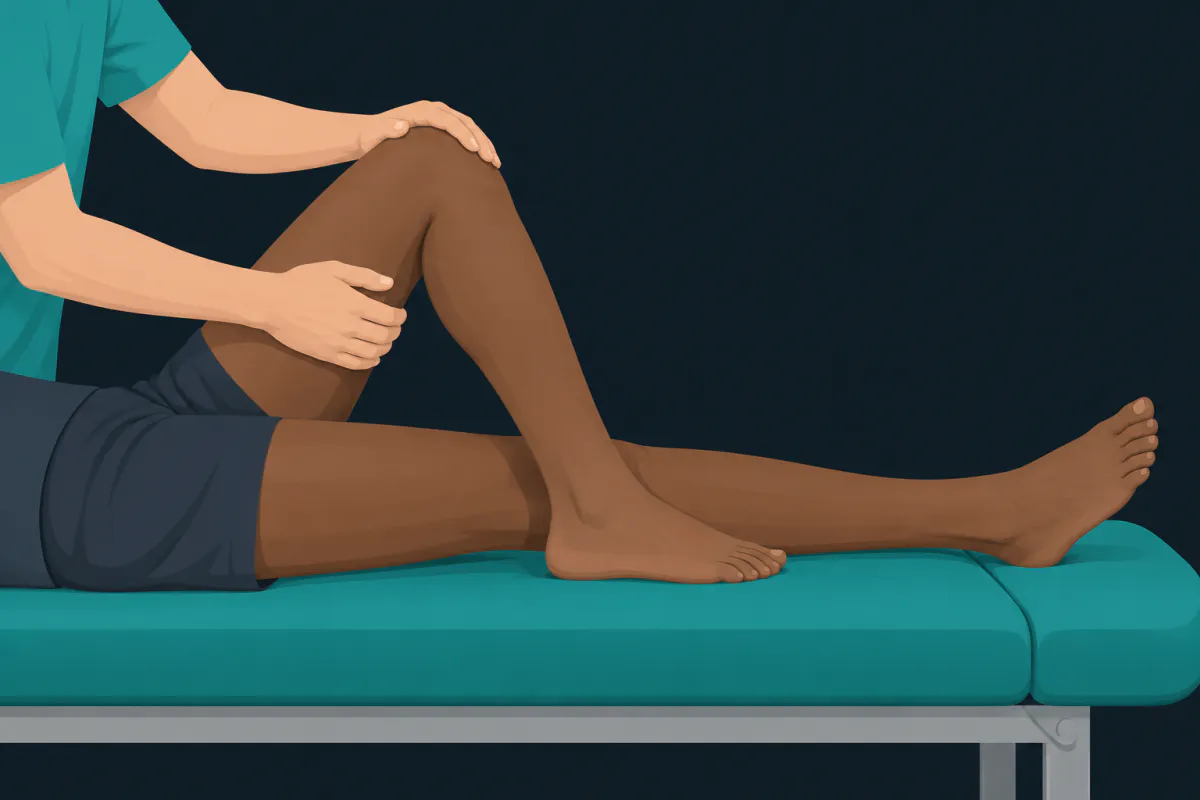
This stage is usually when the knee is expected to finish regaining its range, in both directions. Adams and colleagues list full range of movement among the milestones of their late postoperative phase, alongside quadriceps strength above 80 per cent of the other side, a normal walking pattern and no more than a trace of swelling.
The long-term reason comes from Shelbourne and Gray, who followed 502 patients for a mean of 14.1 years. They defined normal movement as extension within 2 degrees of the other knee and flexion within 5 degrees. A lack of normal extension was the strongest factor linked to lower scores for knee function, and a loss of flexion also counted. This was one centre’s cohort, so it shows a link rather than proof of cause, but it explains why “nearly there” is often watched closely. The usual comparison is with your other knee, because normal differs from person to person.
What the exercises usually include
The exact list varies. Most of what appears at this stage falls into four groups.
- Single-leg strength. Step-ups and single-leg calf raises put more of your weight through the operated leg. Heijne and colleagues measured ACL strain in nine people with healthy ligaments and found no significant difference between step-ups, step-downs, lunges and one-legged sit-to-stands. The strain was similar to that in squats and active knee extension, which earlier studies had measured. These were intact ligaments, not grafts, so the finding describes the exercises rather than your knee.
- Squats. Often body weight only at this point, to a limited depth.
- Hip and trunk work. Banded side steps and slow trunk exercises are common. The evidence for hips and calves is less settled than it may sound. A review by Girdwood and colleagues, of 28 studies, found no widespread weakness in the hip and calf muscles after ACL injury, on evidence of very low certainty, in contrast with the 10 to 20 per cent deficits often reported at the front and back of the thigh. Its authors suggest individual assessment to guide this training.
- Hamstring work. This is where the graft matters most (see below).
Why sessions often move to a few days a week
As the work gets harder, many programmes stop asking for it every day. ACL guidelines do not set one weekly number, so the figure usually borrowed is from the American College of Sports Medicine’s position stand, which recommends two to three days a week for people new to strength training. It was written for healthy adults, not for people after surgery. The days between sessions are part of the plan, as rest days in ACL rehab explains.
Adams and colleagues pair progress with soreness rules. Soreness the day after lifting that is not muscle soreness means a day off and no step up, which is one reason the knee’s response the next morning is worth noticing.
Where your graft changes the plan
Hamstring exercises are the clearest case. If the graft came from your hamstrings, Adams and colleagues delay resisted hamstring work until 12 weeks after surgery, to allow the soft tissue to heal and to limit irritation at the donor site. They add that a hamstring graft does not appear to limit the recovery of hamstring strength later. Other surgeons set other dates, and whichever date yours gave is the one that applies to you.
Meniscus repairs and other added procedures can also move this stage. Those limits belong to your surgeon, and they can outlast the general timeline here.
What usually decides the next step
There is no single agreed test. These are the kinds of things clinicians look at before adding gym loading:
- Swelling after exercise, not only at rest, because harder sessions can bring it back.
- Range of movement, compared with the other knee.
- Pain, during sessions and afterwards.
- Strength. Some clinics measure the quadriceps. Adams and colleagues use above 80 per cent of the other side as a milestone before more gym work.
- Control, whether the knee stays steady during step-ups and single-leg work.
Timing also differs widely here. In the Delaware progression, a patient who is 8 weeks out, with that strength, trace swelling or less and an understanding of the soreness rules, may begin a running progression. Many programmes start later, and when you can run again covers why.
Some signs need prompt contact with your care team, whatever the week:
- a calf that is hot, red, swollen or painful;
- a fever, or spreading redness or discharge at the incision;
- new weakness or numbness in your foot;
- a locked knee.
Where the app fits
In our free ACL rehab app for iOS and Android, this stage is Level 3, “Advanced Strengthening”, typically weeks 6 to 8, and the last level before the gym joins in. Its main session has six exercises: single-leg calf raises, double-leg hamstring bridges, bodyweight squats, deadbugs, assisted step-ups and banded crab walks. It is recommended three to four times a week, on days you choose. The hamstring bridges load the backs of the thighs, so with a hamstring graft the app notes them as not recommended until week 8, four weeks earlier than the Delaware timing above, and your surgeon’s date comes first. The checklist for moving on asks for no pain, full flexion, full extension, no swelling after exercise and 8 weeks since surgery. You tick it yourself: the app does not test your knee. You can use it to log each session, your flexion and extension in degrees and any pain or swelling, so you can see whether swelling or pain follows the harder days. Surgery details can change the timing; with a meniscus root repair, for instance, Level 3 starts no earlier than week 9.
These weeks can be the point where the knee starts to feel ordinary in daily life while it is still well behind in strength. That gap is expected. The exercises are getting harder because the muscle needs them to, and the way your knee answers them tells your physiotherapist when it is ready for more.
The illustrations in this article were generated with AI.
Sources
- Adams D, Logerstedt DS, Hunter-Giordano A, Axe MJ, Snyder-Mackler L. Current concepts for anterior cruciate ligament reconstruction: a criterion-based rehabilitation progression. J Orthop Sports Phys Ther. 2012;42(7):601-614.
- Kotsifaki R, Korakakis V, King E, et al. Aspetar clinical practice guideline on rehabilitation after anterior cruciate ligament reconstruction. Br J Sports Med. 2023;57(9):500-514.
- Shelbourne KD, Gray T. Minimum 10-year results after anterior cruciate ligament reconstruction: how the loss of normal knee motion compounds other factors related to the development of osteoarthritis after surgery. Am J Sports Med. 2009;37(3):471-480.
- Heijne A, Fleming BC, Renstrom PA, Peura GD, Beynnon BD, Werner S. Strain on the anterior cruciate ligament during closed kinetic chain exercises. Med Sci Sports Exerc. 2004;36(6):935-941.
- Girdwood M, Culvenor AG, Patterson B, et al. No sign of weakness: a systematic review and meta-analysis of hip and calf muscle strength after anterior cruciate ligament injury. Br J Sports Med. 2024;58(9):500-510.
- American College of Sports Medicine. American College of Sports Medicine position stand. Progression models in resistance training for healthy adults. Med Sci Sports Exerc. 2009;41(3):687-708.
- Noyes FR, Barber-Westin SD, eds. Noyes' Knee Disorders: Surgery, Rehabilitation, Clinical Outcomes. 2nd ed. Elsevier; 2017.