The guide · Progression, Timeline
ACL rehab weeks 4 to 6: progressive strengthening
Around weeks 4 to 6 after ACL surgery, rehab usually moves from settling the knee to building strength and control. Criteria, not dates, decide what comes next.
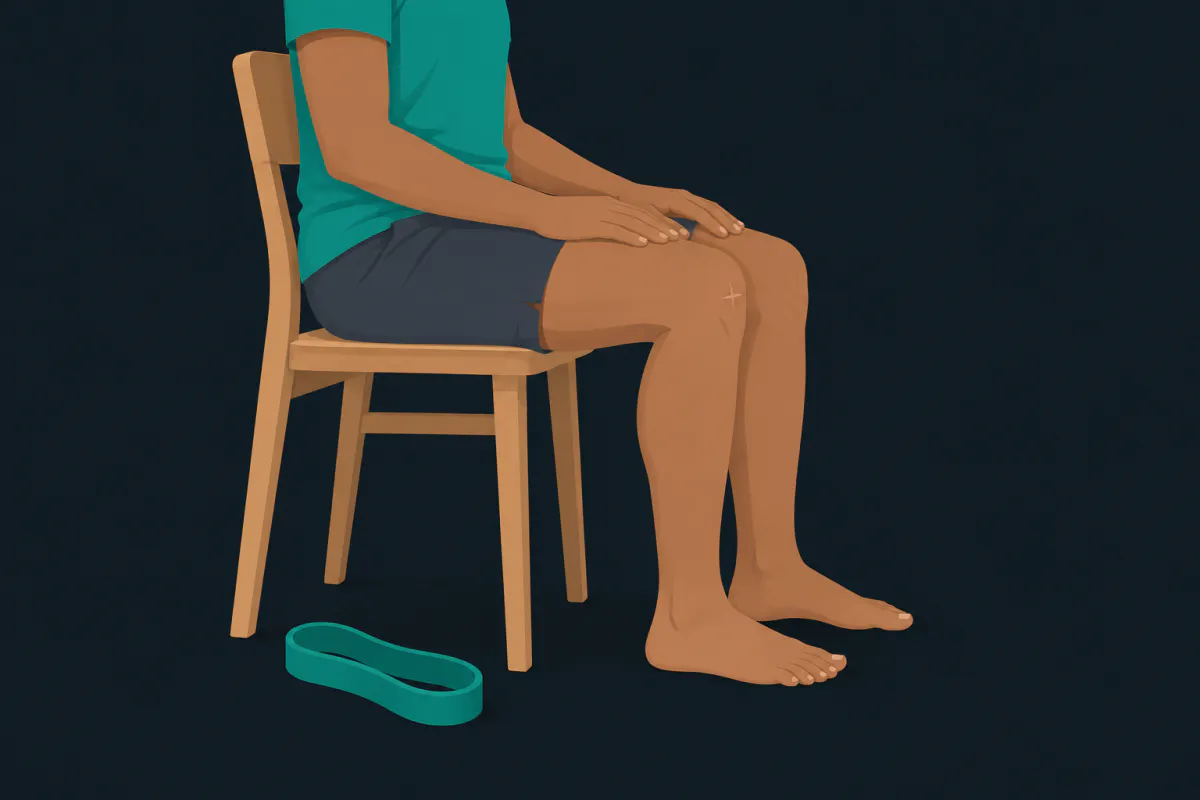
The short answer: around weeks 4 to 6 after an ACL reconstruction, rehabilitation usually moves from settling the knee to building it up. The work turns to thigh strength, control on one leg and the last of the knee’s movement, often with the first seated knee extensions in a limited range from about week 4. What decides the next step is how the knee is doing, usually judged by pain, swelling and range of movement, rather than the date. Your surgeon’s and physiotherapist’s instructions come first, and they can differ from this with your graft or any other repair.
What changes around week 4
The first weeks are mostly about a straight knee, a working quadriceps (the muscle at the front of the thigh) and less swelling. If those are coming along, programmes start asking for more. This is a change of emphasis rather than a fixed date. Building rehabilitation in phases entered by criteria is the structure set out in Noyes’ Knee Disorders, and Adams and colleagues describe the same approach in the University of Delaware progression: each phase has milestones, and the patient moves on by meeting them.
The early goals do not vanish. Extension in particular is still watched. Adams and colleagues cite one study in which 25.3 per cent of patients had more than 5 degrees of difference in passive extension between their knees four weeks after surgery. If yours is one of the knees still short of straight, why a knee won’t straighten covers what is usually done about it.
Why muscle is the focus now
Early weakness is partly a signalling problem: the swollen knee turns the quadriceps down, which is covered in quad activation after ACL surgery. As the weeks pass, muscle size matters more. Thomas and colleagues scanned 20 people six months after reconstruction. The quadriceps of the operated leg was about 15 per cent smaller in cross-section than the other leg’s, and that size explained more of the strength loss than activation did. It was a small study without a comparison group, and it looked at month six, not week four. Its authors conclude that patients may benefit from exercises aimed at muscle size after surgery.
That is one reason this stage asks for repeated sets against some resistance rather than only holding the thigh tight. The muscle will not catch up in two weeks; this is the start of a job that runs for months. What usually comes next is in ACL rehab weeks 6 to 8.
What the exercises usually include
The exact list varies between programmes, but most of what appears at this stage falls into three groups.
- Weight-bearing strength work. Exercises with the foot on the ground, such as partial squats, bridges and calf raises. The Aspetar clinical practice guideline, from Kotsifaki and colleagues, says that combining these with the seated type below may lead to better quadriceps strength than these alone, without any increase in knee looseness.
- Seated knee extensions. Straightening the knee with the foot free, which clinicians call open kinetic chain work.
- Balance and control. Adams and colleagues start balance and neuromuscular work (exercises that train how the muscles respond and coordinate) in their intermediate phase, once flexion is within 10 degrees of the other knee and quadriceps strength is above 60 per cent of the other side. It includes single-leg balance with the knee slightly bent.
The value of the control work has been tested directly. In a randomised trial of 74 people, Risberg and colleagues compared six months of neuromuscular training with traditional strength training. The neuromuscular group reported better knee function at six months, with no difference in strength or hop tests. At two years, the main knee score no longer differed, and each programme had some advantage: better global function and less pain with activity after neuromuscular work, stronger hamstrings after strength work. The authors concluded that a programme should combine both.
The seated knee extension debate
This is the exercise that guidelines disagree on most, because of concern about the strain it can put on the graft.
- The Aspetar guideline says patients may start these exercises in a limited range, 90 to 45 degrees of knee bend, from the fourth week, without compromising knee stability. It adds that anterior knee pain should be watched and the load adjusted, and that hamstring grafts might be more vulnerable to starting early.
- The MOON guideline from Wright and colleagues found insufficient evidence on safety before six weeks, and limits this work in those weeks to light-load, short-arc exercises.
- Fukuda and colleagues randomised 49 people with hamstring grafts to start at week 4, between 45 and 90 degrees, or at week 12. The groups did not differ in knee laxity (looseness), pain or function. Quadriceps strength recovered faster with the early start, but the authors judged the difference of about 5 per cent not clinically significant.
- A meta-analysis by Perriman and colleagues, of ten trials, found no differences in laxity, strength or reported function between this kind of exercise and weight-bearing quadriceps work, on evidence rated low to moderate quality.
So the timing and range differ between programmes for honest reasons. Whichever your physiotherapist has set, including any limit for your graft, is the one that applies to you.
What usually decides the next step
There is no single agreed test for leaving this stage. These are the kinds of things clinicians look at:
- Swelling. A common check is the stroke test: the clinician strokes fluid up one side of the knee and watches whether it bulges on the other. Sturgill and colleagues found that physiotherapists using a five-point grading of this test agreed reliably.
- Range of movement. Extension compared with the other knee, and how far flexion has come.
- Pain. At rest, during sessions and afterwards. Adams and colleagues include a rule of thumb for lifting: soreness the next day that is not muscle soreness means a day off and no step up.
- Control and strength. Whether the movements stay steady, and in some clinics a measured strength comparison.
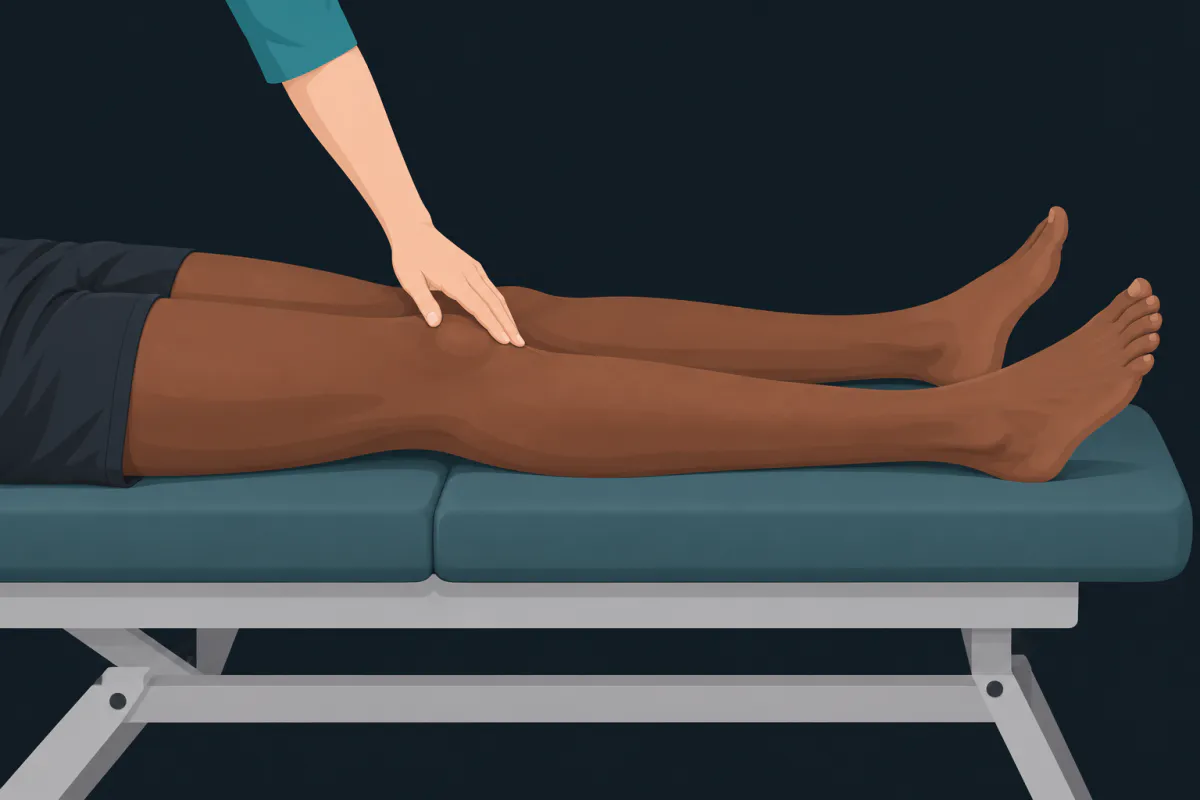
A flare after doing more is common, and pain versus a setback explains how ordinary soreness usually differs from a sign worth reporting. Some signs need prompt contact with your care team, whatever the week:
- a calf that is hot, red, swollen or painful;
- a fever, or spreading redness or discharge at the incision;
- new weakness or numbness in your foot;
- a locked knee.
Where the app fits
In ACL Recovery Tracker, a free ACL rehab app for iOS and Android, this stage is Level 2, “Progressive Strengthening”, typically weeks 4 to 6. Its daily main session has three rounds by default and six exercises: double-leg calf raises, double-leg glute bridges, half wall sits, high knee walks, banded side-lying hip abduction and seated knee extensions. All six need little more than a chair, a wall and a resistance band. The knee extensions use no added weight, but their steps straighten the knee as far as is comfortable, which goes beyond the 90 to 45 degrees above, so any range your physiotherapist sets comes first. The checklist for moving on asks for no more than 3 out of 10 pain, at least 125 degrees of flexion, full extension and no swelling. You tick it yourself: the app does not test your knee. You can use it to log each round, your flexion and extension in degrees and any pain, so the decision to move on starts from a record. Surgery details can change the timing; with a root or complex meniscus repair, for instance, Level 2 starts no earlier than week 9.
These weeks can feel like the first real training after a stretch of careful waiting. The exercises are still modest and the muscle is still far behind, which is expected at this point. What your knee does in response to them tells your physiotherapist more than the date on the calendar.
The illustrations in this article were generated with AI.
Sources
- Kotsifaki R, Korakakis V, King E, et al. Aspetar clinical practice guideline on rehabilitation after anterior cruciate ligament reconstruction. Br J Sports Med. 2023;57(9):500-514.
- Wright RW, Haas AK, Anderson J, et al. Anterior cruciate ligament reconstruction rehabilitation: MOON guidelines. Sports Health. 2015;7(3):239-243.
- Adams D, Logerstedt DS, Hunter-Giordano A, Axe MJ, Snyder-Mackler L. Current concepts for anterior cruciate ligament reconstruction: a criterion-based rehabilitation progression. J Orthop Sports Phys Ther. 2012;42(7):601-614.
- Fukuda TY, Fingerhut D, Moreira VC, et al. Open kinetic chain exercises in a restricted range of motion after anterior cruciate ligament reconstruction: a randomized controlled clinical trial. Am J Sports Med. 2013;41(4):788-794.
- Perriman A, Leahy E, Semciw AI. The effect of open- versus closed-kinetic-chain exercises on anterior tibial laxity, strength, and function following anterior cruciate ligament reconstruction: a systematic review and meta-analysis. J Orthop Sports Phys Ther. 2018;48(7):552-566.
- Thomas AC, Wojtys EM, Brandon C, Palmieri-Smith RM. Muscle atrophy contributes to quadriceps weakness after anterior cruciate ligament reconstruction. J Sci Med Sport. 2016;19(1):7-11.
- Risberg MA, Holm I, Myklebust G, Engebretsen L. Neuromuscular training versus strength training during first 6 months after anterior cruciate ligament reconstruction: a randomized clinical trial. Phys Ther. 2007;87(6):737-750.
- Risberg MA, Holm I. The long-term effect of 2 postoperative rehabilitation programs after anterior cruciate ligament reconstruction: a randomized controlled clinical trial with 2 years of follow-up. Am J Sports Med. 2009;37(10):1958-1966.
- Sturgill LP, Snyder-Mackler L, Manal TJ, Axe MJ. Interrater reliability of a clinical scale to assess knee joint effusion. J Orthop Sports Phys Ther. 2009;39(12):845-849.
- Noyes FR, Barber-Westin SD, eds. Noyes' Knee Disorders: Surgery, Rehabilitation, Clinical Outcomes. 2nd ed. Elsevier; 2017.