The guide · Progression, Timeline
What evidence-based ACL rehab actually means
Research, clinical judgement and your goals, combined. Most ACL rehab research is low certainty, so guidelines also rest on expert consensus.
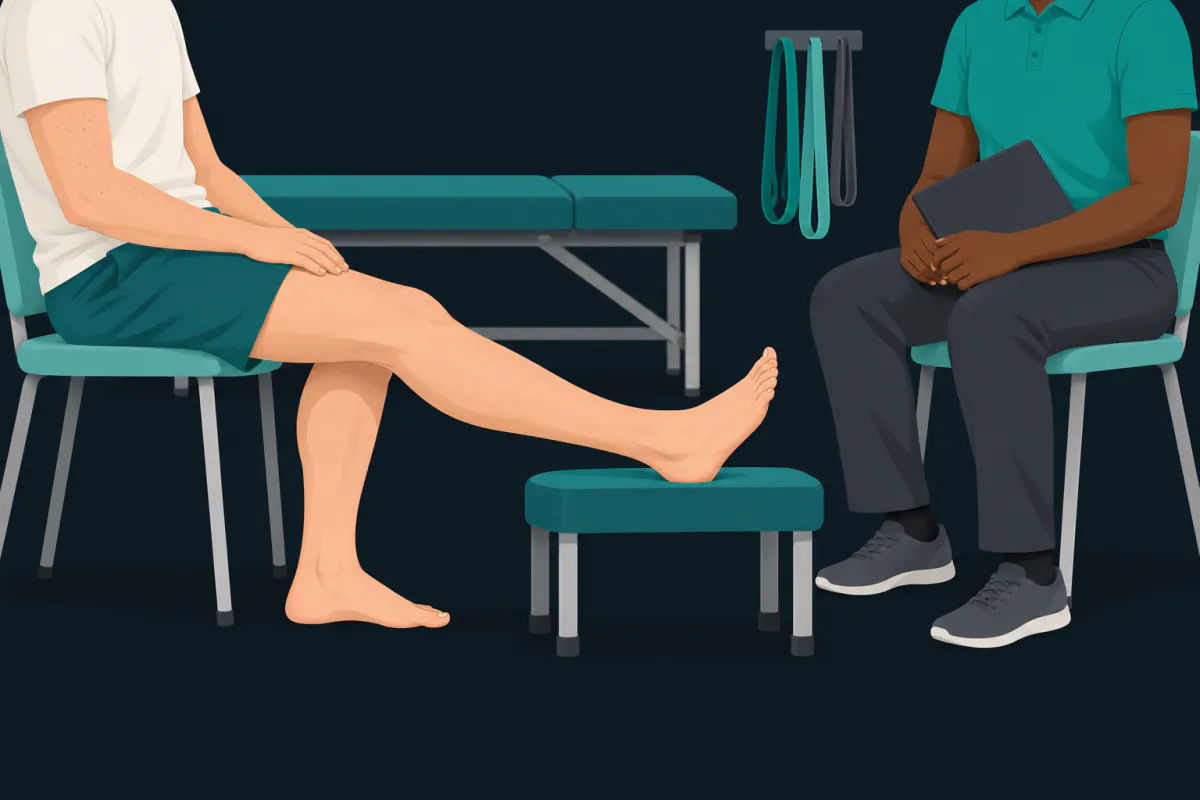
The short answer: an evidence-based ACL rehabilitation programme combines three things, the best research available, the clinical judgement of the people treating you and your own goals and circumstances. It does not mean that every exercise has been proven in a trial. For ACL rehabilitation the research is mostly of low certainty, so the guidelines fill the gaps with the agreement of experienced clinicians, and they move people on by what the knee can do rather than by the date. Your surgeon and physiotherapist apply all of this to your knee, and their plan comes first; this article explains what the label means and how much weight it can carry.
Where the term comes from
The phrase comes from medicine. In a short editorial in the BMJ in 1996, Sackett and colleagues described evidence-based medicine as the careful and explicit use of the current best evidence in decisions about the care of individual patients. They named three ingredients: research from well-designed studies, the expertise a clinician builds through practice, and the patient’s own situation and preferences. In their words, neither research nor expertise “alone is enough”.
Two points from that editorial matter for rehabilitation. First, it is not cookbook care: a guideline still has to be matched to the person in front of the clinician, and expertise decides whether a study applies to them at all. Second, it is not limited to randomised trials. For a question about whether a treatment works, a trial, or better a systematic review of several trials, is the strongest evidence. Where no trial exists, the authors’ advice was to use the next best evidence available rather than to stop. Driving after the operation is an example: no trial has counted crashes, so the research measures how quickly the foot reaches a brake pedal instead, as the article on driving explains.
So a programme can be evidence-based and still contain parts that no trial has tested. What makes it evidence-based is that the choices are made openly, from the best evidence there is, and adjusted to the patient.
How strong the ACL evidence is
Many guidelines and evidence reviews now rate their evidence with a shared system called GRADE, described by Guyatt and colleagues. It sorts evidence into four levels of certainty, from high to very low. High means further research is very unlikely to change what we think the effect is; very low means any estimate of the effect is very uncertain. GRADE also separates the strength of the evidence from the strength of a recommendation, so a panel can recommend something firmly on weak evidence, or cautiously on strong evidence, when benefits, harms and patients’ preferences point that way.
Applied to ACL rehabilitation, the picture is modest. The OPTIKNEE synthesis by Culvenor and colleagues brought together 22 systematic reviews covering 142 trials, mostly of men, and concluded that the general level of evidence for rehabilitation after an ACL or meniscal tear was low. Only four findings reached moderate certainty:
- electrical stimulation of the quadriceps improves quadriceps strength;
- open and closed kinetic chain exercises (exercises with the foot free or with the foot on the ground or a plate) are similarly effective for quadriceps strength and self-reported function;
- a structured home-based programme and structured in-person rehabilitation are similarly effective for strength and self-reported function;
- a knee brace after surgery does not improve function or knee laxity.
The Aspetar clinical practice guideline, written by Kotsifaki and colleagues, used the same GRADE approach to rate trials and systematic reviews for its own recommendations, and reached a similar view. It found a very low level of certainty for most parts of rehabilitation, little evidence on how much exercise, or how hard, leads to better results, and no evidence on which progression or discharge criteria should be used. Most of its recommendations were agreed by expert clinicians. That is not a weakness the guideline hides: it is what a guideline is supposed to do when the trials have not been run.
What the guidelines agree on
Low certainty does not mean anything goes. Andrade and colleagues reviewed the clinical practice guidelines for rehabilitation after ACL reconstruction that had been built from a systematic search of the evidence. They found six, and rated their overall quality as good, with two scoring above 80 per cent on the standard appraisal tool, AGREE II. The lowest-scoring area was applicability, at 29 per cent: how easily a clinician can put the advice into practice.
On the content, the guidelines broadly agreed:
- start moving the knee straight away after surgery;
- build strength and neuromuscular control (how well the muscles and nerves coordinate the leg);
- early full weight-bearing, both open and closed chain exercises, cryotherapy and electrical stimulation may be used, depending on the patient;
- continuous passive motion machines and functional braces are not recommended.

The Dutch guideline by van Melick and colleagues shows how such a document is built. A multidisciplinary group of ACL experts reviewed 90 studies and combined them with a consensus of its own. It recommends a phase of rehabilitation before surgery, then three phases after it, each passed on criteria: a battery of strength and hop tests, quality of movement and psychological tests decides when a patient moves from one to the next. It also recommends that rehabilitation continues for 9 to 12 months.
Why criteria rather than the calendar
If no study has shown which criteria are best, why do guidelines insist on them? Because the alternative, moving on by the week, ignores what the knee is actually doing. Two people at week twelve can have very different strength, swelling and control. Criteria put a check between the calendar and the next, harder stage. How the weeks and the criteria work together over the whole recovery is in how long ACL recovery takes.
The honest reading of the guidelines is that criteria-based progression is the expert consensus, built on what evidence exists, while the exact tests and cut-off values are still being worked out. That is one reason two physiotherapists, both working from the evidence, may use slightly different checklists.
Reading a programme with this in mind
None of this tells you whether a particular programme suits your knee; that is a conversation with your physiotherapist. But the research suggests some features to look for when you read about a programme, in a leaflet, a website or an app:
- It names its sources, so a clinician can check where the advice comes from.
- It moves on by criteria, with typical weeks given as a guide rather than a gate.
- It leaves room for your clinician to change exercises, doses and timing for your surgery and your progress.
- It says what is not known. A programme that presents every detail as proven claims more than the research supports.
Where the app fits
ACL Recovery Tracker, a free ACL rehab app for iOS and Android, is built around the same idea: ten levels with typical weeks, and a progression checklist of criteria for moving up, from swelling and range of motion to strength and hop tests. You tick the checklist yourself, ideally with your physiotherapist; the app does not test the knee or decide that you are ready. If you add your surgery details, the notes they bring link to a Sources list of the published protocols they come from. You can use it to keep the record of sessions, pain and measurements that your physiotherapist needs to apply the evidence to your knee.
Evidence-based is a description of how decisions are made, not a guarantee that each step has been proven. For ACL rehabilitation it means a programme built from the best of a thin evidence base, checked against what your knee can do, and adjusted by people who can examine it.
The illustrations in this article were generated with AI.
Sources
- Sackett DL, Rosenberg WM, Gray JA, Haynes RB, Richardson WS. Evidence based medicine: what it is and what it isn't. BMJ. 1996;312(7023):71-72.
- Culvenor AG, Girdwood MA, Juhl CB, et al. Rehabilitation after anterior cruciate ligament and meniscal injuries: a best-evidence synthesis of systematic reviews for the OPTIKNEE consensus. Br J Sports Med. 2022;56(24):1445-1453.
- Guyatt GH, Oxman AD, Vist GE, et al. GRADE: an emerging consensus on rating quality of evidence and strength of recommendations. BMJ. 2008;336(7650):924-926.
- Kotsifaki R, Korakakis V, King E, et al. Aspetar clinical practice guideline on rehabilitation after anterior cruciate ligament reconstruction. Br J Sports Med. 2023;57(9):500-514.
- Andrade R, Pereira R, van Cingel R, Staal JB, Espregueira-Mendes J. How should clinicians rehabilitate patients after ACL reconstruction? A systematic review of clinical practice guidelines (CPGs) with a focus on quality appraisal (AGREE II). Br J Sports Med. 2020;54(9):512-519.
- van Melick N, van Cingel RE, Brooijmans F, et al. Evidence-based clinical practice update: practice guidelines for anterior cruciate ligament rehabilitation based on a systematic review and multidisciplinary consensus. Br J Sports Med. 2016;50(24):1506-1515.